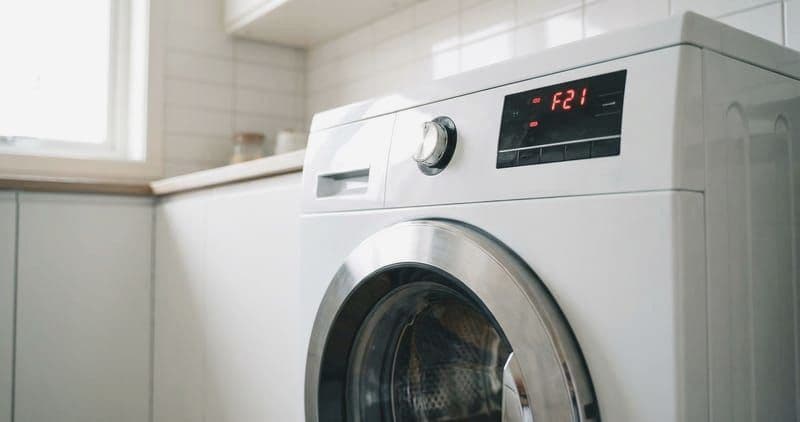
What is the Whirlpool Washer F8E1 error?#
F8E1 means the washer did not reach its target water volume inside the fill timeout — read it as a flow-rate complaint, not a no-water one. The water is usually arriving, just too slowly. The best first checks are the ones you control: the supply valves, the inlet hoses, and the inlet screens.
F8E1 on a Whirlpool Washer: likely causes and repair cost#
On a Whirlpool Washer, the F8E1 code signals: long fill / water supply.
| Likely cause | Typical likelihood |
|---|---|
| Target water volume not reached inside the fill-timeout window | Most common |
| Scale-choked inlet screens throttling the incoming flow | Common |
| House supply pressure too low to satisfy the flow the board expects | Less common |
| One inlet solenoid open-circuit so only half the water arrives | Occasional |
Typical professional repair: up to $220 · Difficulty: moderate · often owner-fixable
Fastest thing to try first: Check water supply valves and inlet hoses.
Symptoms that often accompany F8E1: Fill drags on far longer than a normal load before anything else happens; Water enters as a thin trickle instead of a strong stream; One temperature works normally while the other barely fills; The fill step times out and the machine drains and quits
Technician diagnostic sequence for F8E1:
- F8E1 means the machine did not sense its target fill volume before the timer expired, so measure how fast water actually arrives — catch the fill hose into a bucket for fifteen seconds and compare against a brisk kitchen tap
- Shut the taps, unthread both hoses, and lift out the two mesh inlet strainers; the pitted white scale that grows on them in this hard-water region is the number-one throttle and rinses clean under a tap
- If flow is weak even with the strainers out, the ceiling is the house supply — a stuck saddle valve or a half-open angle stop starves the machine and no washer part will fix it
- Energise each inlet solenoid in turn from the service test and confirm water actually crosses; a coil that reads open-circuit passes no water on its side and drags the fill long
- When flow, pressure, and both solenoids are proven good but fills still crawl, the metering turbine or valve body is calcified internally and the inlet valve is replaced as an assembly
Parts a technician may check or replace: Inlet Valve Assembly; Inlet Strainer Kit
Field note: Read F8E1 as a flow-rate complaint rather than a no-water complaint: the water is usually arriving, just too slowly to hit the target volume before the timer gives up. That reframes the hunt toward anything that throttles flow — strainers, angle stops, saddle valves, a kinked hose — and away from swapping the board, which almost never causes it.
Do You Have the Right Tools?
Bearing puller set ($120), drum spider wrench ($85), multimeter ($85), and diagnostic software. Our technician arrives with $3,000+ in professional tools — your diagnostic is free.
Licensed & Insured · 90-Day Warranty · Same-Day Service
How to troubleshoot the F8E1 error yourself#
Start at the wall and work in. Confirm both hot and cold supply valves are fully open, then check the inlet hoses for a kink or a crushed section behind the machine. Shut the valves, unthread the hoses at the washer, and inspect the inlet strainer screens — scale and grit choke them and throttle the flow, and they often rinse clean. If only one temperature fills slowly while the other is normal, that points at one valve or its screen rather than the house supply. Low household pressure at the tap is another honest cause worth ruling out. Where DIY ends is the inlet valve itself: if the screens are clear, both hoses flow well, and pressure is fine but F8E1 persists, one inlet solenoid may be open-circuit, and replacing the inlet valve assembly is a technician repair. A couple of home tests narrow it down before that call. Disconnect a hose into a bucket and time how fast the tap fills it: a strong stream means the house side is fine and the restriction is inside the machine, while a weak dribble sends you back to the angle stop, a saddle valve, or a kinked supply line. Then watch which temperature struggles — if only hot or only cold fills slowly while the other is normal, that isolates a single valve or its screen rather than the whole supply, since one open-circuit solenoid delivers only half the water the board expects. Whatever you do, do not keep restarting the cycle hoping it beats the timeout; a genuine flow restriction will fail the fill every time and simply drains out again, wasting water and your afternoon.
Is the Whirlpool Washer F8E1 error worth fixing?#
F8E1 is often a free fix — a clogged screen or a half-closed valve costs nothing but a few minutes. When the inlet valve assembly genuinely needs replacing, the repair runs up to $220 including labor, still well under a new washer. On any machine worth keeping I would clear the supply side first and, if needed, replace the valve; it is a straightforward, durable repair. There is no replace-the-washer argument here unless the machine is already failing elsewhere, since even the top of this range is modest.
Safety First — Know the Risks
High-voltage components and pressurized water lines create flood and shock risk. A single loose fitting can cause thousands in water damage. Our techs are licensed and insured — let them handle the risk.
Licensed & Insured · 90-Day Warranty · Same-Day Service
Whirlpool Washer F8E1: frequently asked questions#
What does F8E1 mean on a Whirlpool washer?#
It means the washer could not reach its target water volume before the fill timeout — a slow-fill or flow-rate fault, not usually a complete lack of water.
Is it safe to keep using the washer with F8E1?#
It will stall on fill and drain out rather than wash, but there is no hazard. Fixing the supply restores normal fills.
Can I clear F8E1 myself?#
Often. Open both supply valves fully, straighten the inlet hoses, and clean the inlet strainer screens. Those solve most F8E1 cases.
How much does it cost to repair F8E1?#
Frequently nothing if it is a screen or valve at the wall. A replacement inlet valve assembly, installed, runs up to $220.
Which parts fail when a washer throws F8E1?#
Scale-choked inlet screens most often, sometimes one inlet solenoid going open-circuit so only half the water arrives.
Is a washer with F8E1 worth repairing?#
Yes — many fixes are free, and even an inlet valve near $220 is minor against a new machine. Easy to justify on any sound washer.
Why does slow water supply trigger F8E1?#
The board expects a set volume within a fill window. When flow is throttled by a screen, valve, or low pressure, that volume never arrives in time and F8E1 is raised.
Appliance Repair Technician & Diagnostics Specialist · 10 years experience
Electronics and diagnostics specialist with 10 years of experience in modern smart appliance repair, specializing in LG and Samsung.