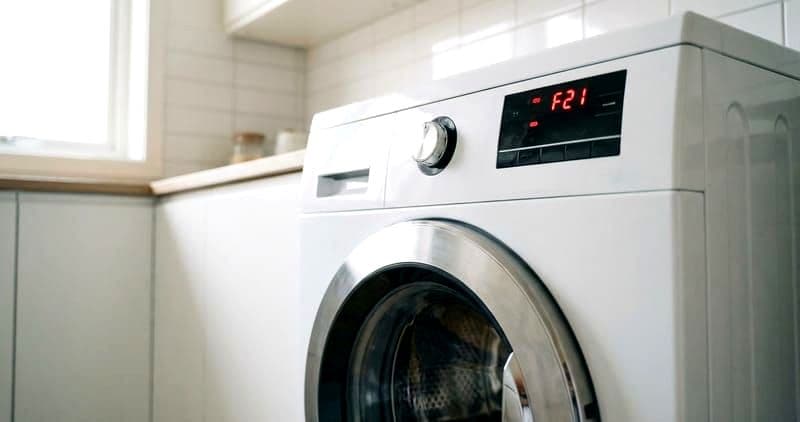
What is the Whirlpool Washer F7E1 error?#
F7E1 means the basket is not reaching the speed the control commanded, so it aborts the spin. It is a mismatch between commanded and measured speed, which a failing speed pickup can cause — but so can plain mechanical drag. Because both look identical on the panel, the first move is to spin the basket by hand and feel for grind or wobble.
F7E1 on a Whirlpool Washer: likely causes and repair cost#
On a Whirlpool Washer, the F7E1 code signals: motor speed sensor.
| Likely cause | Typical likelihood |
|---|---|
| Speed-feedback pickup no longer reporting basket RPM to the board | Most common |
| Fractured magnet ring on the rotor giving a gapped tach pulse | Common |
| Debris in the stator-to-rotor gap dragging the basket below commanded speed | Less common |
| Loose rotor bolt letting the position ring wobble past the pickup | Occasional |
Typical professional repair: $150–$400 · Difficulty: hard · usually a technician job
Symptoms that often accompany F7E1: Basket turns but never ramps up to extraction speed; Cycle aborts at the spin phase and dumps the fault; Only heavy or wet loads trigger it, light loads finish fine; Service-mode tach value flutters or reads zero during a spin command
Technician diagnostic sequence for F7E1:
- The board flags F7E1 when the RPM it commands and the RPM it reads back disagree, so treat this as a feedback-loop fault, not automatically a dead part — start by watching the live tach value in service mode during a spin call
- Pull the lower rear panel and shine a light across the rotor magnet ring; a hairline crack or a chipped pole is enough to drop pulses and is invisible unless you rotate the ring slowly past the pickup
- Torque-check the centre rotor bolt — a rotor that has backed off even slightly lets the ring run out and smears the tach signal, which reads on the meter as a fluttering value
- Clear any lint or coin fragments from the stator gap, then re-run the spin test; a mechanical drag makes the board see under-speed and throw F7E1 even with a perfect pickup
- Only if the ring, bolt, and gap are clean and the tach still reads dead should you replace the speed pickup and re-test the closed loop
Parts a technician may check or replace: Speed Pickup; Motor Control Unit
Field note: Because F7E1 is a mismatch between commanded and measured speed, a mechanical drag (bad bearing, foreign object, backed-off rotor bolt) mimics a failed sensor perfectly on the front panel. Spin the basket by hand with the belt-free direct drive: any grind or wobble means chase the mechanics first and leave the pickup alone until the basket coasts freely.
Do You Have the Right Tools?
Bearing puller set ($120), drum spider wrench ($85), multimeter ($85), and diagnostic software. Our technician arrives with $3,000+ in professional tools — your diagnostic is free.
Licensed & Insured · 90-Day Warranty · Same-Day Service
How to troubleshoot the F7E1 error yourself#
Do the mechanical check before assuming electronics. With the washer unplugged, spin the direct-drive basket by hand: it should coast freely and quietly. Any grind, wobble, or hard drag means a bearing, a foreign object, or a backed-off rotor bolt is holding the basket below the commanded speed, and that mechanical fault must be chased first — a new sensor will not fix drag. Check the door boot and around the basket for a trapped item, since debris in the stator-to-rotor gap is a common cause. Notice whether F7E1 only appears on heavy or wet loads while light loads finish; that pattern also points at drag rather than a dead pickup. Beyond the hand-spin and a visual check, reading the tach value in service mode and replacing the speed pickup or control is a technician job. Give that technician the pattern you have observed, because F7E1 rewards it: a fault that only shows on heavy or wet loads while light loads finish cleanly almost always means mechanical drag that a big load simply exposes, not a dead sensor. So does any grind or wobble you felt on the hand-spin, or a rotor bolt that has visibly backed off. The one part you can check yourself, with the power off, is the boot and the gap around the basket for a coin or an underwire that has migrated into the stator-to-rotor space. If the basket coasts freely, quietly, and true, then and only then does the electronics become the prime suspect — and even then a good technician confirms the tach reads zero or flutters during a commanded spin before condemning the pickup, rather than replacing it on a hunch.
Is the Whirlpool Washer F7E1 error worth fixing?#
F7E1 spans a wide repair range, $150 to $400, because the fix could be a modest speed pickup or a full motor control unit. That is exactly why diagnosis matters: often the real cause is mechanical drag a technician clears for far less than the top of that range. On a washer worth keeping I would have it properly diagnosed and repaired, since even the high end stays under a new machine. Replacement only makes sense if the diagnosis turns up a failing motor on an already-aging washer, where $400 approaches new-washer money.
Safety First — Know the Risks
High-voltage components and pressurized water lines create flood and shock risk. A single loose fitting can cause thousands in water damage. Our techs are licensed and insured — let them handle the risk.
Licensed & Insured · 90-Day Warranty · Same-Day Service
Whirlpool Washer F7E1: frequently asked questions#
What does F7E1 mean on a Whirlpool washer?#
It is a motor speed-sensor fault — the basket did not reach commanded speed, so the spin aborted. A failing speed pickup or mechanical drag can cause it.
Is it safe to keep using the washer with F7E1?#
It will not spin properly, so clothes come out soaked, but it is not hazardous. Best to diagnose it before relying on the spin.
Can I clear F7E1 myself?#
You can rule out drag: unplug and spin the basket by hand. If it grinds or wobbles, the cause is mechanical. Sensor work needs a technician.
How much does it cost to repair F7E1?#
From $150 to $400, depending on whether the fix is a speed pickup, clearing mechanical drag, or a full motor control unit.
Which parts fail when a washer throws F7E1?#
The speed pickup that reports basket RPM, or the motor control unit — but a bad bearing, debris, or a loose rotor bolt often mimics a sensor fault.
Is a washer with F7E1 worth repairing?#
Yes when properly diagnosed, since the cause is often inexpensive drag. Only a failing motor on an old washer, near $400, tips toward replacement.
Why does a bad speed sensor trigger F7E1?#
The control compares commanded speed to what the pickup measures. When the pickup or a mechanical drag keeps the basket below target, the two disagree and F7E1 is raised.
Appliance Repair Technician · 11 years experience
Experienced technician with 11 years specializing in Frigidaire and Electrolux refrigerator and dryer repair with a focus on safety.