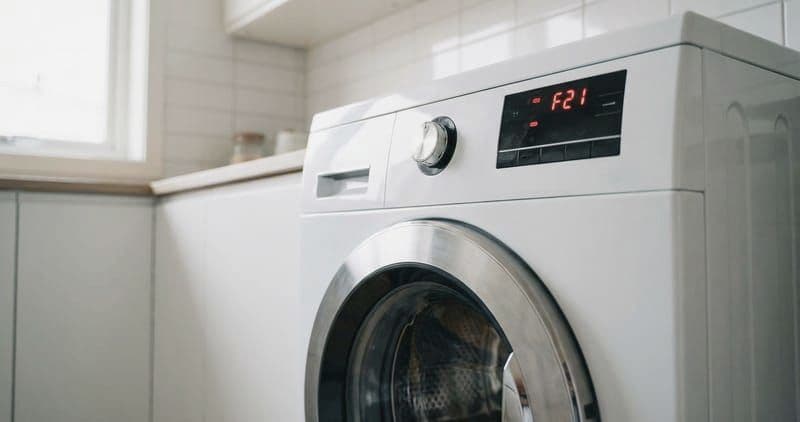
What is the Whirlpool Washer F5E1 error?#
F5E1 means the control cannot confirm the door is closed, so it will not start the cycle. On front-loaders this is the door-closed sense switch or the strike that presses it, not the lock itself. A quick tell is to press the door firmly while pressing Start — if the error clears, a worn strike is the likely culprit.
F5E1 on a Whirlpool Washer: likely causes and repair cost#
On a Whirlpool Washer, the F5E1 code signals: door switch error.
| Likely cause | Typical likelihood |
|---|---|
| Door-closed sense switch failed open | Most common |
| Worn strike hook no longer depressing the switch plunger | Common |
| Broken conductor in the door-switch harness at the flex point | Less common |
Typical professional repair: $90–$200 · Difficulty: moderate · usually a technician job
Symptoms that often accompany F5E1: Washer will not start when Start is pressed; Door appears closed but display does not show door-locked indicator; Intermittent starting failures
Technician diagnostic sequence for F5E1:
- Open and firmly close the door, ensuring it clicks into the latch mechanism
- Inspect the door strike (the hook that catches the latch) for wear, cracks, or misalignment
- Use a multimeter to test the door switch for continuity when actuated — should read 0 ohms closed
- Check the wiring harness from the door switch to the CCU for pinched or frayed wires at the hinge area
Parts a technician may check or replace: Door Switch Assembly; Door Strike
Field note: On front-load Whirlpool WFW and Maytag MHW models, distinguish between F5E1 (switch) and F5E2 (lock). F5E1 means the CCU cannot detect the door is closed — usually the switch or strike. Try pressing the door firmly while starting; if the error clears temporarily, the strike is worn.
Do You Have the Right Tools?
Bearing puller set ($120), drum spider wrench ($85), multimeter ($85), and diagnostic software. Our technician arrives with $3,000+ in professional tools — your diagnostic is free.
Licensed & Insured · 90-Day Warranty · Same-Day Service
How to troubleshoot the F5E1 error yourself#
This one has a genuine owner test. With the washer plugged in, push the door firmly shut and hold light pressure against it as you press Start; if the cycle takes and the door-locked indicator appears, the switch is working but the strike hook is worn and no longer depressing the plunger fully. Inspect the strike on the door for cracks or play, and make sure nothing is caught in the latch pocket. Do one power reset in case the switch latched open on a fluke. Where you stop is the switch and harness: if firm closing does not help and the machine still reads the door open, the door-closed sense switch has failed or a conductor in the switch harness has broken at its flex point, and replacing those is a technician repair rather than a household fix.
Is the Whirlpool Washer F5E1 error worth fixing?#
F5E1 is one of the more affordable door faults to fix. A door switch assembly or a new strike, installed, runs $90 to $200, and a worn strike alone is at the low end. On practically any washer that is well worth doing against the cost of a new machine, and it restores a safety interlock you do not want to bypass. I would repair this on all but the most worn-out washers; even near $200 it is a fraction of replacement and returns the machine to normal service.
Safety First — Know the Risks
High-voltage components and pressurized water lines create flood and shock risk. A single loose fitting can cause thousands in water damage. Our techs are licensed and insured — let them handle the risk.
Licensed & Insured · 90-Day Warranty · Same-Day Service
Whirlpool Washer F5E1: frequently asked questions#
What does F5E1 mean on a Whirlpool washer?#
It means the control cannot detect that the door is closed, so it will not start. The door-closed sense switch or a worn strike is usually to blame.
Is it safe to keep using the washer with F5E1?#
It simply will not start, so there is no hazard — just no wash. It is a safety interlock, so avoid trying to defeat it.
Can I clear F5E1 myself?#
You can test it: press the door firmly while starting. If that clears it, the strike is worn. Replacing the switch itself is a technician job.
How much does it cost to repair F5E1?#
From $90 to $200 for a door switch assembly or strike, installed — a worn strike alone sits at the lower end.
Which parts fail when a washer throws F5E1?#
The door-closed sense switch, the strike hook that presses it, or a broken conductor in the switch harness at its flex point.
Is a washer with F5E1 worth repairing?#
Yes. At $90 to $200 it is one of the cheaper door faults and restores a safety interlock, easily justified over a new machine.
Why does a failed door switch trigger F5E1?#
The control must confirm the door is physically closed before it will run. When the sense switch or strike stops reporting that, it assumes the door is open and raises F5E1.
Appliance Repair Technician · 8 years experience
Experienced technician with 8 years specializing in dishwasher repairs and European appliance brands including Bosch and Thermador.