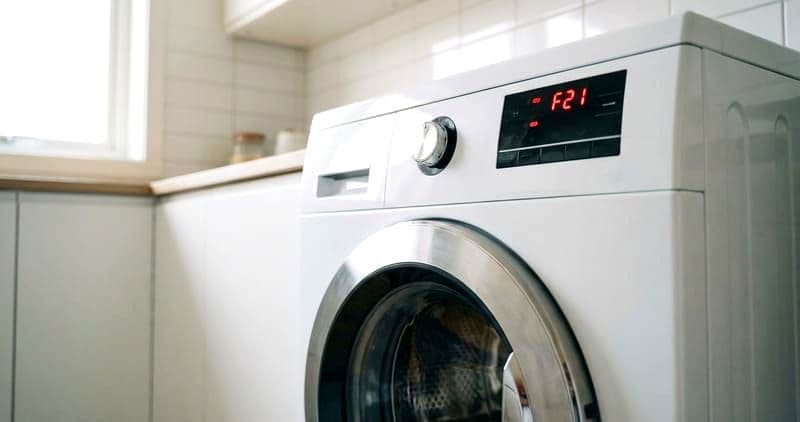
What is the Whirlpool Washer F3E1 error?#
F3E1 points to the water-level sensing system — the analog transducer that tells the board how full the tub is has drifted or lost its signal. The immediate concern is overfilling: if the board never sees the level change, it can keep the valve open. If you see water rising past where it should, shut off the supply valves before troubleshooting.
F3E1 on a Whirlpool Washer: likely causes and repair cost#
On a Whirlpool Washer, the F3E1 code signals: pressure switch / water level.
| Likely cause | Typical likelihood |
|---|---|
| Analog water-level transducer out of calibration | Most common |
| Silted sensing chamber beneath the outer tub | Common |
| Cracked or perished sensing tube to the transducer port | Less common |
| Corroded control-board connector at the level-sensor input | Occasional |
Typical professional repair: $120–$250 · Difficulty: hard · usually a technician job
Symptoms that often accompany F3E1: Fill count never changes so the board keeps the valve open and the tub overfills; Cycle stalls at the fill step and times out without agitating; Displayed water level disagrees with what you can see through the door; Fault clears for a few loads after a descale then returns as sludge rebuilds
Technician diagnostic sequence for F3E1:
- Enter the service diagnostic on the console and read the live analog water-level count — a frozen or railed value confirms the transducer path rather than the tub itself
- On Whirlpool front-loaders the analog pressure transducer clips onto the control-board housing at the upper-left rear, not the cabinet wall — trace the clear sensing tube from that port down to the sump bell housing
- Detach the sensing tube and pour a cup of hot descaling solution into the sump bell to dissolve the detergent sludge that muffles the pressure signal
- Reseat and ohm-out the control-board level-sensor connector; Sacramento hard-water units corrode that terminal pair long before the transducer itself quits
- Only after the tube, bell, and connector are proven clean should the analog transducer be swapped and the empty-tub level re-taught in diagnostics
Parts a technician may check or replace: Analog Pressure Transducer; Sensing Tube
Field note: Whirlpool moved from a mechanical click-switch to a solid-state analog transducer on WFW and WTW modular boards, so the old blow-in-the-hose-for-a-click test no longer applies here — you diagnose it by watching the analog count in service mode. A count that never moves during fill points at a silted sump bell far more often than a dead transducer; descale the bell and re-teach the empty level before condemning the sensor.
Safety note: If the washer is actively overfilling, turn off water supply valves immediately to prevent flooding.
Do You Have the Right Tools?
Bearing puller set ($120), drum spider wrench ($85), multimeter ($85), and diagnostic software. Our technician arrives with $3,000+ in professional tools — your diagnostic is free.
Licensed & Insured · 90-Day Warranty · Same-Day Service
How to troubleshoot the F3E1 error yourself#
Safe owner steps here are limited but worth doing. If the washer is actively overfilling, turn off the hot and cold supply valves at once to prevent a flood. Do one power reset in case the reading latched wrong. Beyond that, the modern Whirlpool washer uses a solid-state analog transducer rather than the old click-switch, so the classic blow-into-the-hose test no longer applies — you cannot verify it by ear. The most common real cause is a silted sensing chamber under the tub, not a dead sensor, and clearing that plus re-teaching the empty level is technician work done in service mode. If your F3E1 clears for a few loads after a descale and then returns as sludge rebuilds, that pattern confirms the sump, and a technician should descale the bell and recalibrate rather than swap parts blindly. Pay attention to which way the fault leans, because it tells the technician a lot: a tub that overfills and keeps the valve open points at the board reading a level that never changes, while a cycle that stalls at fill and times out without agitating suggests the count is stuck low. Either way, the displayed water level disagreeing with what you can see through the door is the clearest confirmation that the sensing side, not the fill side, is at fault. Resist the urge to keep starting loads while it overfills — every attempt risks water on the floor, and the only safe holding action until it is repaired is to leave the supply valves closed between washes.
Is the Whirlpool Washer F3E1 error worth fixing?#
F3E1 is a moderate repair with a good outcome. The analog transducer and sensing tube, with the labor to diagnose and recalibrate, run $120 to $250 — and often the sensor is fine and the fix is simply clearing a silted sump, which is cheaper still. On any washer worth keeping, that is an easy repair to justify against a new machine. I would only lean toward replacement if the washer is elderly and this arrives alongside other failures; on its own, a sub-$250 level-sensor repair is well worth it.
Safety First — Know the Risks
High-voltage components and pressurized water lines create flood and shock risk. A single loose fitting can cause thousands in water damage. Our techs are licensed and insured — let them handle the risk.
Licensed & Insured · 90-Day Warranty · Same-Day Service
Whirlpool Washer F3E1: frequently asked questions#
What does F3E1 mean on a Whirlpool washer?#
It is a water-level sensing fault — the analog pressure transducer is out of calibration or not reporting, so the board cannot read how full the tub is.
Is it safe to keep using the washer with F3E1?#
Not while it overfills. If water rises too high, shut off the supply valves and stop using it until the sensor is checked, to avoid flooding.
Can I clear F3E1 myself?#
Only a power reset and shutting the supply valves if it overfills. Calibration and sump cleaning need service mode, which is a technician job.
How much does it cost to repair F3E1?#
From $120 to $250 for the transducer, sensing tube, and calibration — less when the real fix is just descaling a silted sensing chamber.
Which parts fail when a washer throws F3E1?#
The analog pressure transducer and its sensing tube, though a silted sensing chamber under the tub mimics a dead sensor far more often.
Is a washer with F3E1 worth repairing?#
Yes on a sound machine — a sub-$250 sensor or sump repair is minor against a new washer. Replacement only if the machine is already failing elsewhere.
Why does a drifted transducer trigger F3E1?#
The board relies on the transducer's pressure reading to gauge water level. When it drifts out of band or its chamber silts up, the board loses a trusted level and raises F3E1.
Lead Appliance Repair Technician · 12 years experience
Experienced technician with 12 years specializing in washing machine and dryer repairs across all major brands.