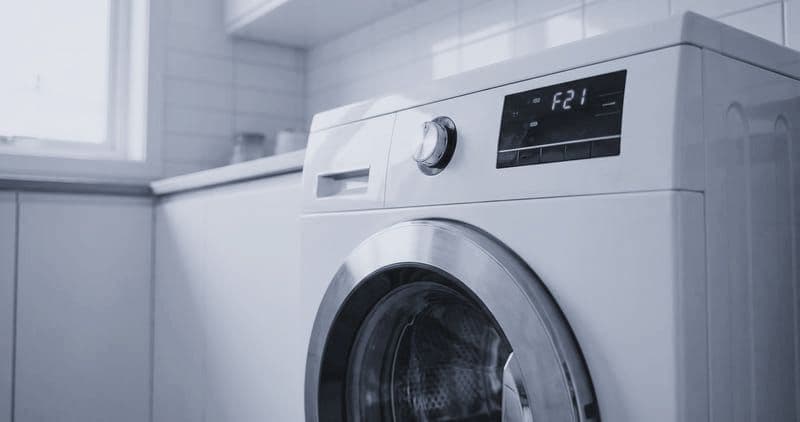
What is the Whirlpool Washer F2E1 error?#
F2E1 means the control read a console pad as held down past its stuck-key timeout, so the washer flagged the user interface. It is a mid-tier fault, often cleared by a reset, but a panel that keeps failing is usually telling you water is getting into the console. Start with an unplug-and-restart before assuming the board is bad.
F2E1 on a Whirlpool Washer: likely causes and repair cost#
On a Whirlpool Washer, the F2E1 code signals: stuck key / user interface.
| Likely cause | Typical likelihood |
|---|---|
| A console pad reading as held down longer than the stuck-key timeout | Most common |
| Detergent film under the touch panel bridging a pad contact | Common |
| Trapped moisture warping the membrane against the board behind it | Less common |
Typical professional repair: $85–$280 · Difficulty: moderate · often owner-fixable
Fastest thing to try first: Unplug for 1 min then restart.
Symptoms that often accompany F2E1: Pads chirp on touch but the selection does not take; The readout shows stray characters or half-lit segments; Console lights flicker or chase with no input
Technician diagnostic sequence for F2E1:
- Pull the plug for a couple of minutes, then walk the whole console one pad at a time, pressing and letting go of each — the board only names the family, not which key, so you flush the stuck one out by exercising them all
- Wipe the seams around every button with a barely-damp cloth; the sticky detergent haze that collects there is enough to hold a pad half-pressed and trip the timeout
- Peel your eye along the overlay edge for a lifting corner or a foggy patch of trapped condensate — a bubbled membrane presses a pad from behind and no amount of cleaning the face will free it
- If a wipe-down and reset do not settle it, the fault lives in the console board and the interface assembly is renewed as a unit
Parts a technician may check or replace: User Interface Board; Console Overlay
Field note: Trace repeat interface failures back to water, not electronics: on these front-loaders the dispenser drawer above the console weeps and the runoff wicks into the board, so a unit that keeps eating panels usually has a wet console housing. Dry it out, seal the dispenser seam, and the replacement lasts instead of dying the same way.
Do You Have the Right Tools?
Bearing puller set ($120), drum spider wrench ($85), multimeter ($85), and diagnostic software. Our technician arrives with $3,000+ in professional tools — your diagnostic is free.
Licensed & Insured · 90-Day Warranty · Same-Day Service
How to troubleshoot the F2E1 error yourself#
Unplug the washer for a minute and restart — a momentarily stuck pad or a bit of trapped moisture often clears with a single power cycle. Wipe the console face and the seam above it, since detergent film bridging a pad contact is a common trigger you can rinse away. Look for the real culprit on front-loaders: the dispenser drawer above the console tends to weep, and that runoff wicks into the interface board. If you can see or feel dampness in the console housing, drying it out and sealing the dispenser seam is what makes a repair last. Where DIY ends is inside the board itself — stray characters, half-lit segments, or pads that chirp but never register after a reset mean the interface board or its overlay needs replacing, and that is a technician job. Before you get there, though, give the console a full day to dry if you suspect moisture: a membrane warped by trapped water sometimes relaxes and reads normally once it is genuinely dry, which is worth confirming before anyone orders a part. And when the board does get replaced, treat the leaking dispenser above it as the real repair — sealing that seam is what stops the second board dying the same slow way as the first.
Is the Whirlpool Washer F2E1 error worth fixing?#
F2E1 sits in a comfortable repair range. A new user-interface board and console overlay, fitted, runs $85 to $280 depending on the model, and that is money well spent on a washer that otherwise works. The one thing I insist on is finding why the first board died: if the dispenser above it is leaking, seal that first or the replacement drowns the same way. With the water path fixed, a sub-$280 interface repair is far cheaper than a new machine and I would do it every time on a sound washer.
Safety First — Know the Risks
High-voltage components and pressurized water lines create flood and shock risk. A single loose fitting can cause thousands in water damage. Our techs are licensed and insured — let them handle the risk.
Licensed & Insured · 90-Day Warranty · Same-Day Service
Whirlpool Washer F2E1: frequently asked questions#
What does F2E1 mean on a Whirlpool washer?#
It is a user-interface fault — the control read a console pad as stuck down. Detergent film, trapped moisture, or a failing board is behind it.
Is it safe to keep using the washer with F2E1?#
It is not dangerous, but selections may not register, so cycles can be unreliable. Reset it first and dry the console before depending on it.
Can I clear F2E1 myself?#
Often a one-minute unplug and a wipe of the panel clears it. If it returns, look for water entering the console rather than resetting again.
How much does it cost to repair F2E1?#
A replacement interface board and overlay, installed, runs $85 to $280 depending on the model.
Which parts fail when a washer throws F2E1?#
The user-interface board and its console overlay. On front-loaders a leaking dispenser drawer above them is the usual reason they fail.
Is a washer with F2E1 worth repairing?#
Yes, once you seal the water path that killed the first board. A sub-$280 interface repair is well below the cost of a new washer.
Why does a stuck console pad trigger F2E1?#
The control watches each pad and expects a press to release within a set time. When one reads held down past that timeout, it assumes a fault and raises F2E1.
Appliance Repair Technician & Diagnostics Specialist · 10 years experience
Electronics and diagnostics specialist with 10 years of experience in modern smart appliance repair, specializing in LG and Samsung.