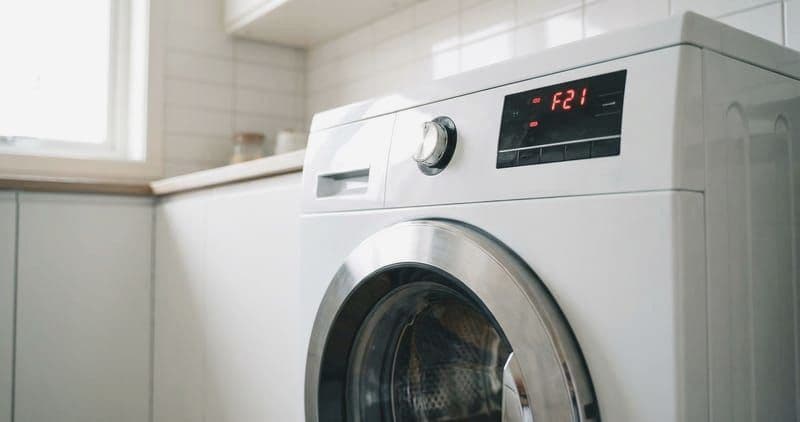
What is the Whirlpool Washer F1E1 error?#
F1E1 means the washer's motor control unit failed its own check and can no longer drive the drum reliably. This is a board-level fault, most often born from a line-voltage surge, and it is a technician repair rather than a DIY one. If you catch a sharp electrical or scorched smell from low in the cabinet, stop and unplug the machine before anything else.
F1E1 on a Whirlpool Washer: likely causes and repair cost#
On a Whirlpool Washer, the F1E1 code signals: motor control error.
| Likely cause | Typical likelihood |
|---|---|
| Motor control unit failed after a line-voltage surge | Most common |
| Triac on the drive board shorted, stalling the motor mid-cycle | Common |
| Poor ground or loose neutral feeding erratic voltage to the board | Less common |
| Heat-cracked solder joints on the power stage from years of duty cycling | Occasional |
Typical professional repair: $280–$450 · Difficulty: professional only · usually a technician job
Symptoms that often accompany F1E1: Dead to the Start press with no motor sound at all; A steady hum from the motor while the basket stays still; A sharp electrical or scorched smell from low in the cabinet; It powers up fine some days and refuses others, hinting at a cracked joint
Technician diagnostic sequence for F1E1:
- Kill power at the plug for a full five minutes first: this drive board latches a fault after a bad handshake and a genuine reset clears the soft trips, leaving only the real hardware faults still showing
- Drop the lower rear panel and follow the ribbon from the drive board up to the main controller, unseating and reseating each end — a green-filmed pin on that link mimics a dead board on this vertical-modular chassis
- Study the power stage under a light for the tells that surge damage leaves: a blistered cap, a scorched trace, a hairline crack radiating from a solder pad near the motor terminals
- Back-probe the drive output to the motor while a cycle calls for spin; voltage present at the board but no motion means the winding or its plug, voltage absent means the board stage itself
- Only once the reset, the link, and the motor side are all cleared does the drive board get condemned and swapped, then the empty cycle re-run to confirm
Parts a technician may check or replace: Motor Control Unit; Drive Board Harness
Field note: The classic killer here is a line surge that shorts a triac on the drive board with no outward mark, so a board that looks pristine can still be the fault. Before fitting a costly replacement, put the machine on a surge-protected circuit — a repeat kill within weeks of a new board is almost always dirty incoming power, not a bad part.
Safety note: Disconnect power before inspecting the drive board. Capacitors on the board can hold a lethal charge for several minutes after unplugging.
Do You Have the Right Tools?
Bearing puller set ($120), drum spider wrench ($85), multimeter ($85), and diagnostic software. Our technician arrives with $3,000+ in professional tools — your diagnostic is free.
Licensed & Insured · 90-Day Warranty · Same-Day Service
How to troubleshoot the F1E1 error yourself#
There is little safe DIY here, and one hard safety limit. Try a single power reset — unplug the washer for a couple of minutes and restart — in case the board simply latched a one-off glitch. Confirm the outlet is sound and properly grounded, because a loose neutral or poor ground feeds the erratic voltage that kills these boards. That is as far as you should go. Do not open the console to probe the drive board: capacitors on it can hold a dangerous charge for minutes after unplugging, and a shorted triac carries no outward mark to find by eye. If the reset does not clear F1E1, or you smell anything scorched, leave it unplugged and call a technician, who will test the board safely and check your incoming power before fitting a costly replacement. There is one more observation worth passing along, because it changes the repair: note whether F1E1 is rock-solid every time or comes and goes, since a board that powers up fine some days and refuses on others is the classic sign of heat-cracked solder joints on the power stage rather than a fully dead board. Note too whether the fault first appeared right after a storm or a neighborhood brownout, which points squarely at surge damage. Neither observation is something you fix yourself, but both steer the technician toward the real cause and away from a blind board swap. What you should not do is keep cycling power hoping it settles: a genuine motor-control fault will not heal, and repeatedly energizing a shorted triac only stresses the drive circuit and the motor it feeds.
Is the Whirlpool Washer F1E1 error worth fixing?#
F1E1 is a repair you price carefully. The motor control unit and the labor to fit it run $280 to $450, because the board is a premium part. On a Whirlpool washer under roughly seven years old and otherwise reliable, that is still well below a comparable new machine and I would repair it — but only paired with surge protection, because a board that died from dirty power will die again without it. When the washer is older and the estimate sits near $450, you are into new-washer territory, and replacement becomes the smarter buy.
Safety First — Know the Risks
High-voltage components and pressurized water lines create flood and shock risk. A single loose fitting can cause thousands in water damage. Our techs are licensed and insured — let them handle the risk.
Licensed & Insured · 90-Day Warranty · Same-Day Service
Whirlpool Washer F1E1: frequently asked questions#
What does F1E1 mean on a Whirlpool washer?#
It is a motor control error — the drive board failed its self-check and cannot run the motor reliably. A voltage surge is the most common cause.
Is it safe to keep using the washer with F1E1?#
No. If it powers up erratically or smells scorched, unplug it. A failing drive board can overheat, so this is not a code to keep running.
Can I clear F1E1 myself?#
Only with a single power reset and a check that the outlet is grounded. A genuine board fault will return and needs a technician to diagnose safely.
How much does it cost to repair F1E1?#
From $280 to $450, since the motor control unit is a premium board and the labor to reach and replace it is significant.
Which parts fail when a washer throws F1E1?#
The motor control unit itself, most often a shorted triac on the drive board. A poor ground or loose neutral upstream is a frequent accomplice.
Is a washer with F1E1 worth repairing?#
On a newer, healthy machine, yes — with surge protection added. On an older washer where the bill nears $450, replacement deserves a serious look.
Why does a voltage surge trigger F1E1?#
A surge can short a triac on the drive board without leaving a visible mark. The board then fails its self-check, cannot command the motor, and raises F1E1.
Senior Appliance Repair Technician · 15 years experience
EPA-certified technician with 15 years of experience specializing in refrigerator and cooling system repairs.