Samsung Washer Thermostat Replacement
A Samsung washer throwing an HE1 or HE2 code, or washing cold when you asked for hot, usually has a failed temperature thermistor (part DC47-00016A) — a clip-on sensor on the outer tub you can meter and swap in under an hour. Check that hot water is actually reaching the machine first.
Samsung washers sense water temperature with an NTC thermistor, not a mechanical thermostat. Its resistance falls as the water warms, and the control board reads that resistance to decide how to blend the hot and cold inlet valves. Most Samsung models have no internal heater — they rely on your home's hot water — so a temperature complaint often starts at the tap, not the sensor.
Symptoms of a Failed Thermistor#
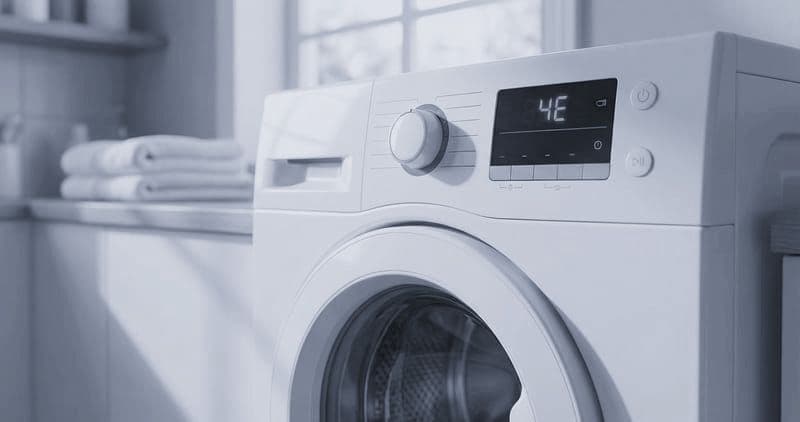
- An HE1 or HE2 code — the heater or temperature circuit is reporting out-of-range values
- Cold water on a hot cycle — the thermistor reads falsely hot, so the board never calls for more hot water
- Scalding water — the thermistor reads falsely cold, so heating overruns
- The cycle will not finish — the board waits for the sensor to confirm target temperature, and a faulty sensor never does
- Wash temperature that does not match the setting — the thermistor's calibration has drifted
You can pull the stored codes by entering Samsung's diagnostic mode with the button combination for your model, which cycles the display through what is in memory.
Do You Have the Right Tools?
Bearing puller set ($120), drum spider wrench ($85), multimeter ($85), and diagnostic software. Our technician arrives with $3,000+ in professional tools — your diagnostic is free.
Licensed & Insured · 90-Day Warranty · Same-Day Service
Confirm the Supply First#
Before condemning the sensor, check that hot water actually reaches the washer. Because most Samsung models do not heat their own water, a slow-to-warm hot tap nearby means the machine is filling cold from the pipes, not misreading the temperature. If your model does have a sump heater and you are chasing an HE code, test that heater too — it should read on the order of 10 to 30 ohms — since a bad heater throws the same code as a bad sensor.
Testing and Replacing#
Meter the thermistor at room temperature: an NTC reads roughly 10,000 to 50,000 ohms, and dunking it in warm water around 100°F should drop the resistance noticeably. An OL or zero reading confirms it is dead.
- Unplug the washer.
- Reach the outer tub through the rear panel or the lower front panel, depending on model.
- Find the thermistor — a small cylindrical or flat sensor clipped to the outer tub wall or set into the sump.
- Unplug the two-pin connector and release the clip or screw holding the sensor.
- Fit the new DC47-00016A in the same spot and reconnect the harness.
- Reassemble and run a warm or hot cycle to confirm the water reaches the right temperature.
Tools: a #2 Phillips, a multimeter, and a small flathead to release the sensor clip.
Safety First — Know the Risks
High-voltage components and pressurized water lines create flood and shock risk. A single loose fitting can cause thousands in water damage. Our techs are licensed and insured — let them handle the risk.
Licensed & Insured · 90-Day Warranty · Same-Day Service
Getting the Part Right#
The OEM number is DC47-00016A. Samsung's DA, DC, DD, DG, and DE prefixes mark the appliance division, and washer model numbers start with WF or WA — check inside the door or under the lid. Samsung revises parts across production runs, so match your full model number rather than trusting the prefix, and remember there is no calibration adjustment on these sensors: the board simply reads resistance, so a drifted thermistor gets replaced, not tuned.
Consequences and Care#
A failing thermistor will not wreck anything mechanically, but the two failure directions have very different stakes. Reading falsely cold, it lets the heater overrun toward scalding water that can damage delicate fabrics; reading falsely hot, it washes everything cold and cuts cleaning power on heavily soiled loads. Neither is worth living with. Since the sensor sits in a chemical, thermally cycling, vibrating environment, its wire connector can also loosen over years — so whenever you are in the tub area, check that connector for corrosion before assuming the sensor itself failed.
Appliance Repair Technician & Diagnostics Specialist · 10 years experience
Electronics and diagnostics specialist with 10 years of experience in modern smart appliance repair, specializing in LG and Samsung.