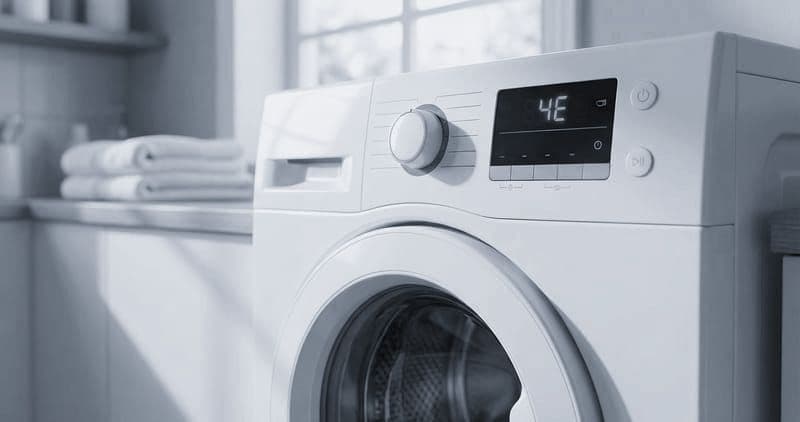
A [Samsung washer](/blog/samsung-washer-dryer-combo-error-codes) overflows when it can't tell how full it is — and about a third of the time the culprit is trivial: the little clear pressure tube that senses water level has kinked, slipped off, or clogged. Behind that come a stuck-open inlet valve, a failed pressure transducer, and, less often, a board fault. An OE code means the backup overflow protection has already tripped.
How Samsung Knows When to Stop Filling#
Samsung washers layer their overflow defense. The primary guard is a water-level pressure sensor: a thin air-pressure tube runs from the bottom of the outer tub up to a transducer on the control board, and as water rises it compresses the air in that tube, which the transducer reads as level. Behind it sits a secondary OE overflow switch that triggers an emergency drain if the primary sensor fails, and a tertiary response that runs the drain pump continuously and commands the inlet valve shut. An overflow only happens when the primary sensor fails and the backup doesn't catch it in time, or when the inlet valve physically can't close.
Do You Have the Right Tools?
Bearing puller set ($120), drum spider wrench ($85), multimeter ($85), and diagnostic software. Our technician arrives with $3,000+ in professional tools — your diagnostic is free.
Licensed & Insured · 90-Day Warranty · Same-Day Service
Overflow Versus Filling-When-Off#
Two related problems point different directions. A true overflow is the machine running a cycle and not stopping at the correct level — that's the level sensor or the board. Water entering the tub when no cycle is active is filling-when-off, and that's the inlet valve or a board relay. Deciding which you have keeps you from chasing the wrong part.
The Causes, Most Common First#
Pressure tube disconnected, kinked, or blocked (about 35%)#
The leading cause and the cheapest fix. If the clear tube slips off at either end, the transducer reads zero pressure — empty — no matter how full the tub is, so the board keeps filling. A kink or a blockage from detergent residue or mineral scale does the same by feeding stale, wrong pressure. On most WF models the tube routes along the left side wall, where it's easy to pinch between the machine and the wall when pushing the washer back into place, so this often follows a move. Unplug, pull the top panel, and trace the tube from the lower tub to the board: reseat both connectors firmly, run your fingers along it for kinks, and blow gently through it from the board end — you should hear bubbling in the tub, confirming it's clear. Clear a blockage with a thin wire or pipe cleaner, or replace the tube.
Inlet valve stuck open (about 25%)#
When the inlet-valve solenoid sticks open — debris on the seat, a failed spring, or a welded board relay — water keeps flowing past the fill-stop command; the board says close, but the valve physically stays open. Samsung's smaller valve orifices make this a bit less common than on some brands, but the flow is still enough to overfill within minutes, and hard-water scale on the valve seat is the usual reason debris holds it open.
Pressure transducer failure (about 20%)#
The transducer that converts the tube's air pressure into a signal can fail outright — a ruptured diaphragm or drifted calibration — and then it reports a wrong level, often reading "empty" permanently and driving a continuous fill. On some Samsung models the transducer is a separate sensor module on a harness, which is a straightforward swap; on others it's integrated into the main board, in which case replacing it means replacing the whole board.
Control board logic failure (about 12%)#
Less common, but the board's fill-control logic can corrupt or a component can fail, sending continuous fill commands regardless of what the sensor reports. This tends to follow a power surge that partly damages the board's processor, and it's the diagnosis of exclusion once the tube, valve, and transducer test good.
Suds lock — detergent overflow (about 8%)#
Sometimes it's not water at all but foam. Too much detergent, or non-HE detergent, builds suds that expand above the water and spill through the door boot or over the tub rim, looking like an overflow, and Samsung flags it with a suds code. EcoBubble models make this worse, since the feature whips detergent into micro-bubbles before the wash — pair that with a heavy or non-HE dose and suds production balloons. The cure is behavioral: use only HE detergent, about two tablespoons per load, and run a rinse-and-spin with no detergent to clear existing foam.
Safety First — Know the Risks
High-voltage components and pressurized water lines create flood and shock risk. A single loose fitting can cause thousands in water damage. Our techs are licensed and insured — let them handle the risk.
Licensed & Insured · 90-Day Warranty · Same-Day Service
A Sensible Order to Diagnose#
Work it cheap-to-expensive, because the most common cause is also the easiest to fix. Start with the pressure tube: reseat both ends, check for kinks, and blow it clear — this alone resolves the largest share of overfills and costs nothing but a few minutes with the top panel off. If the tube is sound, watch a fill: a valve that keeps flowing after the board should have stopped it is a stuck inlet valve, while a machine that fills continuously from empty as though it never senses water points at the transducer reading a false empty. Rule out suds by checking whether it's actually foam spilling rather than water, especially on an EcoBubble model. Only after the tube, valve, and transducer all check out do you suspect the board's logic, since that's the priciest and least likely culprit. Because a pinched tube after a move mimics an expensive sensor failure exactly, this order keeps a two-minute reseat from turning into an unnecessary transducer or board replacement.
If It's Overflowing Right Now#
Act in order. Press Power immediately, which stops the cycle and commands the valves closed. If it keeps filling, unplug the machine and shut both wall supply valves. On a WF front-loader, do not open the door if water is above the door seal — drain through the emergency hose first — while on a WA top-loader you can lift clothing out from the top, minding the water weight. Note the level where it stopped, since a stop at a specific point suggests partial sensor function versus a fill to the brim. An OE code afterward means the overflow protection activated: the drain pump ran, the valve was commanded shut, and the cycle ended, and the washer won't restart until the level drops and you power-cycle it. Don't just reset and rerun, though — the underlying sensor or valve fault will overfill again. To prevent repeats, dose HE detergent correctly, clean the pressure tube yearly, verify its routing after moving the machine, add a surge protector for the board, and consider an automatic supply shutoff valve as flood insurance.
Related reading: a Samsung washer filling when off and a Samsung washer that won't finish a cycle.
Samsung [washer repair](/bay-area/services/washer-repair) across [Sacramento](/sacramento/sacramento) and the Bay Area — level-sensor, valve, and board diagnostics in one visit. Book a technician.
Senior Appliance Repair Technician · 15 years experience
EPA-certified technician with 15 years of experience specializing in refrigerator and cooling system repairs.