Before you diagnose a [Samsung washer](/blog/samsung-washer-dryer-combo-error-codes) that won't heat, settle one question: does your model even have an internal heater? Many US-market Samsung washers don't — they borrow hot water from your home's water heater. On the models that do heat, an HE error almost always traces to a bad thermistor or a burned-out element.
Step One: Heater or No Heater?#
This single fact decides the entire diagnosis, and most owners skip it. Samsung washers with an internal element are the ones offering Steam Wash, Sanitize, or AllergyCare cycles — models such as the WF45R6100AW, WF50R8500AV, and WF56H9100AG carry a tubular heating element inside the outer tub. Basic WF units and most WA top-loaders have no element at all and simply draw warm or hot water from your household supply. The quick check: if there are no Steam or Sanitize buttons on the panel, your machine almost certainly has no heater, and lukewarm water is a home-water-heater, inlet-valve, or crossed-hose problem rather than anything inside the washer.
Do You Have the Right Tools?
Bearing puller set ($120), drum spider wrench ($85), multimeter ($85), and diagnostic software. Our technician arrives with $3,000+ in professional tools — your diagnostic is free.
Licensed & Insured · 90-Day Warranty · Same-Day Service
What the HE Codes Are Telling You#
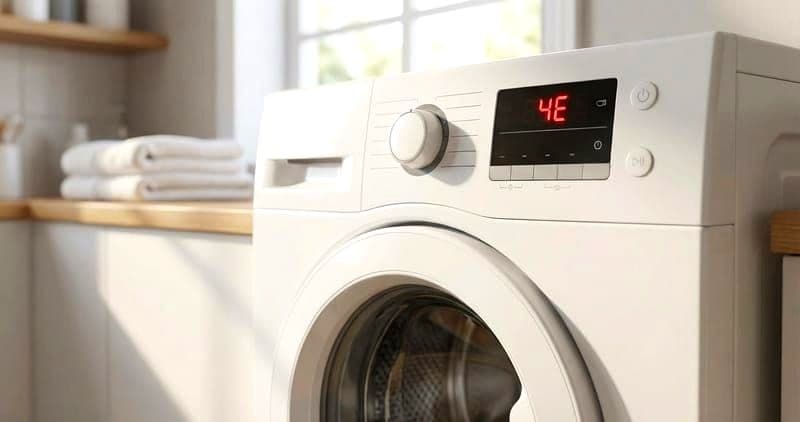
On a heater-equipped Samsung, the wash element is a tubular rod much like a water-heater element, and a thermistor immersed in the tub reports temperature to the control board, which switches the element on until the target is reached and then cycles it to hold. When that loop breaks, the board posts an HE-family code. A plain HE means the heater failed to raise temperature within the expected time. HE1 means over-temperature — the thermistor is reporting water above the 95C safety cutoff. HE2 means no temperature rise at all despite power to the element. A model without a heater should never show HE; if one does, suspect a control-board firmware fault, not a heating part.
The Causes, Most Likely First#
Thermistor failure (about 35%)#
The most common cause is not the element but the sensor watching it. Samsung's NTC thermistor is a small probe in the outer-tub wall, sitting in the wash water. If it reads wrong — shorted so it reads too hot, or open so it reads too cold — the board either never fires the heater (thinking the water is already warm, giving you cold washes) or throws HE1 believing the water passed 95C. It is an easy check: a healthy Samsung thermistor reads roughly 40,000 to 50,000 ohms at room temperature near 25C, with resistance falling as it warms. An infinite or near-zero reading means it has failed, and the probe is reachable without major teardown.
Heater element burn-out (about 30%)#
The tubular element itself burns open with age, or faster if it ever runs partly exposed to air instead of fully submerged — an element heating dry overheats and fails. Samsung elements are typically rated 1800 to 2000 watts and connect by spade terminals or a plug. Test continuity across it: a good element reads about 10 to 30 ohms, while infinite resistance means it has burned open. Access is from the rear of the tub or from beneath, depending on the model.
Control-board heater relay failure (about 20%)#
Driving the element pulls serious current — on the order of 15 to 16 amps at 120V — through a relay on the control board. That relay can weld from a surge or simply wear out after many high-current switching cycles, at which point the element never energizes even though the thermistor and element are fine. This is the harder fix, since it means board-level work rather than a bolt-in part.
Wiring or connection fault (about 15%)#
The high-current leads at the element can corrode or loosen, adding resistance that saps heater output so the water warms too slowly and eventually trips HE when the target is missed within the board's timeout. Inspect the connectors at the element terminals for discoloration, melting, or oxidation, and tug-test each one — a good connector should not pull off without pressing its release tab.
Safety First — Know the Risks
High-voltage components and pressurized water lines create flood and shock risk. A single loose fitting can cause thousands in water damage. Our techs are licensed and insured — let them handle the risk.
Licensed & Insured · 90-Day Warranty · Same-Day Service
Use Self Clean+ as a Free Heat Test#
Every Samsung washer offers a Self Clean+ cycle, which runs near 60C (about 140F) using either your hot supply or the internal element on equipped models. Run it as a diagnostic: if your household hot water is working but Self Clean+ still finishes lukewarm on a heater-equipped machine, the internal heating system has failed and you are back to the thermistor-then-element-then-relay order above. And remember you are not stranded meanwhile — standard Hot, Warm, and Cold cycles use your home's water heater, so the washer stays usable while you sort out the internal element.
Related reading: a Samsung washer with no hot or cold water and a Samsung washer that won't finish a cycle.
Samsung [washer repair](/bay-area/services/washer-repair) across [Sacramento](/sacramento/sacramento) and the Bay Area — thermistor, element, and control-board service in one visit. Book a technician.
Senior Appliance Repair Technician · 15 years experience
EPA-certified technician with 15 years of experience specializing in refrigerator and cooling system repairs.