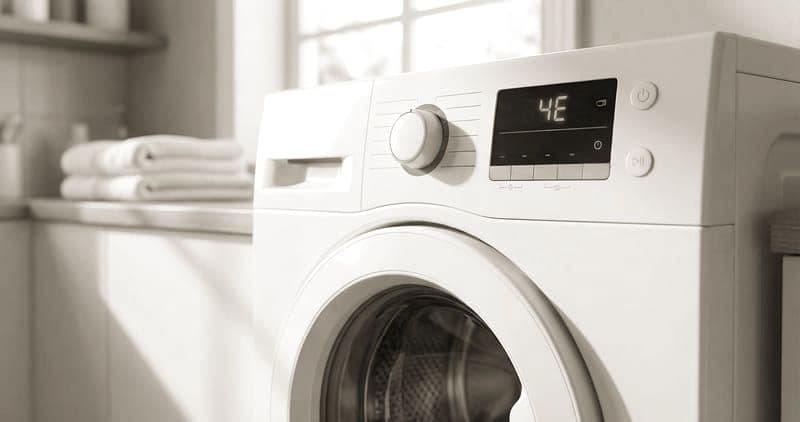
What is the Samsung Washer HE error?#
An HE code flags a water-temperature problem on your Samsung washer — the machine is not seeing the water temperature it expects for the selected cycle. A surprisingly common cause is the simplest: the hot and cold fill hoses got swapped at installation, so the machine draws cold when it wants hot. Other times it is the water valve or, on models with a heater, the heating element. Clothes coming out of a "warm" wash stone cold, or unusually long cycles as the machine waits to reach temperature, are the giveaways. First, check the hose connections at the back.
HE on a Samsung Washer: likely causes and repair cost#
On a Samsung Washer, the HE code signals: water temperature error.
| Likely cause | Typical likelihood |
|---|---|
| Hoses reversed | Most common |
| Water valve issue | Common |
| Heater failure | Less common |
Typical professional repair: $125–$300 · Difficulty: moderate · often owner-fixable
Fastest thing to try first: Check hot/cold hose connections.
Symptoms that often accompany HE: Clothes not getting clean (cold water only); Steam or excessive heat during cycle; Cycle times extending significantly (machine waiting for target temperature)
Technician diagnostic sequence for HE:
- Verify the hot and cold water supply hoses are connected to the correct inlets — hot (red mark) to hot, cold (blue mark) to cold. Reversed hoses are the most common cause
- Turn on the hot water faucet nearest to the washer and check that hot water arrives within 30 seconds. A water heater set too low or a long pipe run can cause HE codes
- For Samsung washers with internal heaters (HE2 sub-code): access the heater by removing the rear or bottom panel. Test the heater element with a multimeter — it should read 12-25 ohms. Open circuit means the heater is burned out
- Check the thermistor (temperature sensor) near the heater — it should read approximately 10 k-ohm at room temperature. A faulty thermistor gives the board false temperature data
Parts a technician may check or replace: Samsung DC62-00142G; Samsung DC47-00019A; Samsung DC32-00007A
Field note: HE1 means water is not heating; HE2 means water is overheating. HE2 is more urgent — an overheating heater can damage clothing and warp the plastic tub. If you see HE2, inspect the heater element for calcium scale buildup that causes hot spots.
Do You Have the Right Tools?
Bearing puller set ($120), drum spider wrench ($85), multimeter ($85), and diagnostic software. Our technician arrives with $3,000+ in professional tools — your diagnostic is free.
Licensed & Insured · 90-Day Warranty · Same-Day Service
How to troubleshoot the HE error yourself#
The best DIY win on HE is verifying the fill hoses. With the taps off, confirm the hot hose is on the hot inlet and cold on cold — reversed hoses are the leading cause in the table above and a free fix. While you are back there, make sure both taps are fully open and the inlet screens are not clogged, since restricted hot flow mimics a temperature fault. Run a hot-water cycle after correcting the hoses to see if HE clears. What I hand to a technician is the water valve or heater diagnosis: if the hoses are correct and taps open but HE persists, testing the valve solenoids or a heating element is a "moderate" repair better done with a meter than by guesswork.
Is the Samsung Washer HE error worth fixing?#
HE is worth chasing down, and often the fix costs nothing when it is just reversed hoses. When a part is genuinely at fault, the table above lists $125 to $300, covering a water valve or heater repair — reasonable for a washer you rely on. Against replacing the machine that is a small share of the cost, so I fix it. Only on an aging washer with multiple issues would replacement enter the conversation; a standalone HE on a sound machine is worth the $125 to $300 at most, and frequently far less.
Safety First — Know the Risks
High-voltage components and pressurized water lines create flood and shock risk. A single loose fitting can cause thousands in water damage. Our techs are licensed and insured — let them handle the risk.
Licensed & Insured · 90-Day Warranty · Same-Day Service
Samsung Washer HE: frequently asked questions#
What does the HE error mean on a Samsung Washer?#
It indicates a water-temperature fault: the washer is not reaching or reading the expected temperature. A common trigger is reversed hot/cold fill hoses.
Is it safe to keep using a Samsung Washer that shows the HE error?#
Generally yes, though washes may run cold or take much longer. There is no hazard, but cleaning performance suffers until it is corrected.
Can I clear the HE error myself, or do I need a technician?#
Check and correct the fill-hose connections and confirm the taps are open — that clears many HE codes for free. A faulty valve or heater needs a technician.
How much does it cost to repair the HE error on a Samsung Washer?#
Often nothing if reversed hoses are the cause. If a valve or heater is at fault, the table above lists $125 to $300.
Which parts usually fail when a washer throws the HE code?#
Frequently it is a plumbing setup issue (reversed hoses), not a part. When hardware fails, it is the water valve or heating element from the table above.
Why do reversed hoses trigger the HE error?#
With the hoses swapped, the machine pulls cold water when the cycle calls for hot; the temperature never matches the target, so the washer reports HE.
Lead Appliance Repair Technician · 12 years experience
Experienced technician with 12 years specializing in washing machine and dryer repairs across all major brands.