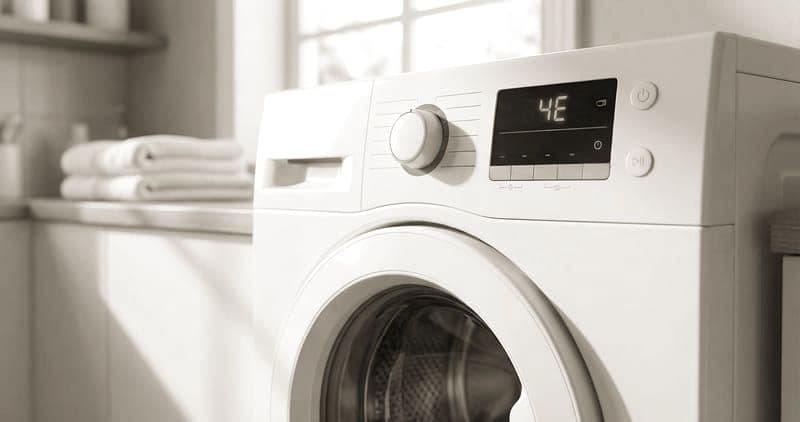
What is the Samsung Washer 3C error?#
The 3C code points at the drive motor or motor-control circuit on your Samsung washer — the drum is not turning as commanded. You may see the drum sit still while the machine hums, or 3C appear during the spin when the motor is under load. This is the most serious of the common washer codes because it involves the motor and drive board rather than a hose or filter. It will not endanger your home, but the machine is effectively out of service. A single power cycle is worth trying in case a transient overload latched the code.
3C on a Samsung Washer: likely causes and repair cost#
On a Samsung Washer, the 3C code signals: motor / drive error.
| Likely cause | Typical likelihood |
|---|---|
| Motor failure | Most common |
| Drive board issue | Common |
| Wiring problem | Less common |
Typical professional repair: $200–$450 · Difficulty: professional only · usually a technician job
Symptoms that often accompany 3C: Drum does not spin or agitate; Motor hums but drum does not move; Error appears during the spin cycle under load; Intermittent stopping during wash or rinse cycles
Technician diagnostic sequence for 3C:
- Unplug the washer, wait 2 minutes, and plug back in. Run a calibration cycle (hold Delay End + Soil Level for 3 seconds on most Samsung models) to reset motor parameters
- Open the rear panel and inspect the motor wiring harness — a loose connector between the motor and the drive board is a common cause. Samsung uses blade-type connectors that can vibrate loose
- Check the Hall sensor on the motor (a small board mounted at the back of the motor with 5 thin wires). Test the sensor resistance between pins — it should read approximately 10-15 ohms between adjacent pairs
- If the Hall sensor tests good, check the motor windings: each phase should read 4-8 ohms. Significantly different readings between phases indicates a partially shorted winding
- Sub-codes: 3E1 = motor overloaded (check for an oversize load); 3E2 = low motor current (wiring); 3E3 = Hall sensor; 3E4 = motor drive board
Parts a technician may check or replace: Samsung DC31-00098A; Samsung DC31-00111A or model-specific; Samsung DC92-01531A
Do You Have the Right Tools?
Bearing puller set ($120), drum spider wrench ($85), multimeter ($85), and diagnostic software. Our technician arrives with $3,000+ in professional tools — your diagnostic is free.
Licensed & Insured · 90-Day Warranty · Same-Day Service
How to troubleshoot the 3C error yourself#
Honestly, 3C leaves little for an owner to do safely. Try one power cycle — unplug for a few minutes and restart — because a brief overload from a badly overloaded drum can trip 3C on a healthy motor; remove some laundry and retry. Check that nothing is physically jamming the drum, like a garment caught between the drum and gasket. Beyond that, the causes in the table above — a failed motor, a drive board fault, or motor wiring — are "professional" territory. The motor and inverter board carry serious voltage and require testing under load to diagnose. This is the washer code where I tell owners to stop at the power cycle and call a technician rather than open the cabinet.
Is the Samsung Washer 3C error worth fixing?#
3C is the washer code where repair-versus-replace genuinely deserves thought. The table above lists $200 to $450 — the highest of the washer codes — because motor or drive-board work is involved. On a newer or higher-capacity machine, that is worth it and restores a unit worth much more. On an older washer, $200 to $450 starts to approach a meaningful fraction of a new one, so if the machine is well-worn and has had other issues, price a replacement before committing. For a machine with good years left, though, fixing the drive is the sound choice.
Safety First — Know the Risks
High-voltage components and pressurized water lines create flood and shock risk. A single loose fitting can cause thousands in water damage. Our techs are licensed and insured — let them handle the risk.
Licensed & Insured · 90-Day Warranty · Same-Day Service
Samsung Washer 3C: frequently asked questions#
What does the 3C error mean on a Samsung Washer?#
It indicates a drive motor or motor-control fault, so the drum will not spin or agitate as commanded. It often appears during the spin cycle under load.
Is it safe to keep using a Samsung Washer that shows the 3C error?#
The machine is effectively unusable, but there is no home hazard. Avoid repeated restart attempts, which stress the motor, and arrange service.
Can I clear the 3C error myself, or do I need a technician?#
You can try one power cycle and remove an overloaded drum, but motor and drive-board diagnosis is a technician job involving high voltage.
How much does it cost to repair the 3C error on a Samsung Washer?#
The table above lists $200 to $450, the priciest washer code, reflecting motor or drive-board repair.
Which parts usually fail when a washer throws the 3C code?#
The drive motor or the motor-control (inverter) board, sometimes the connecting wiring, as shown in the table above.
Is a Samsung Washer with the 3C error worth repairing?#
On a newer or high-capacity machine, yes. On an older, well-worn washer, the $200 to $450 repair is a large enough share of a new one to justify pricing replacement first.
Appliance Repair Technician · 8 years experience
Experienced technician with 8 years specializing in dishwasher repairs and European appliance brands including Bosch and Thermador.