Midea standalone freezers — both upright and chest models — have become popular budget options in the US market. Whether you have a Midea-branded unit or a Comfee model (same manufacturer, same internals), the error code system is straightforward. Standalone freezers have simpler control systems than full refrigerators, which means fewer things can go wrong and easier diagnosis when they do.
This guide covers all error codes for Midea upright freezers (MRU and WHS series) and chest freezers (MRC and CFC series), along with temperature alarms and blinking indicators that signal problems before they become critical.
How Midea Freezer Error Codes Work#
Midea standalone freezers use a simpler control platform than their refrigerators. Most models have a basic digital temperature display that doubles as the error code display. Codes appear as "E" followed by a number (E1–E5). Some budget models with no digital display use a blinking indicator light pattern.
Temperature alarm vs. error code: Midea freezers have a built-in high-temperature alarm that beeps and displays "H" or a blinking temperature reading when the interior temperature rises above the safe threshold (typically 10 degrees Fahrenheit for more than 30 minutes). This is not the same as an error code — it is a food safety warning.
To reset an error code:
- Press the alarm/reset button (if available on your model) to silence any alarm.
- Unplug the freezer for 5 minutes.
- Plug back in and observe — if the code returns immediately, the fault needs repair.
- If the code returns after 30–60 minutes of operation, the fault is intermittent and may be temperature-related.
Do You Have the Right Tools?
Refrigerant gauges ($200+), vacuum pump ($250), leak detector ($150), and EPA-certified recovery equipment. Our technician arrives with $3,000+ in professional tools — your diagnostic is free.
Licensed & Insured · 90-Day Warranty · Same-Day Service
E1 — Temperature Sensor Error#
The control board cannot read the interior temperature sensor (thermistor). This is the most common error on Midea freezers and prevents the compressor from operating correctly because the control board does not know the current temperature.
Common causes:
- Failed thermistor (degrades over time from constant cold exposure)
- Disconnected sensor wire (vibration from compressor loosens connectors)
- Corroded connector pins (moisture condensation at the connection point)
- Sensor wire pinched by shelving or frozen items
- Ice formation around the sensor breaking the element
How to fix:
- Locate the temperature sensor — on upright models, it is typically clipped to the evaporator coils or mounted on the back wall inside the freezer compartment. On chest freezers, it is usually attached to the inner liner wall or suspended from the top edge.
- Check the sensor wire: follow it from the sensor location to where it exits the freezer compartment and connects to the control board (usually on the back or top of the unit). Look for pinched wires, especially where the wire passes through the insulation.
- Reseat the connector firmly. Frost formation at the connection point can push connectors apart over time.
- Measure thermistor resistance: at room temperature (70 degrees), expect approximately 5,000–7,000 ohms (NTC type). At freezer temperature (0 degrees), expect approximately 25,000–35,000 ohms. If the reading is 0 (shorted) or infinite (open), replace the sensor.
- On chest freezers, the sensor wire often runs along the top edge of the tub. Rearranging frozen items can snag and pull the wire — check for physical damage.
Part cost: Thermistor varies by model and repair complexity. Professional repair varies by model and repair complexity.
E2 — Defrost Sensor Error (Upright Frost-Free Models Only)#
The defrost sensor (evaporator thermistor) is reading abnormally. This sensor tells the control board when to end the defrost cycle. Only frost-free upright freezers have this sensor — manual-defrost models and chest freezers do not.
Common causes:
- Failed defrost sensor/thermistor
- Sensor displaced from its mounting position on the evaporator
- Ice encasing the sensor (defrost cycle not clearing ice around the sensor)
- Disconnected sensor wire
How to fix:
- Access the evaporator by removing the back panel inside the freezer compartment. This requires removing shelves and any items stored against the back wall.
- The defrost sensor is clipped directly to an evaporator tube or coil. It should be in firm thermal contact with the evaporator surface. If it has come loose and is hanging in air, reattach it.
- Check for heavy ice buildup around the sensor — if the evaporator is completely iced over, the defrost heater may not be reaching the sensor area. Manual defrost (unplug for 8–12 hours) to clear ice, then investigate the defrost heater.
- Measure sensor resistance: at room temperature, expect 5,000–7,000 ohms. At defrost cycle end temperature (approximately 45 degrees), expect approximately 4,000–5,000 ohms.
- If the sensor tests good but E2 persists, check the wire for breaks in the section that runs through the cold compartment.
Part cost: Defrost sensor varies by model and repair complexity. Professional repair varies by model and repair complexity.
Safety First — Know the Risks
Refrigerant (R-134a/R-600a) requires EPA certification to handle. Improper discharge is a federal violation and health hazard. Our techs are licensed and insured — let them handle the risk.
Licensed & Insured · 90-Day Warranty · Same-Day Service
E3 — Defrost Heater Error (Upright Frost-Free Models Only)#
The control board has determined the defrost system is not functioning — either the heater is not activating, or the evaporator is not reaching the target defrost temperature within the allotted time.
Common causes:
- Failed defrost heater element (open circuit)
- Failed defrost thermostat/bi-metal switch (does not close to allow current to the heater)
- Control board defrost relay stuck open
- Heavy ice buildup overwhelming the heater capacity
How to fix:
- Unplug the freezer and remove the back panel inside the freezer compartment to access the evaporator.
- If the evaporator coils are completely encased in ice, the defrost system has been failing for a while. Manual defrost first: leave unplugged with the door open for 8–12 hours, or carefully use a hair dryer on low heat (never a heat gun — the plastic liner can warp).
- Once defrosted, test the defrost heater for continuity: it is a glass or aluminum tube element running along the evaporator coils. Expected resistance: 20–50 ohms. If infinite (open), the heater element is broken.
- Test the defrost thermostat (bi-metal): at room temperature, it should be closed (continuity). At temperatures above its set point (typically 50–70 degrees), it opens to stop defrost. If it is open at room temperature, it has failed.
- If both heater and thermostat test good, the control board defrost timer/relay may be stuck. On models with an electronic defrost timer (controlled by the main board), the board may need replacement.
Part cost: Defrost heater varies by model and repair complexity. Defrost thermostat varies by model and repair complexity. Professional repair varies by model and repair complexity.
E4 — Evaporator Fan Error (Upright Models Only)#
The evaporator fan motor is not running or not reaching expected speed. This fan circulates cold air from the evaporator throughout the freezer compartment. Without it, the area near the evaporator stays cold but the rest of the compartment warms up.
Common causes:
- Ice buildup blocking the fan blades (connected to defrost system failure)
- Failed fan motor (bearing seizure from moisture exposure)
- Disconnected fan motor connector
- Fan blade broken or cracked
How to fix:
- Open the freezer and listen — the evaporator fan should be running whenever the compressor is running. Some models stop the fan when the door is open (to prevent frost from being blown onto stored food), so you may need to manually press the door switch to simulate a closed door while listening.
- Remove the back panel inside the freezer compartment to access the fan.
- Check for ice buildup around the fan blade area. Even a small amount of ice on the blades can prevent them from spinning. If ice is present, the defrost system may also need attention.
- If no ice, try to spin the fan blade by hand. It should rotate freely. If it is stiff or seized, the motor bearings have failed.
- Test the fan motor by measuring resistance across the motor leads: expect 100–500 ohms depending on motor type. If open, the motor winding has failed.
Part cost: Evaporator fan motor varies by model and repair complexity. Professional repair varies by model and repair complexity.
The Real Cost of DIY
Average DIY attempt: $150-400 in tools you may use once, plus the risk of further damage. Our diagnostic visit costs $0 — we find the problem and give you an honest quote.
Licensed & Insured · 90-Day Warranty · Same-Day Service
E5 — Communication / Control Board Error#
The control board has detected an internal fault or cannot communicate with the compressor control system. This is a general electronics error that covers several potential failure points.
Common causes:
- Power surge damage to the control board
- Failed relay on the control board (compressor relay most common)
- Voltage supply issue to the control board
- Failed inverter board (on models with variable-speed compressors)
How to fix:
- Unplug the freezer for 10 minutes for a full capacitor discharge and reset.
- Check the power supply — verify outlet voltage with a multimeter (should read 110–120V AC). Voltage below 100V can cause control board communication errors.
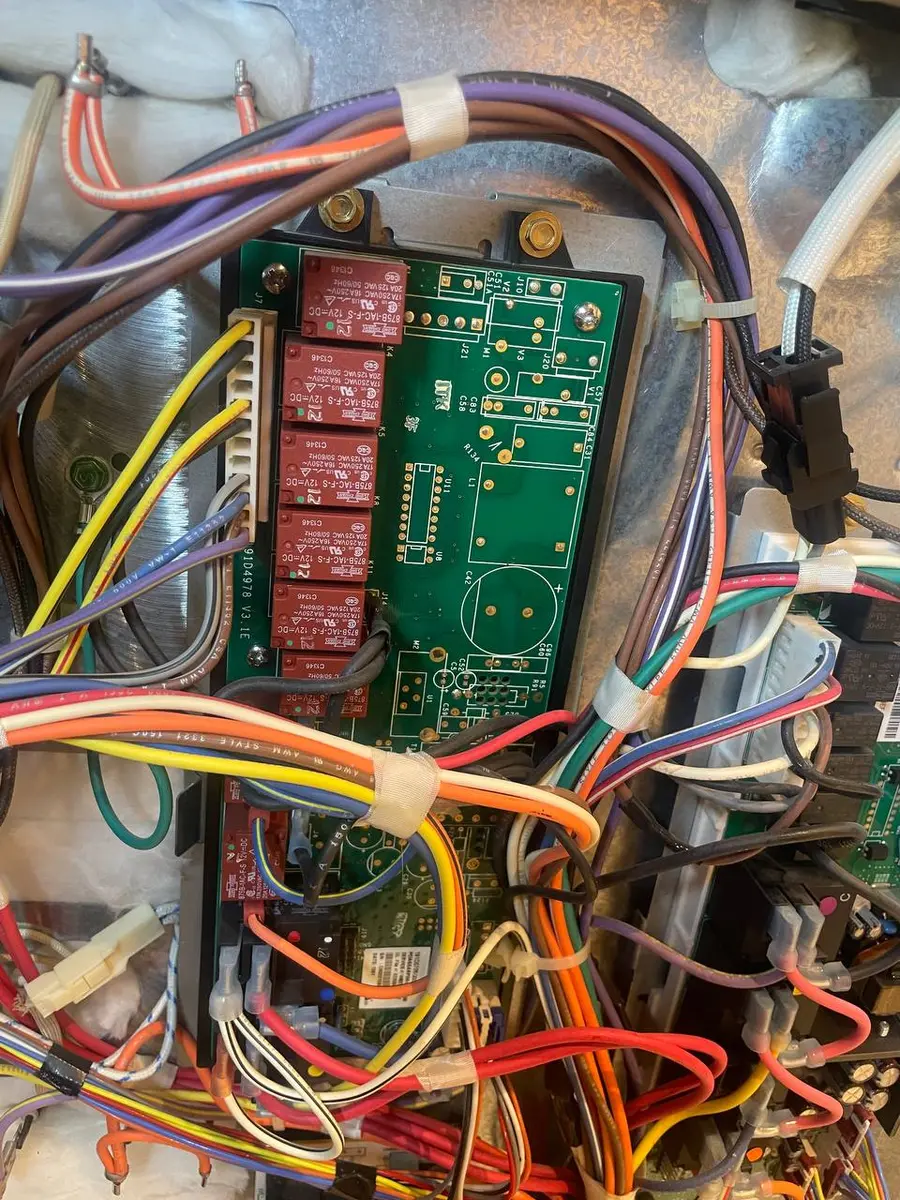
- If E5 persists after power cycle, inspect the control board for visible damage. Access the board by removing the top rear cover panel (upright) or the control housing on the exterior (chest). Look for burn marks, swollen capacitors, or cracked solder joints.
- Check all connectors on the board for corrosion or loose fit. Condensation from the cold compartment can migrate to the control board area, especially on budget models with minimal moisture barriers.
- On models with inverter compressors, E5 may indicate an inverter board fault rather than the main board. If the compressor is completely silent (no click, no hum), the compressor starting components or inverter are the likely cause.
Part cost: Control board varies by model and repair complexity. Inverter board (if applicable) varies by model and repair complexity. Professional repair varies by model and repair complexity.
Temperature Alarm (H or Blinking Display)#
This is not a numbered error code but is the most common alert on Midea freezers. The display shows "H" or the temperature display blinks rapidly, accompanied by an audible alarm.
Common causes:
- Door left open or not sealed properly
- Large amount of room-temperature food added at once
- Power outage (temperature rose while power was off)
- Compressor not running (separate fault)
- Condenser coils dirty (compressor cannot maintain temperature)
- Ambient temperature too high for the freezer location
How to fix:
- Press the alarm silence button and check the door — ensure it is fully closed and the seal (gasket) is not torn or folded.
- If you recently added a large quantity of unfrozen food, the alarm is expected. The freezer needs 4–8 hours to bring a large load down to target temperature.
- Check that the compressor is running — place your hand on the side or back of the unit. It should feel warm, indicating the compressor is working. If the exterior is room temperature, the compressor may not be running.
- Inspect the condenser coils — on upright models, they are on the back panel. On chest freezers, they are built into the sidewalls (accessible from the bottom). Dust-covered condensers reduce cooling capacity significantly. Vacuum the coils on back-mounted condensers annually.
- Check the ambient temperature where the freezer is located. Midea chest freezers in garages can struggle to maintain temperature during California summer heat (above 100 degrees ambient), especially budget models rated for standard ambient range (55–95 degrees). Some models are rated for extended ambient range (50–110 degrees) — check your model's specifications.
Don't Void Your Warranty
Opening your appliance yourself may void the manufacturer warranty. Our repair comes with a 90-day guarantee, and we document everything for warranty compliance.
Licensed & Insured · 90-Day Warranty · Same-Day Service
Chest Freezer Specific Issues#
Chest freezers have simpler systems than uprights (no defrost system, no fan, no door switch in most cases), which means fewer error codes but different maintenance needs:
No error code but freezer is warm:
- Check the thermostat dial — it may have been bumped to a warmer setting.
- Test the compressor: unplug for 10 minutes, plug back in. You should hear a click (relay) followed by a hum (compressor running). If click-click-click repeating without sustained hum, the compressor starting relay or overload is failing.
- Check the condenser (sidewalls on chest freezers). Blocked airflow around the unit prevents heat dissipation. Maintain 3 inches of clearance on all sides.
Frost buildup in chest freezer:
- Chest freezers are manual-defrost — frost accumulation of 1/4 inch or more reduces efficiency. Defrost when frost reaches 1/4 inch thickness.
- Excessive frost indicates: lid gasket leaking, lid opened too frequently, or high-humidity environment. Check gasket seal by closing the lid on a dollar bill — resistance should be felt when pulling the bill out.
Frequently Asked Questions#
Q: My Midea freezer is running but not cold enough. No error code appears. What is wrong? A: If the compressor runs continuously but the freezer barely reaches 20–25 degrees instead of the target 0 degrees, common causes include: dirty condenser coils (clean them), low refrigerant charge (requires professional sealed system repair), ambient temperature too high for the freezer's rating, or a failed door/lid gasket letting warm air in continuously. Check the gasket first — it is the most common and cheapest fix.
Q: How long does a Midea freezer last? A: Midea standalone freezers typically last 8–12 years. The compressor is the most durable component (sealed system, 10+ years typical). The most common failure points are the temperature sensor (3–5 years), defrost components on upright models (5–8 years), and the control board (6–10 years). Chest freezers with fewer components tend to outlast uprights.
Q: Should I unplug my Midea freezer during a long power outage? A: No — leave it plugged in so it restarts immediately when power returns. A full, closed Midea chest freezer maintains safe temperature (below 40 degrees) for 48+ hours without power. An upright freezer maintains safe temperature for 24–36 hours if the door stays closed. Minimize door openings during an outage. Cover the freezer with blankets for additional insulation during extended outages.
Q: Can I put my Midea freezer in the garage? A: Check your model's ambient temperature rating. Standard-range models (55–95 degrees ambient) may struggle in Sacramento garages during summer. Extended-range models (50–110 degrees) handle garage installation better. In winter, very cold garages (below 40 degrees) can cause the opposite problem — the compressor does not run because the ambient temperature is already cold enough, but the freezer compartment may actually warm above the target temperature because the condenser releases too much heat into the already-cold room.
Q: My Midea freezer makes a popping or clicking sound every few minutes. Is that an error? A: Clicking every few minutes (click-hum-runs for a while-click-stops) is normal compressor cycling. However, clicking that repeats every 2–3 seconds without the compressor sustaining a run indicates a failed compressor start relay or overload protector. This does not always trigger an error code immediately — the control board may take several failed start attempts before displaying E5. Replace the relay/overload kit (varies by model and region) before the compressor overheats from repeated start attempts.
Is It Worth Your Time?
Diagnosing a cooling issue requires testing the compressor, start relay, thermostat, condenser fan, and defrost system — 4-6 hours of DIY research and testing. Our technician diagnoses the issue in about 30 minutes — same-day appointments available.
Licensed & Insured · 90-Day Warranty · Same-Day Service
When to Call a Professional#
Midea freezers are simpler than full refrigerators, but some issues need professional expertise:
- E5 with compressor not starting — Compressor sealed system diagnosis requires specialized equipment and EPA 608 certification for refrigerant work.
- Freezer not cooling with no error code and compressor running — Likely a refrigerant leak, which requires professional leak detection and recharge.
- E3 on upright models — If the defrost heater and thermostat test good, the control board or wiring needs professional diagnosis.
- Temperature alarm that does not resolve — If the freezer cannot reach target temperature despite compressor running and clean condenser, the sealed system may have an issue (partial restriction or low charge).
- Electrical burning smell — Unplug immediately and call a professional. This could indicate a failing compressor relay, overheated wiring, or control board fault.
Dealing with a Midea freezer error code? EasyBear technicians have experience with Midea's growing product line including standalone freezers. Free diagnostic visit — we identify the problem, explain repair vs. replacement economics, and fix on the spot when possible. Every repair includes our 90-day parts and labor warranty. Schedule your free diagnosis today.
Lead Appliance Repair Technician · 12 years experience
Experienced technician with 12 years specializing in washing machine and dryer repairs across all major brands.