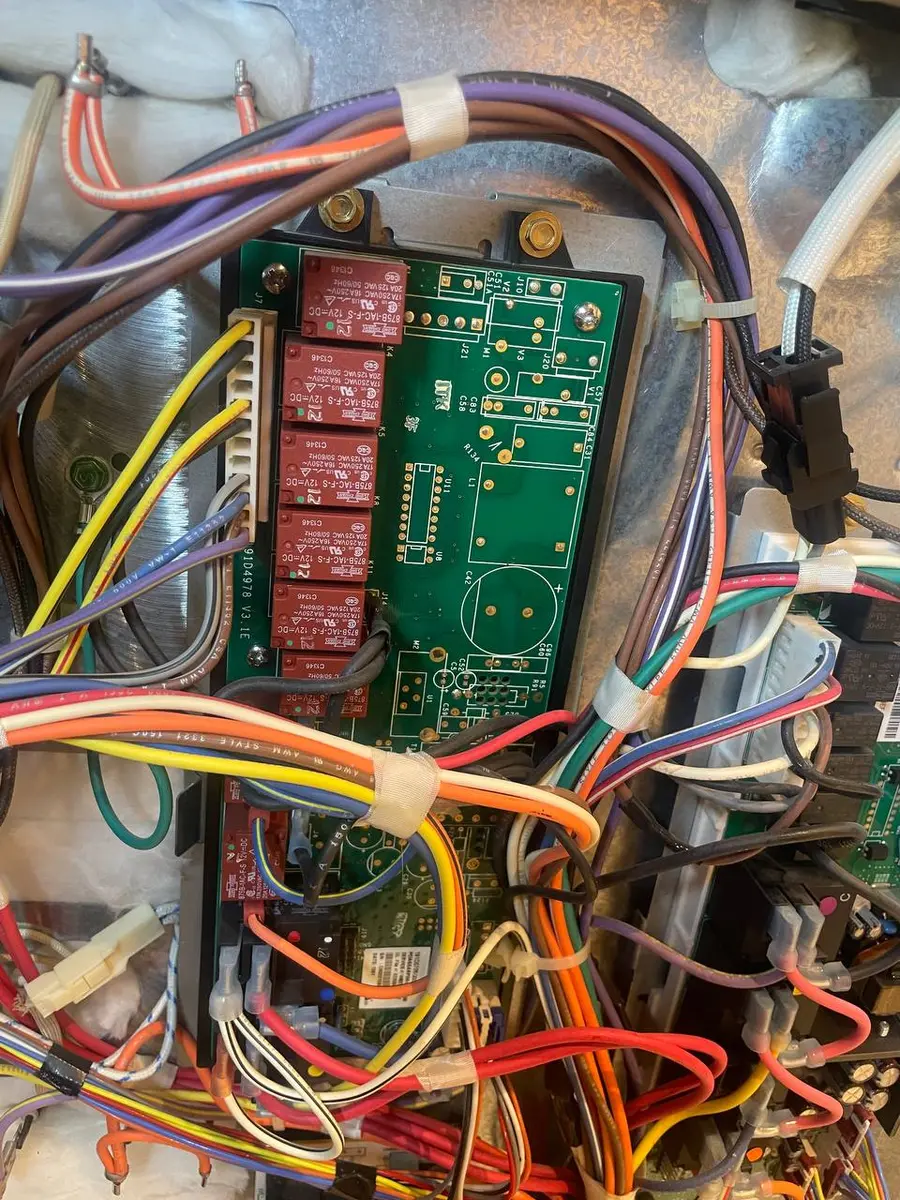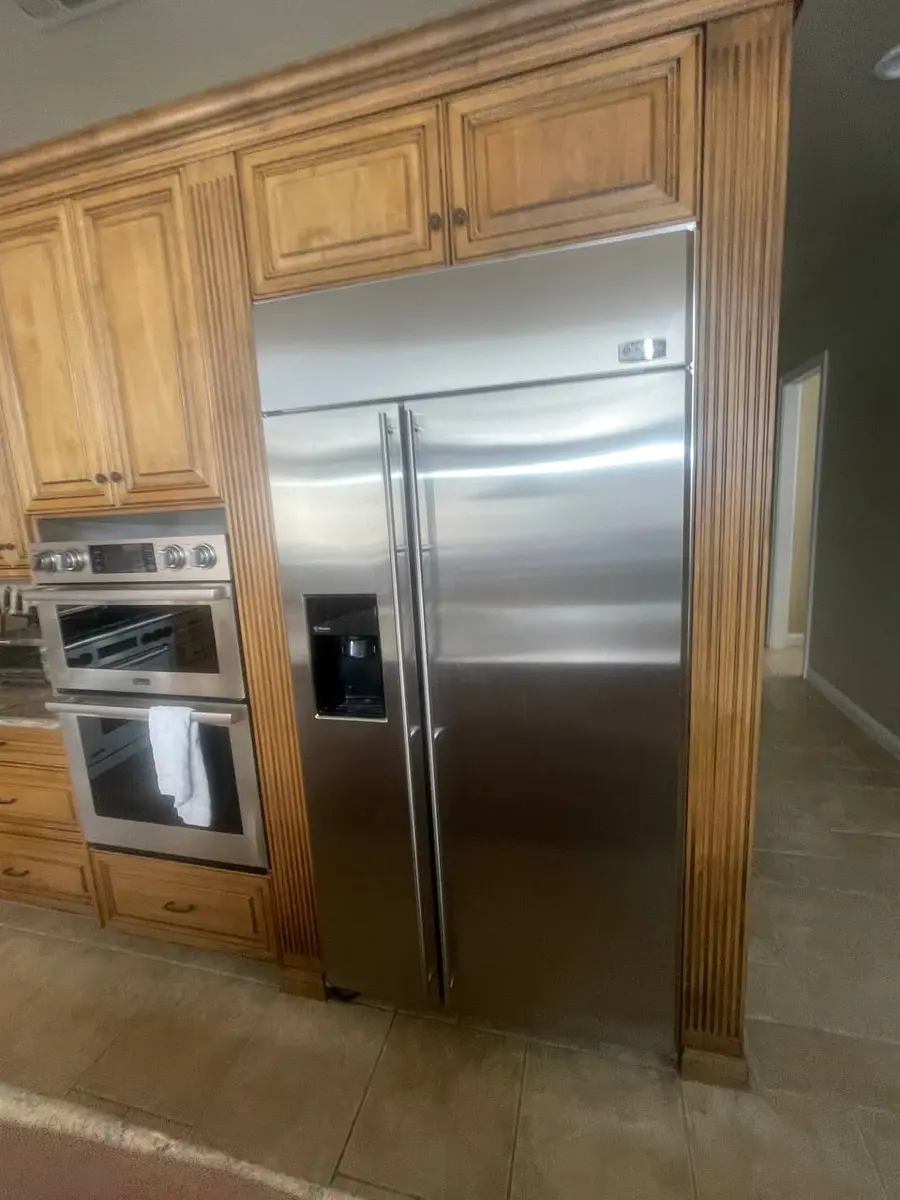
KitchenAid refrigerators represent the premium tier of the Whirlpool Corporation lineup, featuring advanced cooling systems like the Preserve and ExtendFresh temperature management, the FreshFlow air filter, and the PrintShield stainless steel finish. When something goes wrong, these refrigerators communicate through alphanumeric error codes displayed on the control panel. As a Whirlpool subsidiary, KitchenAid shares the same F#E# error code format, but the components and repair costs reflect the brand's premium positioning. This guide covers every KitchenAid refrigerator error code across French Door (KRFC, KRFF), Side-by-Side (KRSF), Built-In (KBFN, KBBR), and Counter-Depth (KRFC604F) models.
How KitchenAid Refrigerator Error Codes Work#
KitchenAid refrigerators use a network of sensors and control boards to monitor temperatures, defrost cycles, ice production, and door status. When a sensor reading deviates from the expected range, the main control board logs the error and displays a code on the LCD or LED panel. On models with the FreshVue display (touch screen on French Door models), error codes appear as alphanumeric text. On models with basic LED displays, codes may flash as a numbered pattern.
Before troubleshooting any code:
- Write down the exact error code displayed.
- Unplug the refrigerator (or flip the breaker) for 5 minutes.
- Restore power and monitor for 24 hours — some codes are transient.
- If the code returns, proceed with the specific troubleshooting below.
Important: KitchenAid refrigerators have a built-in diagnostic mode. Press the door alarm button three times within 10 seconds, then press the freezer temperature down button three times within 10 seconds. The display will enter service diagnostics and cycle through all active and stored error codes.
Do You Have the Right Tools?
Refrigerant gauges ($200+), vacuum pump ($250), leak detector ($150), and EPA-certified recovery equipment. Our technician arrives with $3,000+ in professional tools — your diagnostic is free.
Licensed & Insured · 90-Day Warranty · Same-Day Service
Error Code 5 (PO) — Power Outage Detected#
This is an informational code that appears after power has been interrupted and restored. The KitchenAid control board logs the event and alerts you to check food safety.
Common causes:
- Utility power outage
- Tripped circuit breaker
- Loose plug connection at the wall outlet
- GFCI outlet tripped (if refrigerator is on a GFCI circuit, which is not recommended)
How to fix:
- Press any button on the control panel to acknowledge and clear the code.
- Check the refrigerator temperature — it should be 37°F or below. The freezer should be 0°F or below.
- A fully stocked freezer maintains safe temperature for about 48 hours during an outage; a half-full freezer for about 24 hours.
- If the compressor does not restart within 10 minutes of power restoration, unplug for 5 minutes and plug back in to reset the start relay.
Part cost: No parts needed. If outages are frequent in your area (common during Sacramento summer peak demand), consider a dedicated surge protector for the refrigerator.
Error Code CF — Communication Failure#
The main control board and the user interface display board cannot communicate. This is a serious code that prevents temperature adjustment and monitoring.
Common causes:
- Broken wire in the door hinge harness (part WPW10838614) — the number one cause on French Door models like KRFC604FSS and KRFF507HPS
- Loose connector between the main control board and the UI board
- Failed main control board (part W10503278)
- Failed UI display board (part W10834525)
How to fix:
- Open and close the refrigerator doors while watching the display. If the display flickers or cuts out during door movement, the door hinge wire harness is damaged.
- Unplug the refrigerator and access the top hinge area. Inspect the wire harness that runs through the left door hinge for frayed, pinched, or broken wires. On KRFC and KRFF French Door models, this harness flexes with every door opening and wire fatigue is extremely common after 3-5 years.
- If the harness is intact, reseat the connectors on both the main control board (located behind the rear lower access panel) and the UI board (behind the dispenser panel or inside the door).
- If connections are solid, test for communication voltage (5V DC serial signal) between the boards using a multimeter. Absence of signal on the main board side indicates a failed main board; absence on the UI side indicates a failed UI board.
Part cost: Door hinge harness (WPW10838614) varies by model and repair complexity. Main control board (W10503278) varies by model and repair complexity. UI display board (W10834525) varies by model and repair complexity. Professional repair totals varies by part depending on the failed component.
Safety First — Know the Risks
Refrigerant (R-134a/R-600a) requires EPA certification to handle. Improper discharge is a federal violation and health hazard. Our techs are licensed and insured — let them handle the risk.
Licensed & Insured · 90-Day Warranty · Same-Day Service
Error Code 1 — Freezer Sensor Failure#
The freezer temperature sensor (thermistor) is reporting an out-of-range reading — either shorted or open circuit.
Common causes:
- Failed freezer thermistor (part WPW10384183)
- Disconnected sensor wire harness
- Frost buildup encasing the sensor (related to a defrost system problem)
- Corroded connector pins from moisture infiltration
How to fix:
- Locate the freezer thermistor — on KitchenAid French Door models (KRFC, KRFF), it is clipped to the evaporator cover inside the freezer compartment, near the top.
- Disconnect the sensor and measure resistance with a multimeter. At room temperature (77°F), it should read approximately 16,600 ohms. At freezer temperature (0°F), it should read approximately 83,000 ohms. A reading of 0 ohms (shorted) or infinite/OL (open) confirms a failed sensor.
- Check the wire harness connector for corrosion or ice damage. Clean corroded pins with electrical contact cleaner.
- If frost has completely encased the sensor, you likely have a concurrent defrost problem — check the defrost heater and defrost thermostat as well.
Part cost: Freezer thermistor (WPW10384183) varies by model and repair complexity. Professional repair varies by model and repair complexity.
Error Code 2 — Refrigerator Sensor Failure#
The fresh food compartment temperature sensor is reading abnormally. The refrigerator cannot accurately regulate the fresh food section temperature.
Common causes:
- Failed refrigerator thermistor (part WPW10384184)
- Sensor wire pinched or disconnected during shelf removal/installation
- Condensation damage at the sensor connector
- Main control board not reading the sensor signal properly
How to fix:
- The fresh food thermistor is typically mounted near the air diffuser at the top rear of the refrigerator compartment on KRFC and KRFF models. On Built-In models (KBFN), it may be behind the rear panel inside the compartment.
- Remove the thermistor and measure resistance. At room temperature (77°F), expect approximately 16,600 ohms. At refrigerator temperature (37°F), expect approximately 32,000 ohms.
- Inspect the sensor wire along its entire path — it can get pinched when sliding shelves in and out, especially on models with adjustable glass shelves.
- Replace the sensor if readings are out of specification.
Part cost: Refrigerator thermistor (WPW10384184) varies by model and repair complexity. Professional repair varies by model and repair complexity.
The Real Cost of DIY
Average DIY attempt: $150-400 in tools you may use once, plus the risk of further damage. Our diagnostic visit costs $0 — we find the problem and give you an honest quote.
Licensed & Insured · 90-Day Warranty · Same-Day Service
Error Code 4 — Defrost Sensor / Bimetal Error#
The defrost system temperature sensor or bimetal thermostat is malfunctioning. This can lead to excessive frost buildup on the evaporator, reduced cooling, and eventually a warm refrigerator.
Common causes:
- Failed defrost bimetal thermostat (part WPW10225581)
- Failed defrost sensor/fuse assembly (part WPW10276646)
- Frost buildup blocking the sensor from accurately reading evaporator temperature
- Wiring issue between the sensor and the adaptive defrost control
How to fix:
- Remove the freezer contents and the interior rear panel to expose the evaporator coils. If the coils are heavily frosted (more than a light rime), the defrost system has already been failing.
- Locate the defrost sensor and bimetal — they are mounted directly on or near the evaporator tubing, usually at the top of the evaporator.
- Test the bimetal thermostat for continuity at room temperature — it should be closed (near 0 ohms). At freezer temperature, it should be open.
- Test the defrost sensor: at room temperature, resistance should be approximately 16,600 ohms.
- If heavy frost is present, you will also need to verify the defrost heater and the adaptive defrost control board are functioning.
Part cost: Defrost bimetal thermostat (WPW10225581) varies by model and repair complexity. Defrost sensor/fuse (WPW10276646) varies by model and repair complexity. Professional defrost system repair varies by model and repair complexity including parts and manual defrost.
Error Code 6 — Condenser Fan Motor Error#
The condenser fan motor is not running or not reaching the expected speed. This fan is critical for dissipating heat from the condenser coils.
Common causes:
- Failed condenser fan motor (part WPW10310240)
- Debris or ice blocking the fan blade
- Disconnected or damaged fan motor wiring
- Failed fan motor relay on the main control board
How to fix:
- Access the condenser fan at the bottom rear of the refrigerator — remove the rear lower access panel.
- Check for debris around the fan blade: dust, pet hair, food wrappers, and ice buildup are common obstructions on KitchenAid models with the compressor compartment at the bottom.
- Spin the fan blade by hand — it should rotate freely. Any resistance indicates a seized motor bearing.
- With power applied, the fan should run whenever the compressor runs. If the compressor is running but the fan is not, test for voltage at the fan motor connector (should be 12V DC on most KitchenAid models).
- If voltage is present but the motor does not spin, replace the motor.
Part cost: Condenser fan motor (WPW10310240) varies by model and repair complexity. Professional repair varies by model and repair complexity.
Don't Void Your Warranty
Opening your appliance yourself may void the manufacturer warranty. Our repair comes with a 90-day guarantee, and we document everything for warranty compliance.
Licensed & Insured · 90-Day Warranty · Same-Day Service
Error Code 7 — Evaporator Fan Motor Error#
The evaporator fan (the fan that circulates cold air from the evaporator into the refrigerator and freezer compartments) has failed or is running below expected RPM.
Common causes:
- Failed evaporator fan motor (part WPW10188389)
- Ice buildup around the fan blade from a defrost system failure
- Fan blade cracked or detached from the motor shaft
- Wiring harness damage inside the freezer compartment
How to fix:
- Open the freezer and listen — you should hear the evaporator fan running when the doors are closed (press the door switch to simulate a closed door). Silence or a grinding noise indicates a fan problem.
- Remove the interior rear panel of the freezer compartment to access the fan.
- Check for ice buildup around the fan blade. If ice is present, a defrost system failure is the root cause — the ice is a symptom, not the primary problem.
- If no ice, spin the fan blade by hand. It should spin freely. Grinding or stiffness means the motor bearings are worn.
- Test the motor electrically: 12V DC at the connector should make it spin. No spin with voltage present means a dead motor.
Part cost: Evaporator fan motor (WPW10188389) varies by model and repair complexity. Professional repair varies by model and repair complexity. If ice buildup was the cause, budget for concurrent defrost system repair.
Error Code 9 — Ice Maker Sensor / Motor Error#
The ice maker system has detected a fault — either the mold thermostat, the ice maker motor module, or the fill valve circuit. This is one of the most common KitchenAid refrigerator complaints, especially on French Door models.
Common causes:
- Failed ice maker module motor (part WPW10190961)
- Frozen fill tube preventing water from reaching the ice maker
- Failed mold thermostat (part WPW10384185)
- Ice maker fill valve failure (part W10865826)
- Ice level optical sensor blocked or failed (on models with the automatic ice level control)
How to fix:
- Check the fill tube at the back of the freezer — a frozen fill tube is the most common cause of ice maker failure on KitchenAid French Door models (KRFC, KRFF). If the tube has a solid ice plug, use a hair dryer on low heat to melt it, then investigate why it froze (usually a faulty fill tube heater or a door gasket leak allowing warm moist air in).
- Test the ice maker by pressing the test button on the module (small hole on the side or bottom of the ice maker — use a paper clip). The ice maker should cycle through: harvest arms rotate, water fills, then wait for freeze. If it does not respond, the motor module is failed.
- Check the mold thermostat by measuring resistance — at room temperature it should read near 0 ohms (closed). At freezing temperature, it opens to signal the control to harvest ice.
- On models with the under-counter ice system (KUIX models), also check the water filter and water pressure — below 20 PSI causes incomplete fills and small or hollow ice cubes.
Part cost: Ice maker module (WPW10190961) varies by model and repair complexity. Fill tube heater kit (WPW10178390) varies by model and repair complexity. Professional ice maker repair varies by model and repair complexity.
Is It Worth Your Time?
Diagnosing a cooling issue requires testing the compressor, start relay, thermostat, condenser fan, and defrost system — 4-6 hours of DIY research and testing. Our technician diagnoses the issue in about 30 minutes — same-day appointments available.
Licensed & Insured · 90-Day Warranty · Same-Day Service
Error Code dI — Defrost Timer / Adaptive Defrost Error#
The adaptive defrost control has detected an anomaly in the defrost cycle timing or execution.
Common causes:
- Failed adaptive defrost control board (part WPW10366605)
- Defrost heater not drawing current (open heater element)
- Defrost thermostat stuck open, preventing the heater from activating
- Wiring fault in the defrost circuit
How to fix:
- Enter diagnostic mode to check the defrost heater operation: the diagnostic will activate the defrost heater, and you should be able to feel warmth at the evaporator within 2-3 minutes.
- If the heater does not activate in diagnostics, measure continuity across the defrost heater terminals — should read 20-40 ohms. Infinite reading means the heater element is broken.
- Check the defrost thermostat (bimetal) — it should be closed (continuous) at temperatures above 40°F.
- If both heater and thermostat test good, the adaptive defrost control board is likely failed. On KitchenAid Built-In models (KBFN, KBBR), the defrost control is integrated into the main control board, making it a more expensive replacement.
Part cost: Adaptive defrost control (WPW10366605) varies by model and repair complexity. Defrost heater (WPW10165425) varies by model and repair complexity. Main control board with integrated defrost (W10503278) varies by model and repair complexity. Professional repair varies by model and repair complexity.
Error Code SY EF — Evaporator Fan Circuit#
A system-level error indicating the main control board cannot drive the evaporator fan. This is distinct from Error Code 7 (fan motor failure) — SY EF specifically points to the control circuit rather than the fan itself.
Common causes:
- Failed relay or MOSFET on the main control board that drives the evaporator fan
- Short circuit in the fan motor wiring causing the board relay to trip
- Intermittent connector contact at the main board
How to fix:
- First verify the evaporator fan motor itself is good (see Error Code 7 troubleshooting).
- If the fan motor tests good electrically but does not receive power, the issue is on the main control board.
- Inspect the main control board for visible damage around the fan motor relay — burnt traces, discolored components, or swollen capacitors.
- SY EF typically requires main control board replacement (part W10503278).
Part cost: Main control board (W10503278) varies by model and repair complexity. Professional repair varies by model and repair complexity including diagnostics and parts.
The Risk of Getting It Wrong
A wrong diagnosis often turns a simple fix into a costly replacement. Without proper diagnostic tools, you might replace the wrong part — or cause additional damage. Our free diagnostic eliminates the guesswork.
Licensed & Insured · 90-Day Warranty · Same-Day Service
Error Code SY CE — Communication Error (System Level)#
A system-level communication failure between multiple control boards. On KitchenAid models with separate boards for the compressor inverter, display, and main control, SY CE indicates a bus communication breakdown.
Common causes:
- Failed main control board
- Failed inverter board (on variable-speed compressor models)
- Wire harness damage between boards
- Connector corrosion from moisture in the compressor compartment
How to fix:
- Unplug the refrigerator for 10 minutes. This is a longer reset than typical because the inverter board has capacitors that hold charge.
- Inspect all wire harness connections between the main control board and the inverter board (located near the compressor at the bottom rear).
- Check for condensation or moisture in the compressor compartment — KitchenAid Counter-Depth models (KRFC604F) are particularly susceptible to condensation on the inverter board due to the shallow cabinet depth placing the board closer to the condenser.
- If connections are clean and dry, the main control board or inverter board has failed. Professional diagnosis is recommended to determine which board.
Part cost: Inverter board varies by model and repair complexity. Main control board (W10503278) varies by model and repair complexity. Professional repair varies by model and repair complexity.
KitchenAid Refrigerator Diagnostic Mode#
KitchenAid refrigerators have a built-in service diagnostic mode that technicians use to quickly identify problems:
- Entering diagnostic mode: Press the door alarm button 3 times within 10 seconds, then press the freezer temperature down button 3 times within 10 seconds. The display enters service mode.
- Cycling through tests: Use the temperature up/down buttons to cycle through individual component tests — compressor, evaporator fan, condenser fan, defrost heater, damper motor, and ice maker.
- Reading stored error codes: In diagnostic mode, the display shows all active and recently stored fault codes with a timestamp (in hours of compressor run-time).
- Forced defrost: From diagnostic mode, activate the defrost heater test to manually defrost the evaporator — useful when diagnosing frost buildup issues without removing panels.
- Exiting diagnostic mode: Press the door alarm button once, or unplug the refrigerator.
Free Diagnostic Visit — Zero Risk
Our certified technician comes to your home, diagnoses the problem with professional tools, and gives you an honest quote — all at zero cost. No parts markup, no hidden fees. If you decide not to proceed, you pay nothing.
Licensed & Insured · 90-Day Warranty · Same-Day Service
Frequently Asked Questions#
Q: Why does my KitchenAid French Door refrigerator keep having ice maker problems? A: KitchenAid French Door models (KRFC, KRFF) are known for ice maker issues, primarily frozen fill tubes. The fill tube runs from the water valve at the bottom, up through the cabinet to the freezer. Warm moist air enters during door openings and condenses inside the tube, eventually freezing it solid. KitchenAid addressed this with a fill tube heater kit (WPW10178390) on newer models, but older units may need the kit retrofitted. Additionally, door gaskets that do not seal tightly allow continuous warm air infiltration — inspect the gasket for gaps or tears.
Q: How do I reset my KitchenAid refrigerator after an error code? A: Unplug the refrigerator for 5 minutes, then restore power. Allow 24 hours for temperatures to stabilize before judging if the error has cleared. For persistent codes, enter the diagnostic mode (door alarm 3x, then freezer temp down 3x within 10 seconds each) to view stored codes and run component tests. Clear stored codes from diagnostic mode by pressing and holding the temperature up and down buttons simultaneously for 5 seconds.
Q: Are KitchenAid refrigerator parts more expensive than Whirlpool parts? A: Yes and no. KitchenAid and Whirlpool use many of the same internal components (compressors, thermistors, fan motors) with identical part numbers. However, KitchenAid-specific parts like the premium stainless steel panels, PrintShield touch-up kits, LCD display boards, and Built-In model trim kits carry a 20-40% premium. Always cross-reference the part number rather than the brand name — many KitchenAid replacement parts are sold under the Whirlpool brand at lower cost with identical specifications.
Q: My KitchenAid refrigerator is making a clicking noise but no error code is displayed. What does this mean? A: A clicking noise without an error code usually indicates the compressor start relay is failing. The relay tries to start the compressor, fails, clicks off, and tries again. The start relay and overload protector (part WPW10613606) is an inexpensive repair (varies by model and region for the part) but if ignored, repeated failed starts can damage the compressor. If the clicking is coming from the back bottom area and the refrigerator is not cooling, replace the start relay promptly.
Q: How long do KitchenAid Built-In refrigerators typically last? A: KitchenAid Built-In refrigerators (KBFN, KBBR, KBSD series) are designed for a 15-20 year lifespan when properly maintained. The most common repairs between years 5-10 are the ice maker module, thermistors, and door gaskets. The compressor and sealed system typically last 12-18 years. Given the Built-In installation cost (varies by model and region for cabinetry integration), repairing is almost always more economical than replacing until the compressor or sealed system fails.
When to Call a Professional#
Some KitchenAid refrigerator issues require specialized tools and knowledge:
- Sealed system repairs (compressor, evaporator, condenser) — Requires EPA 608 certification for refrigerant handling. Never attempt DIY refrigerant work.
- SY codes (SY EF, SY CE, SY CF) — System-level errors involving control board interaction require board-level diagnosis with specialized tools.
- Built-In model repairs — KitchenAid Built-In refrigerators require careful disassembly within cabinetry. Improper access can damage surrounding cabinetry or the refrigerator's trim panels.
- Repeated ice maker failures — If the ice maker fails again after a straightforward repair, there is typically a secondary root cause (gasket leak, fill tube heater, water valve flow rate) that requires systematic diagnosis.
- Intermittent error codes — Codes that appear and disappear can indicate wiring harness issues that are difficult to locate without systematic testing under operating conditions.
A certified technician with KitchenAid experience can access advanced diagnostic modes, interpret error history logs with timestamps, and identify root causes that prevent repeat failures.
Tired of dealing with KitchenAid refrigerator error codes? EasyBear's certified technicians specialize in KitchenAid and Whirlpool premium refrigerator repair. We stock the most common KitchenAid parts — thermistors, fan motors, ice maker modules, and door hinge harnesses — so most repairs are completed in a single visit. We offer a free diagnostic visit where our technician identifies the exact problem, explains your options, and completes the repair on the spot. Every repair is backed by our 90-day parts and labor warranty. Schedule your free diagnosis today.
Lead Appliance Repair Technician · 12 years experience
Experienced technician with 12 years specializing in washing machine and dryer repairs across all major brands.