How to Troubleshoot Frigidaire Stove Bake Element
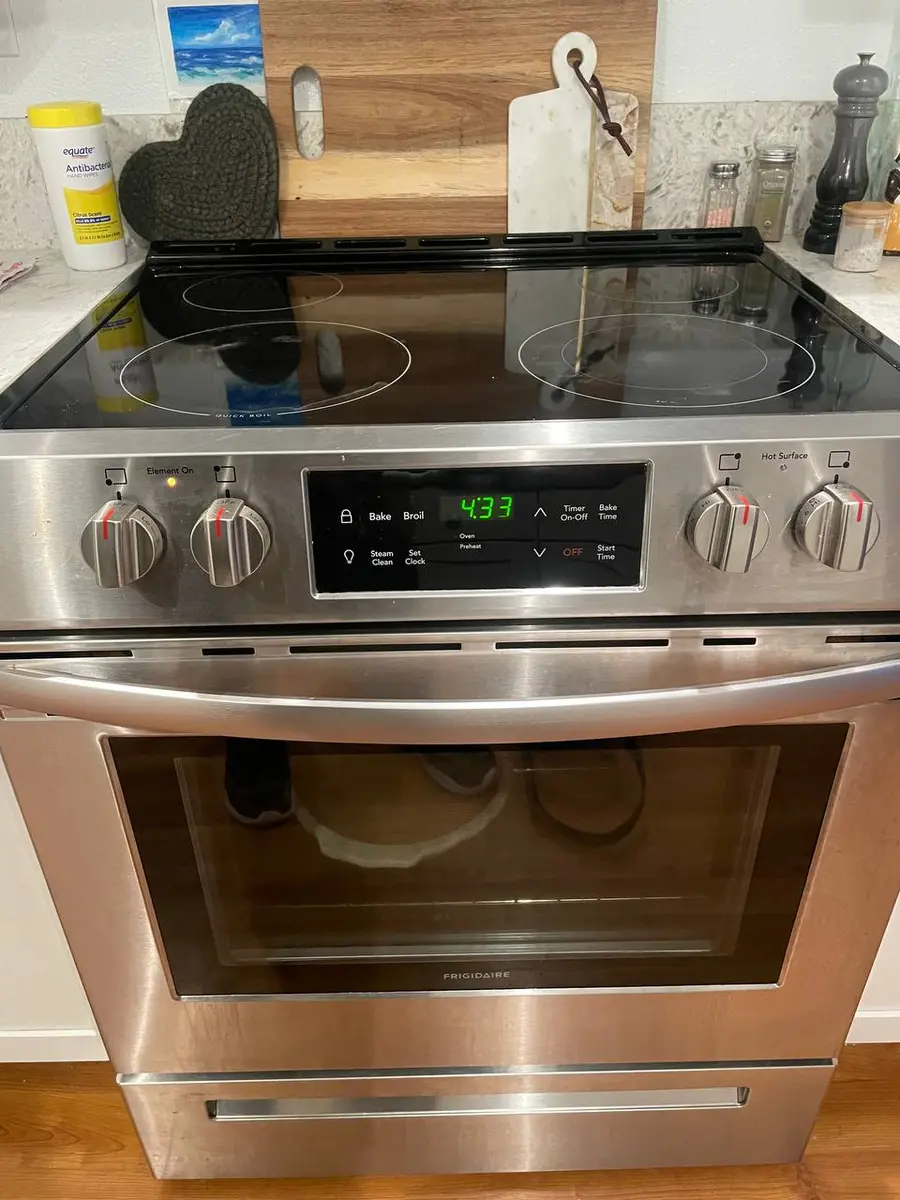
A Frigidaire oven that broils but won't bake almost always has a failed 316075103 bake element or a dead bake relay on the control board. Working the circuit from the element outward takes about 30 to 60 minutes and sits at an intermediate skill level.
When the lower bake element quits, the oven never climbs to temperature in standard bake mode even though broil — which fires the separate upper element — still works normally. That split, bake dead and broil fine, is the fingerprint of a bake-circuit fault, and it lets you ignore the parts that are obviously healthy. The walkthrough below moves in order from the element itself out to the wiring, the temperature sensor, the door-lock interlock, and finally the control board relay.
Tools and Parts#
| Item | Purpose |
|---|---|
| Phillips #2 screwdriver | Rear panel and element screws |
| Multimeter | Resistance and voltage checks |
| 1/4-inch nut driver | Rear panel access |
| Flashlight | Cavity inspection |
| Bake element 316075103 | Supersedes to 316075104; model dependent |
Do You Have the Right Tools?
Combustion analyzer ($300), igniter tester ($120), temperature calibrator ($150), and gas pressure manometer. Our technician arrives with $3,000+ in professional tools — your diagnostic is free.
Licensed & Insured · 90-Day Warranty · Same-Day Service
Before You Start#
Safety warning: Turn off the 240V circuit breaker. Allow the oven to cool completely if recently used. The bake element circuit carries 240V when the oven is operating. During live-voltage testing steps (if needed), exercise extreme caution — 240V contact can cause severe burns or cardiac arrest.
Budget 30 to 60 minutes for the full diagnosis. Comfortable multimeter use is the main prerequisite.
Step-by-Step#
1. Confirm the failure is bake-only#
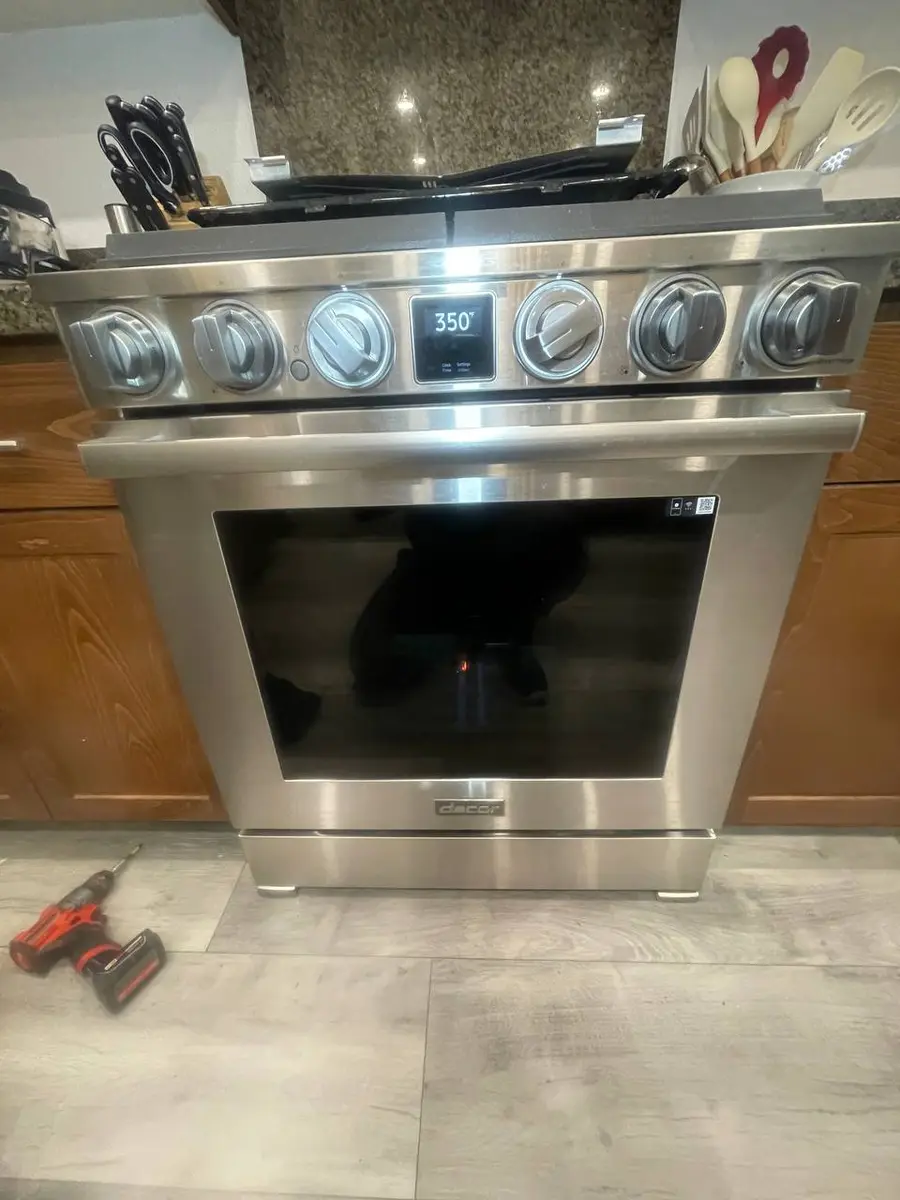
Set the oven to bake at 350°F and wait about 15 minutes. Open the door and watch the bottom element — a healthy one glows dull red while it heats. No glow at any point in the preheat means the bake circuit is down. Now select broil; if the top element glows, power and board logic are fine and the fault is isolated to bake. If neither element works, suspect the temperature sensor, the main board, or lost power such as a tripped breaker or an open thermal fuse.
2. Inspect the element#
With the breaker off and the cavity cool, pull the racks for a clear view. Look for breaks, blisters, cracks, or a burn-through hole in the metal sheath, and check the rear terminals for scorch marks. Obvious damage confirms the element with no further testing.
3. Read the element resistance#
Remove the two screws holding the element to the rear wall, ease it forward, and unplug both spade terminals. On the meter's resistance range, read across the terminals. A good 316075103 measures roughly 20–40 ohms. An open or OL reading means it burned through internally — replace it. A near-zero reading means an internal short — replace it. A normal reading sends you upstream.
4. Check for supply voltage#
If the element reads good, the board may not be feeding it. With the element unplugged, restore power, set bake at 350°F, and carefully measure the two supply wires using insulated probes on dry footing with one hand only. A full 240 volts and no heat points to an element that opens only when hot — replace it. Around 120 volts means one leg is missing, so confirm both breaker poles are on. Zero volts means the board never closed the bake relay; continue to step 5. If live testing feels unsafe, skip it and keep going with the power off.
5. Test the temperature sensor#
The board reads the sensor to decide when to energize the bake element, and an out-of-range sensor makes it refuse — often posting F30, F31, or F10. With power off, unplug the sensor's two-wire connector on the upper rear wall and read resistance: about 1,080–1,100 ohms at room temperature near 70°F. An infinite reading is open and triggers F30; a near-zero reading is shorted and triggers F31. A sensor that reads normal with no code points back at the board relay.
6. Rule out the door-lock interlock#
Self-clean models latch the door with a small motor. If the board believes the door is locked, it can block the bake element as a safety measure. Confirm the LOCK icon stays dark during normal baking and that the latch and its switch report the correct state.
7. Judge the control board#
If the element, sensor, wiring, and interlock all pass, the board's bake relay has failed. That relay is not separately serviceable, so the whole board is swapped. Bake-dead with broil-fine, no error codes, and zero volts at the element during a bake call all converge here.
Safety First — Know the Risks
Gas ovens involve live gas lines — a loose connection creates explosion and carbon monoxide risk. Electric ovens run on 240V circuits. Our techs are licensed and insured — let them handle the risk.
Licensed & Insured · 90-Day Warranty · Same-Day Service
Common Misreads#
| Assumption | Reality |
|---|---|
| The element looks fine, so it is good | Internal opens are invisible — always read resistance |
| No code means the sensor is fine | Some sensor drift never posts a code |
| New element, still no heat | The dead board relay was the real fault |
| Half the element glows | One 240-volt leg is missing — check both breaker poles |
Specifications (316075103)#
| Parameter | Value |
|---|---|
| Part number | 316075103 (cross-references 316075104) |
| Voltage | 240 volts AC |
| Wattage | 2,500–3,000 watts, model dependent |
| Resistance | 20–40 ohms |
| Mounting | Two rear-wall screws |
| Terminals | Two spade connectors |
The Real Cost of DIY
Average DIY attempt: $150-400 in tools you may use once, plus the risk of further damage. Our diagnostic visit costs $0 — we find the problem and give you an honest quote.
Licensed & Insured · 90-Day Warranty · Same-Day Service
When to Call a Pro#
Bring in a technician if you have confirmed a bad board but would rather not handle ribbon cables and wire harnesses, if the range is gas with an electric igniter (a different path through the gas safety valve and hot-surface igniter), if safe 240-volt measurement is beyond your comfort, or if the oven overheats with the element stuck on — an F10 with a welded relay contact is a safety emergency.
Appliance Repair Technician & Diagnostics Specialist · 10 years experience
Electronics and diagnostics specialist with 10 years of experience in modern smart appliance repair, specializing in LG and Samsung.