Haier is the world's largest appliance manufacturer by volume, and since acquiring GE Appliances in 2016, the brand has expanded rapidly in the US market. Haier-branded refrigerators are especially popular in apartments, dorms, and compact living spaces, though the company also produces full-size French Door and bottom-freezer models. When something goes wrong, your Haier fridge displays an alphanumeric error code on the control panel. This guide covers every known Haier refrigerator error code, what triggers it, and how to resolve it — whether you can fix it yourself or need professional help.
How Haier Refrigerator Error Codes Work#
Haier refrigerators use a sensor-driven control board that continuously monitors compressor operation, defrost cycles, fan speeds, and temperature readings. When a sensor returns a value outside normal parameters, the control board stores the fault and displays an E-code on the LED or LCD panel. On compact models without a digital display, the temperature indicator LEDs will blink in a specific pattern to signal the fault.
Before any troubleshooting: Unplug the refrigerator for 5 minutes, then plug it back in. This clears transient errors caused by power surges or brief sensor glitches. If the code returns, proceed with the specific fix below.
Do You Have the Right Tools?
Refrigerant gauges ($200+), vacuum pump ($250), leak detector ($150), and EPA-certified recovery equipment. Our technician arrives with $3,000+ in professional tools — your diagnostic is free.
Licensed & Insured · 90-Day Warranty · Same-Day Service
E1 — Freezer Temperature Sensor Fault#
The freezer compartment temperature sensor (thermistor) is reading an abnormal value — either open circuit, short circuit, or out of expected range.
Common causes:
- Failed thermistor (open or shorted internally)
- Disconnected wire harness at the sensor connector
- Corroded connector pins from moisture exposure
- Control board sensor input failure (rare)
How to fix:
- Locate the freezer thermistor — it is typically clipped to the evaporator cover inside the freezer compartment, attached by a two-wire connector.
- Unplug the refrigerator. Disconnect the thermistor wire connector and measure resistance with a multimeter. At 32°F (0°C), a working thermistor should read approximately 32,000 ohms (32kΩ). At room temperature (77°F / 25°C), it should read approximately 10,000 ohms (10kΩ). A reading of 0Ω (short) or infinite/OL (open) confirms a failed sensor.
- Inspect the wire harness for pinched, chewed, or corroded wires between the sensor and the main control board.
- Replace the thermistor if faulty. Haier refrigerator thermistors cost varies by model and region. Installation takes 15–20 minutes.
E2 — Fresh Food Temperature Sensor Fault#
Identical to E1 but for the fresh food (refrigerator) compartment sensor. The control board cannot read the correct temperature in the main compartment.
Common causes:
- Failed fresh food thermistor
- Wire harness damage between sensor and board
- Moisture intrusion at the connector (common in high-humidity environments)
How to fix:
- The fresh food thermistor is usually mounted near the top of the refrigerator compartment, behind the interior rear panel or near the air duct.
- Test with a multimeter using the same resistance values as E1 — approximately 10kΩ at 77°F.
- Replace if readings are out of spec. Part cost: varies by model and region.
Safety First — Know the Risks
Refrigerant (R-134a/R-600a) requires EPA certification to handle. Improper discharge is a federal violation and health hazard. Our techs are licensed and insured — let them handle the risk.
Licensed & Insured · 90-Day Warranty · Same-Day Service
E3 — Defrost Sensor Fault#
The defrost temperature sensor (mounted on or near the evaporator coils) is reporting an abnormal reading. This sensor tells the control board when the defrost cycle should end.
Common causes:
- Failed defrost thermistor or bi-metal thermostat
- Ice buildup around the sensor causing false readings
- Disconnected sensor wire
How to fix:
- Remove the evaporator cover inside the freezer (usually held by screws or clips). The defrost sensor is attached to the evaporator coil assembly, often near the top.
- If the evaporator is covered in thick ice (more than a thin frost layer), the defrost system has been failing. Manually defrost by leaving the refrigerator unplugged with doors open for 12–24 hours, with towels to catch water.
- Test the defrost sensor with a multimeter. Expected resistance is approximately 10kΩ at room temperature.
- Check the defrost heater — a glass tube or calrod element running along the evaporator. It should read 20–40Ω of resistance. An open reading means the heater is burned out.
Part cost: Defrost sensor varies by part defrost heater varies by part. Professional defrost system repair varies by model and repair complexity.
E4 — Evaporator Fan Motor Fault#
The evaporator fan (inside the freezer) is not running or is running too slowly. This fan circulates cold air from the evaporator coils throughout both the freezer and fresh food compartments.
Common causes:
- Ice buildup around the fan blades preventing rotation
- Failed fan motor (burned out windings)
- Disconnected fan motor wiring
- Blocked air duct restricting airflow
How to fix:
- Open the freezer and listen — you should hear the evaporator fan running when the door is closed (many models have a door switch that stops the fan when the door opens; press the door switch manually to test).
- If the fan is not spinning, unplug the refrigerator and remove the evaporator cover. Check for ice buildup around the fan blades. Clear any ice and allow the area to defrost.
- Spin the fan blade by hand. It should rotate freely. If it is stiff or seized, the motor bearings are worn and the motor needs replacement.
- Test the fan motor electrically — it should draw 12V DC and read approximately 200–400Ω across the motor terminals.
Part cost: Evaporator fan motor varies by part. A common repair that takes about 30 minutes.
The Real Cost of DIY
Average DIY attempt: $150-400 in tools you may use once, plus the risk of further damage. Our diagnostic visit costs $0 — we find the problem and give you an honest quote.
Licensed & Insured · 90-Day Warranty · Same-Day Service
E5 — Condenser Fan Motor Fault#
The condenser fan (located near the compressor at the bottom or rear of the unit) is not running. This fan cools the condenser coils and the compressor itself.
Common causes:
- Failed condenser fan motor
- Debris (dust, pet hair) jamming the fan blades
- Disconnected motor wiring at the connector
How to fix:
- Pull the refrigerator away from the wall. Remove the rear access panel or the bottom front grille (depending on model) to access the condenser fan.
- Clean accumulated dust, lint, and pet hair from the fan blades and the condenser coils using a vacuum with a brush attachment or a condenser coil brush (varies by model and region at hardware stores).
- Spin the fan blade by hand. If it is seized, replace the motor.
- Check the motor electrically with a multimeter.
Part cost: Condenser fan motor varies by part. Cleaning the condenser coils is free and should be done every 6–12 months as preventive maintenance.
E6 — Communication Error Between Boards#
The main control board and the display/UI board are not communicating properly. This is a data link failure between the two PCBs.
Common causes:
- Loose ribbon cable or wire harness between the control board (usually at the rear bottom) and the display board (usually at the top front)
- Failed control board or display board
- Power surge damage to one or both boards
How to fix:
- Unplug the refrigerator. Locate both boards and reseat all wire connectors firmly. The ribbon cable connecting them often runs through the door hinge area on French Door models and can get pinched.
- Inspect connectors for burn marks, corrosion, or bent pins.
- If reseating connectors does not resolve the issue, a board replacement is needed. Determine which board is faulty by checking if the display responds to button presses (if yes, the display board is likely fine — the main control board is suspect).
Part cost: Main control board varies by part display board varies by part. Professional board diagnosis and replacement varies by model and repair complexity.
Don't Void Your Warranty
Opening your appliance yourself may void the manufacturer warranty. Our repair comes with a 90-day guarantee, and we document everything for warranty compliance.
Licensed & Insured · 90-Day Warranty · Same-Day Service
E7 — Compressor Overload / High Temperature#
The compressor is running but not cooling, or the compressor is overheating and triggering the overload protector.
Common causes:
- Dirty condenser coils causing the compressor to overheat
- Failed compressor start relay or overload protector
- Low refrigerant charge (sealed system leak)
- Compressor motor failure (locked rotor or weak windings)
- Ambient temperature too high for the rated operating range
How to fix:
- Clean the condenser coils thoroughly (see E5 instructions). Dirty coils are the most common cause of compressor overheating.
- Check the compressor start relay — it is a small device plugged into the compressor terminals at the rear. Remove it and shake it. If it rattles, the internal contacts have broken loose and the relay must be replaced (varies by model and region).
- Listen to the compressor. If it hums for a few seconds and then clicks off, the start relay or overload may be faulty. If it runs continuously but the unit is warm, the refrigerant charge may be low (sealed system repair requiring EPA-certified technician).
- Compressor replacement on a Haier refrigerator typically cost varies by model and region with labor. For compact models a certain threshold retail, replacement may not be economical.
E8 — Ice Maker Fault (Models with Ice Maker)#
The ice maker assembly is reporting a malfunction — either the motor, the water inlet, or the harvest sensor is not responding correctly.
Common causes:
- Frozen water supply line to the ice maker
- Failed ice maker motor or ejector mechanism
- Water inlet valve not opening (solenoid failure)
- Ice maker thermostat/sensor failure
How to fix:
- Check the water supply — ensure the water line behind the refrigerator is connected and the supply valve is fully open.
- Inspect the fill tube (the small tube that delivers water to the ice maker tray). If it is frozen, use a hair dryer on low heat to thaw it. A frozen fill tube often indicates a defrost problem or a faulty fill tube heater.
- Manually trigger an ice harvest cycle by pressing and holding the ice maker test button for 3 seconds. If the motor does not activate, the ice maker module may need replacement.
Part cost: Ice maker assembly varies by part. Water inlet valve varies by part.
Is It Worth Your Time?
Diagnosing a cooling issue requires testing the compressor, start relay, thermostat, condenser fan, and defrost system — 4-6 hours of DIY research and testing. Our technician diagnoses the issue in about 30 minutes — same-day appointments available.
Licensed & Insured · 90-Day Warranty · Same-Day Service
E9 — Door Ajar / Door Switch Fault#
The control board believes a door is open even though it appears closed, or the door switch is not registering the door position correctly.
Common causes:
- Misaligned door (sagging hinges not holding the door flush against the gasket)
- Worn or torn door gasket not creating a proper seal
- Failed door switch
- Magnetic gasket losing magnetism
How to fix:
- Close the door and check for gaps between the door gasket and the cabinet. Place a dollar bill between the gasket and the frame, close the door, and try to pull it out. If the bill slides out easily, the gasket seal is inadequate.
- Inspect the door gasket for tears, cracks, or deformation. Replace if damaged — gaskets cost varies by model and region depending on the model and door size.
- Check door alignment by loosening the top hinge bolts, repositioning the door so it sits flush, and retightening. On French Door models, both doors must be level with each other.
- Test the door switch with a multimeter — it should show continuity when pressed (door closed) and open circuit when released.
E0 — Control Board Fault#
A general control board self-test failure. The main PCB has detected an internal error that does not map to a specific sensor or component.
Common causes:
- Power surge damage to the board
- Failed capacitor or relay on the control board
- Firmware corruption (rare, typically after a severe power event)
- Water damage to the board from a leak above
How to fix:
- Perform a hard reset: unplug for 10 minutes, then plug back in. If E0 clears and the unit operates normally, the error was transient.
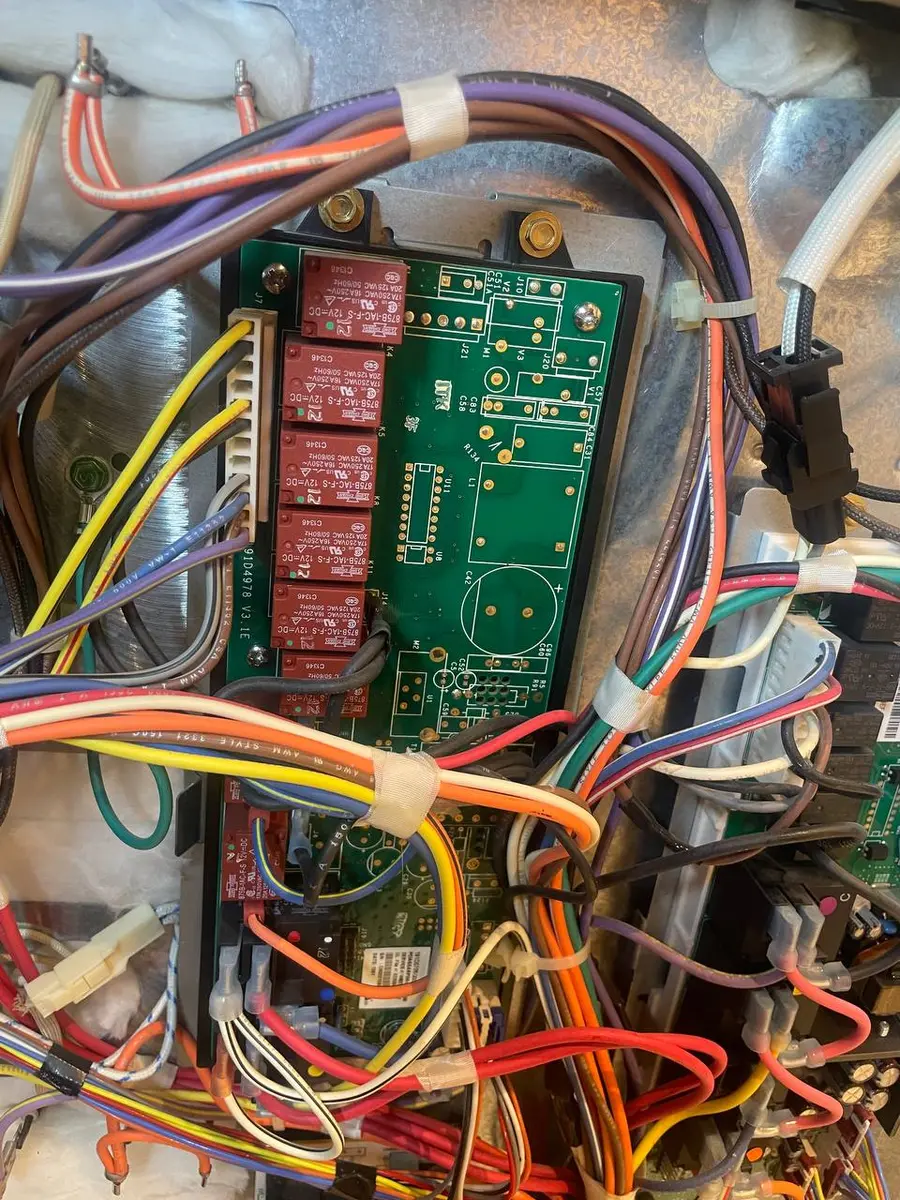
- If E0 persists, inspect the main control board for visible damage — swollen or leaking capacitors, burn marks on traces, or corroded solder joints. The board is usually located behind a rear panel at the bottom of the unit.
- Board replacement is typically the only fix. Haier main control boards cost varies by model and region depending on the model.
The Risk of Getting It Wrong
A wrong diagnosis often turns a simple fix into a costly replacement. Without proper diagnostic tools, you might replace the wrong part — or cause additional damage. Our free diagnostic eliminates the guesswork.
Licensed & Insured · 90-Day Warranty · Same-Day Service
Haier Refrigerator Diagnostic Mode#
Haier refrigerators have a built-in service diagnostic mode:
- Enter diagnostic mode: With the refrigerator plugged in, press and hold the freezer temperature button and the fresh food temperature button simultaneously for 5 seconds. The display will show the current firmware version and then cycle through stored error codes.
- Read error history: The control board stores the last 5–10 error codes even after a reset. This is valuable for identifying intermittent issues.
- Forced defrost mode: Press the freezer temp button 4 times within 8 seconds. This forces a manual defrost cycle — useful for diagnosing E3/E4 issues caused by ice buildup.
- Compressor test: In diagnostic mode, the system will cycle through compressor-on and fan-on tests automatically.
Haier-Specific Considerations#
GE Appliances connection: Since Haier owns GE Appliances, some Haier models share components and control boards with GE, Hotpoint, and Café branded refrigerators. If you cannot find a Haier-specific part, check the GE Appliances parts catalog using the same part number — there is often a cross-reference.
Compact model limitations: Haier's popular compact refrigerators (2.7–4.5 cu ft) have simpler control systems with fewer sensors. These models typically only display E1 and E2 codes. If the compressor fails on a compact unit (retail price varies by model and region), replacement is usually not economical — the compressor repair cost often exceeds the unit's value.
Parts sourcing: Haier parts can be more difficult to source than mainstream US brands. Authorized parts distributors include Encompass Parts, Reliable Parts, and GE Appliances Parts (parts.geappliances.com). Expect 5–10 business day shipping for some components. Aftermarket alternatives exist for common parts like thermistors and fan motors.
Warranty coverage: Haier offers a 1-year full parts and labor warranty on most models, with a 5-year limited warranty on the sealed system (compressor, evaporator, condenser) covering parts only. Keep your purchase receipt — warranty claims require proof of purchase date.
Free Diagnostic Visit — Zero Risk
Our certified technician comes to your home, diagnoses the problem with professional tools, and gives you an honest quote — all at zero cost. No parts markup, no hidden fees. If you decide not to proceed, you pay nothing.
Licensed & Insured · 90-Day Warranty · Same-Day Service
Frequently Asked Questions#
Q: How do I reset my Haier refrigerator after an error code? A: Unplug the refrigerator from the wall outlet for 5 minutes, then plug it back in. This clears most transient error codes. If the code returns after the reset, the underlying component issue needs to be addressed. On models with a reset button on the control panel, press and hold it for 3 seconds after power is restored.
Q: My Haier fridge shows E1 but the temperature seems fine. Should I worry? A: Yes. Even if the temperature appears normal now, an E1 code means the freezer thermistor is giving unreliable readings. The control board cannot accurately regulate temperature without a working sensor, which can lead to food freezing in the fresh food section or insufficient cooling in the freezer. Replace the thermistor before the problem worsens.
Q: Are Haier refrigerator parts compatible with GE parts? A: In many cases, yes. Since Haier acquired GE Appliances, many components are shared across brands. Check the part number stamped on your existing component and search it on both Haier and GE parts websites. Cross-reference databases on sites like RepairClinic and AppliancePartsPros can identify equivalent parts across brands.
Q: Why does my Haier fridge run constantly but not cool properly? A: Continuous running without adequate cooling typically indicates one of three issues: dirty condenser coils restricting heat dissipation (clean them), a failing compressor that cannot build sufficient pressure (listen for unusual clicking or humming), or a refrigerant leak in the sealed system (requires EPA-certified technician). Start with cleaning the condenser coils — this resolves about 40% of these cases.
Q: Is it worth repairing a Haier compact refrigerator? A: For compact models (under 5 cu ft) retailing at varies by model and region the repair math is straightforward: if the estimated repair cost exceeds 50% of the replacement cost, buy a new unit. Thermistor and fan motor replacements (varies by model and region total) are worth doing. Compressor or sealed system repairs (significant cost) are not economical on compact units.
When to Call a Professional#
While many Haier refrigerator error codes point to simple fixes like cleaning coils or replacing a $15 sensor, some situations require professional service:
- E7 with no cooling — Sealed system diagnostics and refrigerant work require EPA 608 certification and specialized equipment.
- E6 with board failure — Control board diagnosis and replacement requires electronic expertise to avoid misdiagnosis (replacing the wrong board wastes varies by model and region).
- Persistent E3 with repeated ice buildup — Recurring defrost failures often indicate multiple component issues (heater + timer/board + drain) that need systematic diagnosis.
- Any refrigerant odor or oil stains — These indicate a sealed system leak that must be repaired by a certified technician.
- Compressor not starting — While the start relay is a cheap DIY fix, a locked rotor or failed compressor requires professional tools and recovery equipment.
Dealing with a Haier refrigerator error code you cannot resolve? EasyBear technicians are trained on Haier and GE Appliances product lines and carry common replacement parts in stock. We offer free diagnostic visits — our tech identifies the exact cause, explains your options, and in most cases completes the repair on the same visit. Every repair is backed by our 90-day parts and labor warranty. Schedule your free diagnosis today.
Lead Appliance Repair Technician · 12 years experience
Experienced technician with 12 years specializing in washing machine and dryer repairs across all major brands.