Short answer: a dryer averages 10-14 years, and its parts give out on a predictable schedule — the thermal fuse first (years 2-4), the heating element or igniter by 4-7, and the control board or motor in the final stretch. Knowing the curve tells you what to budget for and when replacement beats one more fix.
Premium models reach the top of that 10-14 range; budget units sit near the bottom. Steady maintenance moves every milestone 2-4 years in your favor, so the biggest variable is not the badge on the door — it is how the machine is cared for.
Which dryer brands hold up best?#
Dryers show the least brand-to-brand spread of any major appliance, but the tiers are still real:
| Brand | How it tracks the curve | Standout |
|---|---|---|
| Miele | Failures shift 2-4 years later | Heat-pump models all but eliminate heating-element failure |
| Whirlpool / Maytag | Follows the standard timeline | Most reliable mainstream choice |
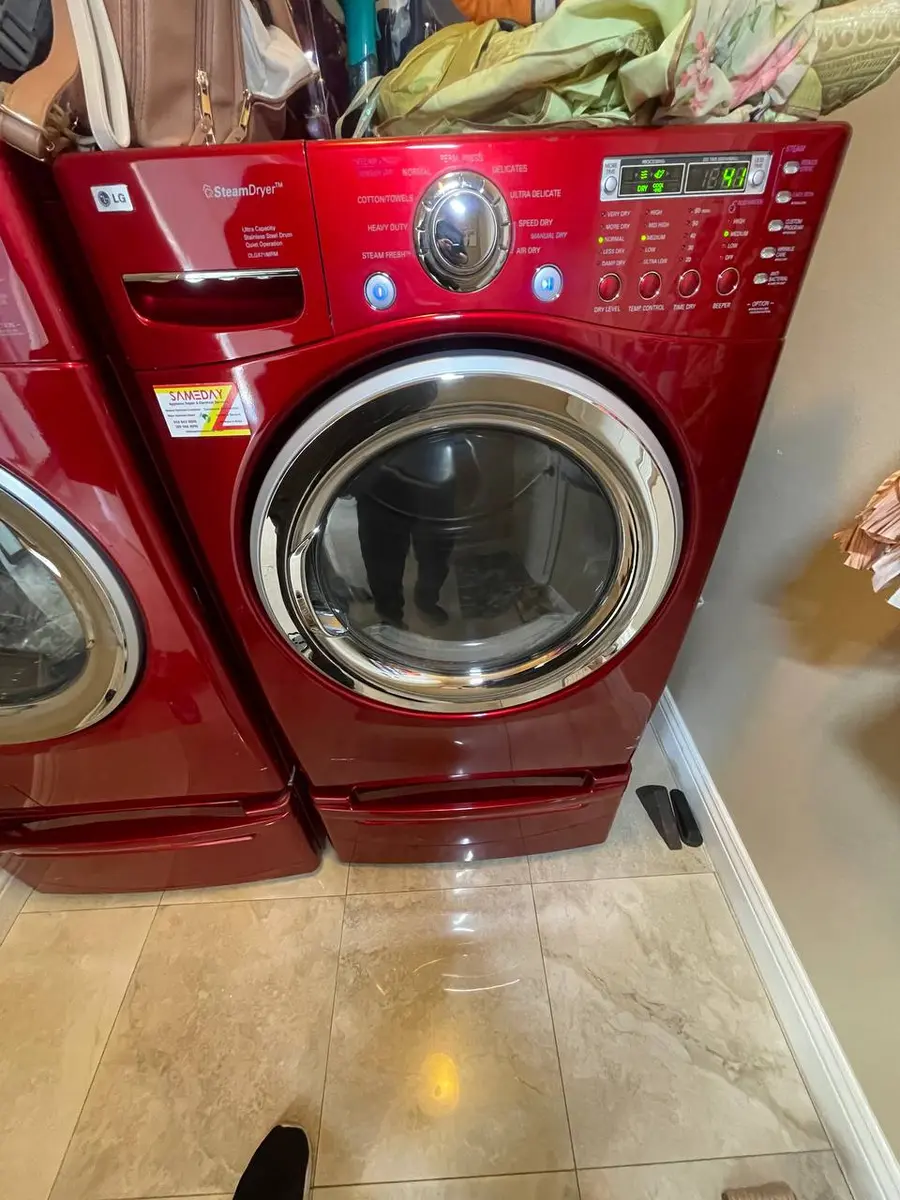
| Samsung / LG | Tracks the standard timeline closely | Smallest variation of any dryer category |
Do You Have the Right Tools?
Gas leak detector ($130), thermal fuse tester ($95), belt tension gauge, and vent inspection camera ($180). Our technician arrives with $3,000+ in professional tools — your diagnostic is free.
Licensed & Insured · 90-Day Warranty · Same-Day Service
The failure timeline, part by part#
| Age | Most likely failure | Frequency |
|---|---|---|
| 0-2 years | Manufacturing defects (warranty) | Rare |
| 2-4 years | Thermal fuse | Very common |
| 3-5 years | Drum belt | Common |
| 3-5 years | Gas valve coils (gas dryers) | Common |
| 4-7 years | Heating element / igniter | Very common |
| 5-8 years | Drum roller(s) | Common |
| 6-9 years | Idler pulley | Common |
| 7-10 years | Control board | Occasional |
| 9-13 years | Motor | Occasional |
Early years: cheap parts, one recurring cause#
The thermal fuse headlines years 2-4. It is a safety device that blows when the dryer overheats, and the overheating almost always traces to restricted airflow from a clogged exhaust vent. Swap the fuse without clearing the vent and it will blow again — the airflow problem, not the fuse, is the real fault. A squealing drum belt (years 3-5) is the other early complaint, and the squeal is your cue to act before the belt snaps mid-cycle.
Safety First — Know the Risks
Gas dryers carry carbon monoxide and explosion risk. Even electric dryers involve 240V circuits that can deliver a fatal shock. Our techs are licensed and insured — let them handle the risk.
Licensed & Insured · 90-Day Warranty · Same-Day Service
Middle years: the parts that heat and turn#
Heating elements and igniters (years 4-7) take the hardest wear; heavy use plus poor airflow speeds up burnout, and annual vent cleaning is the cheapest way to stretch element life. Drum rollers and the idler pulley follow through years 5-9 — ordinary wear items a technician can swap in a single visit. Their first symptom is usually noise rather than failure: a rumble or thump from the rollers, a squeal from the pulley.
Late years: electronics, then the motor#
Control boards (years 7-10) are surge-sensitive, so a surge protector is a cheap hedge against a power spike taking out the priciest small part in the machine. The motor is the last major component to go, usually between years 9 and 13, and it rarely fails silently — expect a loud noise, a burning smell, or intermittent running well before it stops for good.
The Real Cost of DIY
Average DIY attempt: $150-400 in tools you may use once, plus the risk of further damage. Our diagnostic visit costs $0 — we find the problem and give you an honest quote.
Licensed & Insured · 90-Day Warranty · Same-Day Service
Gas and electric wear differently#
Electric dryers live and die by the heating element; gas models add an igniter and gas valve coils (years 3-5) to the list of things that can go. Either way, the first thing you notice is the same — longer drying times, with clothes still damp after a full cycle. That points to a weakening element or igniter, or to restricted airflow, and acting on it early is far cheaper than waiting for a complete no-heat breakdown.
None of the turning-part noises is an emergency, but a worn part left alone grinds up its neighbors and turns one cheap fix into a stacked repair. This is why the mid-life window matters: on a well-kept dryer, failures that would land at year 5 often hold off until year 7-8, and that single shift is what stretches total lifespan from 10 years toward 14.
What maintenance actually buys you#
Two habits push the whole timeline 2-4 years later: emptying the lint trap after every load and clearing the exhaust vent once a year. That is the gap between a dryer that wears out at 10 and one that runs past 14, and it lifts overall lifespan by roughly 20-30%.
Don't Void Your Warranty
Opening your appliance yourself may void the manufacturer warranty. Our repair comes with a 90-day guarantee, and we document everything for warranty compliance.
Licensed & Insured · 90-Day Warranty · Same-Day Service
Repair or replace?#
- Under 5 years: repair — plenty of life remains.
- 5-10 years: repair if the quote is under 50% of a new unit and this is only your first or second major fix.
- 10-14 years: repair simple, in-budget faults only; major parts tip toward replacement.
- Over 14 years: replace — another failure is likely within a year or two even after a fix.
Once a single repair crosses 50% of a new dryer's price on a unit past its tenth year, replacement is the smarter money. Not sure which stage yours is in? Book a diagnostic and get the exact part and its remaining life.
Appliance Repair Technician & Diagnostics Specialist · 10 years experience
Electronics and diagnostics specialist with 10 years of experience in modern smart appliance repair, specializing in LG and Samsung.