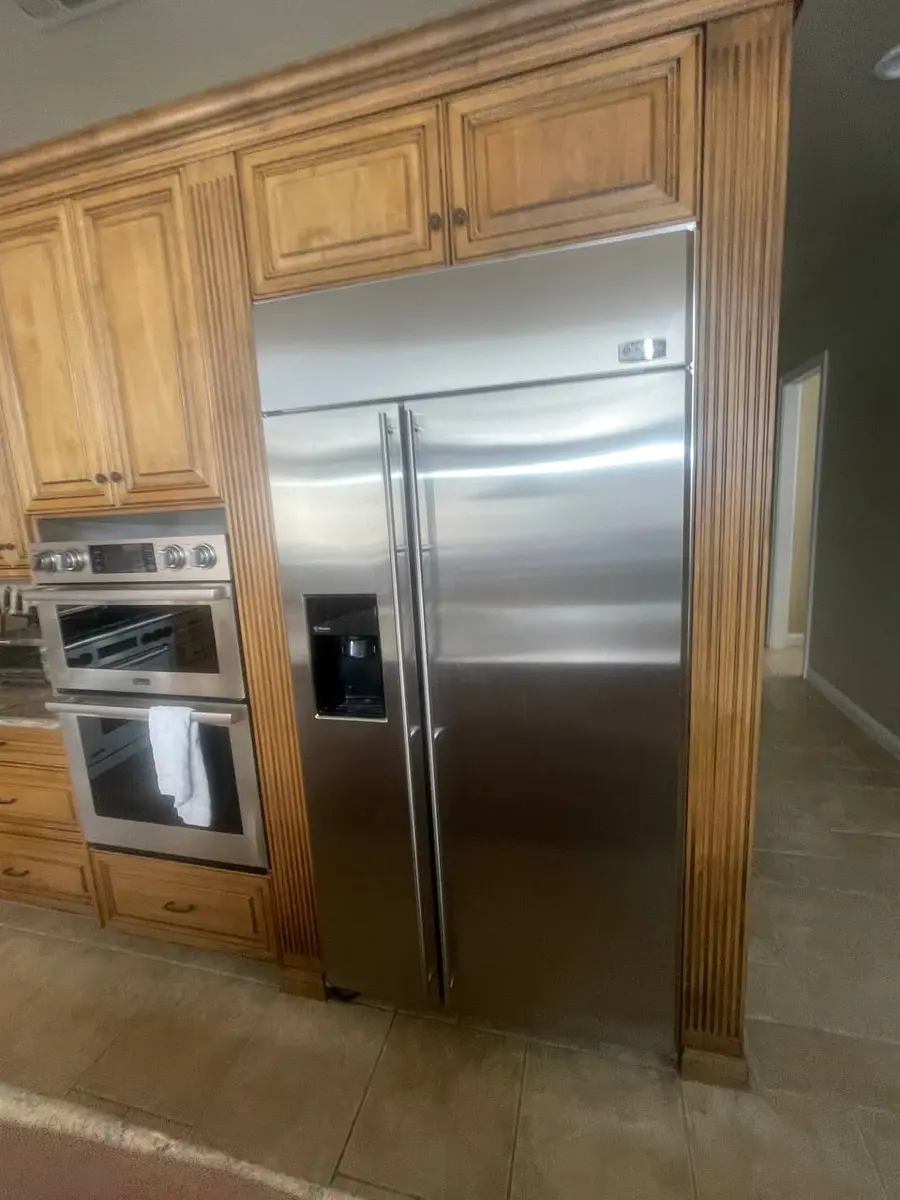
Bertazzoni refrigerators — the Professional REF36X, Heritage REF36HERB, and Master REF31BMX series — bring Italian luxury design to kitchen refrigeration at price points between $4,000 and $9,500. These counter-depth French door and bottom-freezer models use Embraco/Aspera compressors and electronic control boards that communicate failures through error codes displayed on the front panel. When a Bertazzoni refrigerator shows an error code, understanding it quickly matters — food safety is at stake, and luxury appliance service calls typically cost varies by model and region. This guide covers every Bertazzoni refrigerator error code with professional-level diagnostics.
How Bertazzoni Refrigerator Error Codes Work#
Bertazzoni refrigerators display error codes on the temperature display panel. On Professional and Heritage series with LCD displays, codes appear as "E" followed by a number (E1–E9). On older Master series models with LED segment displays, the code may show as a flashing number sequence. The control board monitors compressor operation, evaporator and condenser temperature sensors (NTC thermistors), defrost heater circuits, fan motors, and door switch status.
Important: Bertazzoni refrigerators continue attempting to cool even when displaying an error code (unlike dishwashers or ovens that halt operation). The error indicates degraded performance, not complete shutdown — your food may still be safe depending on when the error started. Check internal temperatures with a separate thermometer immediately.
To reset most Bertazzoni refrigerator error codes:
- Unplug the refrigerator from the wall outlet (or switch off the breaker).
- Wait 5 minutes (the compressor needs time to equalize refrigerant pressure).
- Plug back in.
- Monitor for 30 minutes — if the error returns, the underlying issue persists.
Do You Have the Right Tools?
Refrigerant gauges ($200+), vacuum pump ($250), leak detector ($150), and EPA-certified recovery equipment. Our technician arrives with $3,000+ in professional tools — your diagnostic is free.
Licensed & Insured · 90-Day Warranty · Same-Day Service
E1 — Fresh Food Compartment Sensor Error#
The NTC temperature sensor for the fresh food (refrigerator) compartment is reading out of range — either shorted, open circuit, or reporting impossible temperatures.
Common causes:
- NTC thermistor failure (drift or complete failure after thermal cycling)
- Sensor wire pinched by drawer slides or ice tray (common on Bertazzoni models where the sensor wire routes near the deli drawer track)
- Connector corrosion at the control board (moisture migration from inside the cabinet)
- Sensor displaced from its mounting clip (reads air temperature instead of wall temperature)
How to fix:
- Locate the sensor: On Professional/Heritage models, the fresh food sensor is clipped to the rear wall of the refrigerator compartment, near the top behind the air distribution vent cover. Remove the vent cover (2 screws) to access it.
- Measure sensor resistance: Disconnect the sensor leads. At 37F (normal fridge temp), the NTC sensor should read approximately 7,000–10,000 ohms (7–10k). At room temperature (72F), expect 3,000–5,000 ohms. An open circuit (infinite) or zero ohms indicates sensor failure.
- Inspect the wire path: Trace the sensor wire from the sensor to where it exits the cabinet. On Bertazzoni models, the wire routes along the top of the liner and down the right side. Check for pinch points at drawer slide mountings.
- Check the connector: At the control board (usually accessed by removing the top cover of the refrigerator), verify the connector is seated and free of corrosion.
Part cost: NTC temperature sensor varies by part. Professional repair varies by part.
E2 — Freezer Compartment Sensor Error#
The NTC sensor for the freezer compartment is reading out of range.
Common causes:
- Freezer NTC thermistor failure
- Sensor wire damaged by frost heave (ice buildup pushing the wire against sharp edges)
- Sensor coated in ice (frost accumulation around the sensor changes its reading)
- Connector issue at control board
How to fix:
- Locate the sensor: The freezer sensor is typically mounted to the rear wall of the freezer compartment, behind the evaporator cover panel. Remove the freezer drawers and the rear cover panel (4–6 screws) to access it.
- Measure resistance: At 0F (normal freezer temp), expect 15,000–25,000 ohms (15–25k). At room temperature, expect 3,000–5,000 ohms (same NTC type as the fresh food sensor).
- Check for ice encapsulation: If the sensor is encased in ice, the evaporator area has a defrost problem. Clear the ice, but also investigate why defrost is failing (see E5).
- Inspect wiring: Freezer sensor wires are exposed to more extreme conditions. Look for cracked insulation, green corrosion at connectors, or wires pulled from terminals by ice buildup.
Part cost: Freezer NTC sensor varies by part. Professional repair varies by part.
Safety First — Know the Risks
Refrigerant (R-134a/R-600a) requires EPA certification to handle. Improper discharge is a federal violation and health hazard. Our techs are licensed and insured — let them handle the risk.
Licensed & Insured · 90-Day Warranty · Same-Day Service
E3 — Evaporator Sensor Error#
The evaporator coil temperature sensor is reporting abnormal readings. This sensor monitors the evaporator itself (not the compartment air) to control defrost timing and detect icing conditions.
Common causes:
- Evaporator sensor NTC failure
- Sensor physically detached from the evaporator tube (should be in thermal contact with a specific tube in the coil)
- Ice completely encasing the sensor and evaporator (defrost system failure — see E5)
- Wire harness routed too close to defrost heater (heat damage during defrost cycles)
How to fix:
- Access the evaporator: Remove the freezer drawers and the rear panel inside the freezer. The evaporator coil is the finned aluminum structure behind this panel.
- Inspect visually: If the entire evaporator is covered in thick frost or ice, the defrost system has failed. The evaporator sensor will read incorrectly when encased in ice. Resolve the defrost issue first (see E5 below).
- Check sensor mounting: The evaporator sensor must be clipped to a specific tube on the evaporator coil (usually marked with a colored clip or tape from the factory). If it has fallen off, it reads air temperature instead of evaporator tube temperature — causing incorrect defrost timing.
- Measure resistance: At evaporator operating temperature (-10F to 5F), expect 20,000–40,000 ohms.
Part cost: Evaporator sensor varies by part. Professional repair varies by part (often involves defrost system diagnosis).
E4 — Compressor Start Failure#
The control board attempted to start the compressor but did not detect the expected current draw, indicating the compressor did not start.
Common causes:
- Failed compressor start relay (PTC or electronic start device)
- Compressor overload protector tripped (thermal protection from overheating)
- Compressor motor winding failure (locked rotor)
- Low voltage at the outlet (compressor needs minimum 200V on 240V models, or 105V on 120V models)
- Failed inverter board (on variable-speed compressor models)
How to fix:
- Listen at startup: When the compressor should start, listen carefully. A clicking sound every few minutes followed by silence = start relay or overload protector cycling. A humming that lasts 5–10 seconds then stops = locked rotor or mechanical seizure.
- Check the start relay: On Bertazzoni Professional/Heritage models, the start relay is mounted directly on the compressor terminal pins at the rear bottom of the unit. Pull it off (unplug the refrigerator first). Shake it gently — if you hear a rattle, the internal component has broken free and the relay needs replacement.
- Test compressor windings: With the relay and overload removed, measure resistance between the 3 compressor pins (Common, Start, Run). Common-to-Run should be 3–8 ohms, Common-to-Start should be 8–20 ohms, Start-to-Run should equal the sum of the other two. If any reading is open or near zero, the compressor has failed.
- Check voltage: Measure voltage at the wall outlet while a high-draw appliance (like a hair dryer) is running on the same circuit. If voltage drops below 105V (120V circuit) or 200V (240V circuit), the circuit is undersized.
Part cost: Compressor start relay varies by part. Overload protector varies by part. Inverter board varies by part. Compressor replacement varies by part (parts + refrigerant recharge). Professional repair varies by part depending on root cause.
The Real Cost of DIY
Average DIY attempt: $150-400 in tools you may use once, plus the risk of further damage. Our diagnostic visit costs $0 — we find the problem and give you an honest quote.
Licensed & Insured · 90-Day Warranty · Same-Day Service
E5 — Defrost System Error#
The defrost cycle is not completing successfully. The control board either detects that the evaporator temperature did not rise above 40F during defrost, or that the defrost heater did not draw expected current.
Common causes:
- Defrost heater burned out (open circuit)
- Defrost thermostat (bi-metal or thermal fuse) failed open — stuck in "cold" position, preventing heater activation
- Defrost timer/control board defrost relay failure (not sending power to heater)
- Evaporator sensor failed (unable to detect that defrost is complete — overlaps with E3)
How to fix:
- Check the evaporator: Remove freezer drawers and rear panel. If the evaporator is completely iced over (thick ice blocking airflow), the defrost system has been failing for multiple cycles. Manually defrost by leaving the door open for 8–12 hours with towels underneath, or use a hair dryer on low heat (never use sharp tools to chip ice — you'll puncture the evaporator tube).
- Test the defrost heater: With the refrigerator unplugged, locate the defrost heater (glass tube or calrod element mounted below or behind the evaporator). Measure resistance — expect 20–50 ohms. Open circuit = heater burned out.
- Test the defrost thermostat: Located on the evaporator tube, this bi-metal switch should be closed (0 ohms/continuity) when the evaporator is below 32F. If it reads open at freezing temperatures, it has failed.
- Test the thermal fuse: Some Bertazzoni models have a thermal fuse in series with the defrost heater. This is a one-shot device — if it has blown (open circuit), replace it. The fuse blows as a safety backup when the thermostat fails to open.
Part cost: Defrost heater varies by part. Defrost thermostat varies by part. Thermal fuse varies by part. Professional repair varies by part.
E6 — Condenser Fan Motor Error#
The condenser fan (located near the compressor at the rear bottom of the unit) is not running when the compressor is active.
Common causes:
- Condenser fan motor failure (seized bearings or burned winding)
- Fan blade obstructed (debris pulled through the condenser coils, or wiring caught in the blade)
- Fan motor wiring disconnected
- Control board fan relay failure
How to fix:
- Access the condenser fan: Pull the refrigerator away from the wall. Remove the rear lower access panel (usually a few screws or clips). The condenser fan is mounted near the compressor, often in a shroud directing air across the condenser coils.
- Check for obstructions: Spin the fan blade by hand. It should rotate freely. Look for dust buildup, debris, or wiring that may be contacting the blade. Pet hair and lint are the most common obstructions on Bertazzoni bottom-mounted condensers.
- Test the motor: Disconnect the fan motor leads and measure winding resistance — expect 50–200 ohms. If open, the motor has failed. If resistance is normal, check for 120V at the connector when the compressor is running.
- Clean condenser coils: While you have access, vacuum or brush the condenser coils. Dirty condenser coils cause the compressor to overheat and work harder, contributing to premature fan motor failure.
Part cost: Condenser fan motor varies by part. Professional repair varies by part.
Don't Void Your Warranty
Opening your appliance yourself may void the manufacturer warranty. Our repair comes with a 90-day guarantee, and we document everything for warranty compliance.
Licensed & Insured · 90-Day Warranty · Same-Day Service
E7 — Evaporator Fan Motor Error#
The evaporator fan (inside the freezer or fresh food compartment, behind the rear panel) is not operating. This fan circulates cold air from the evaporator throughout the compartments.
Common causes:
- Fan motor failure (common after 5–7 years — bearings wear in cold environment)
- Ice buildup around the fan blade (defrost issue causing ice to reach the fan area)
- Fan blade cracked or missing (Bertazzoni uses plastic fan blades that can become brittle from cold)
- Control board not sending power to fan
- Door switch stuck open (fan is wired to stop when door is open — stuck switch = fan never runs)
How to fix:
- Listen with the door closed: The evaporator fan should run whenever the compressor is running and the door is closed. If you hear the compressor but no fan sound from inside, confirm by pressing and holding the door switch (simulates closed door) — you should hear the fan start.
- Check for ice: Open the freezer, remove drawers, and remove the rear panel. Look for ice buildup around the fan. If ice has reached the fan area, a defrost problem is the root cause (see E5).
- Test the motor: Disconnect the fan motor (two wire leads) and measure resistance — expect 30–150 ohms. If the motor is seized (fan blade won't spin by hand) or winding is open, replace it.
- Check the door switch: Press the door switch manually. If the fan starts, the switch may be misaligned or failing intermittently.
Part cost: Evaporator fan motor varies by part. Professional repair varies by part.
E8 — Door Alarm / Door Switch Error#
The door has been open beyond the alarm timeout (typically 2 minutes), or the door switch is reporting an impossible state (door simultaneously open and closed).
Common causes:
- Door genuinely left ajar (gasket not sealing due to food containers or debris)
- Door gasket torn or deformed (not making full contact with cabinet)
- Door switch mechanical failure
- Door hinge sagging (heavy door + full bins pull the door out of alignment)
- Magnetic gasket demagnetized in sections (rare but possible on older units)
How to fix:
- Check the obvious: Ensure the door is fully closed. Check that no food containers, bags, or ice trays are preventing full closure.
- Inspect the gasket: Close the door on a dollar bill at various points around the perimeter. You should feel resistance when pulling the bill out. If the bill slides freely at any point, the gasket is not sealing there.
- Check door alignment: Look at the door from the front — it should be parallel to the cabinet. If the top or bottom is angled away, the hinge may need adjustment. Bertazzoni Professional models have adjustable hinges (hex wrench adjustment at top hinge).
- Test the door switch: Press the switch manually and release. You should hear/feel a distinct click. If the switch is mushy or doesn't click, replace it.
Part cost: Door gasket varies by part. Door switch varies by part. Hinge kit varies by part. Professional repair varies by part.
Is It Worth Your Time?
Diagnosing a cooling issue requires testing the compressor, start relay, thermostat, condenser fan, and defrost system — 4-6 hours of DIY research and testing. Our technician diagnoses the issue in about 30 minutes — same-day appointments available.
Licensed & Insured · 90-Day Warranty · Same-Day Service
E9 — Communication / Control Board Error#
A general communication fault between the main control board and the display/UI board. This is a catch-all code for internal communication failures.
Common causes:
- Ribbon cable between main board and display board loose or damaged
- Main control board failure (capacitor degradation, relay failure)
- Display board failure
- Power surge damage to communication circuits
- Moisture intrusion at board connectors (condensation from temperature differential)
How to fix:
- Power cycle thoroughly: Unplug for 10 minutes (longer than standard reset). Communication errors sometimes resolve after a full capacitor discharge.
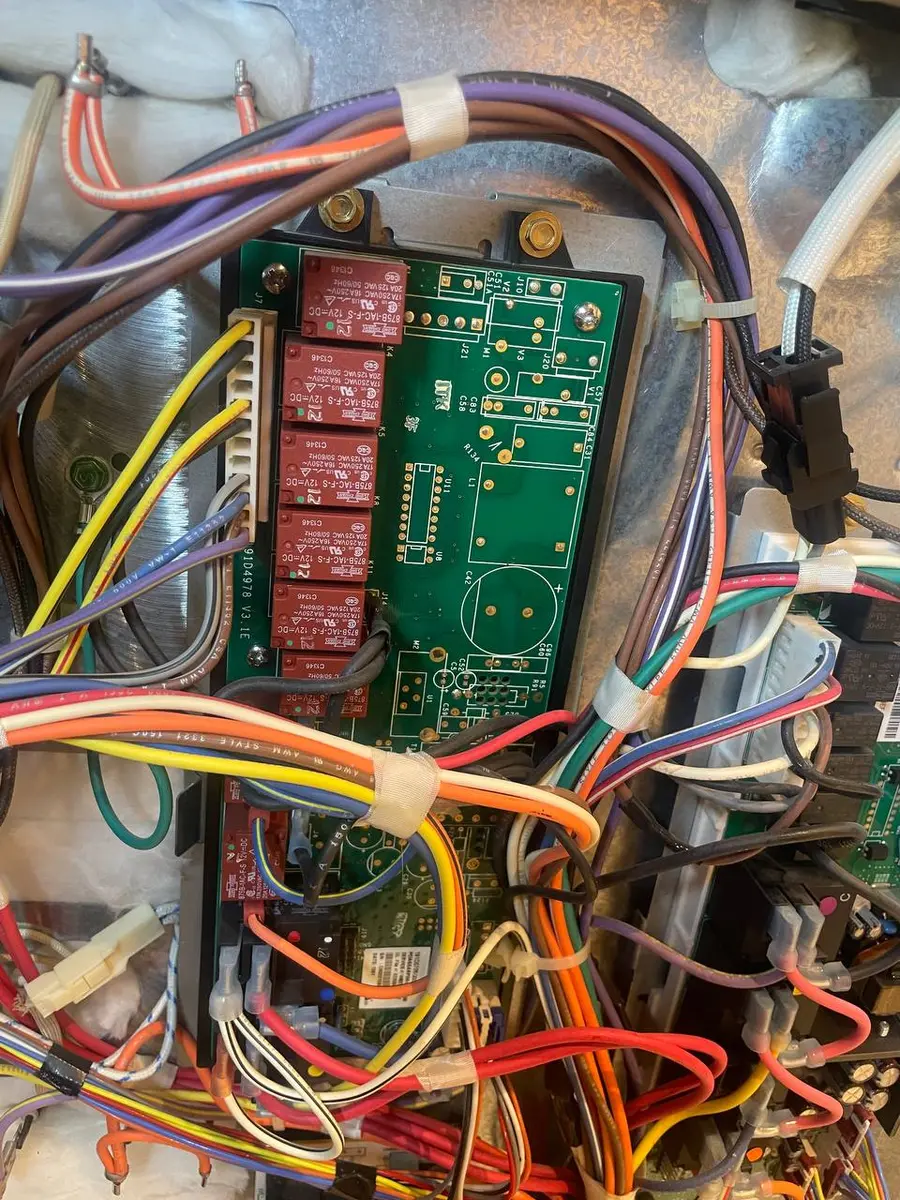
- Check ribbon cable: Access the main control board (typically behind top rear panel or behind a cover on the back of the unit). Check that the ribbon cable connecting to the display board is fully seated on both ends. Push connectors firmly.
- Inspect for moisture: Look for condensation or corrosion on board connectors. Bertazzoni refrigerators can develop moisture at the control board area where the cold cabinet meets the warm ambient air. If you see green corrosion, clean with isopropyl alcohol and a small brush.
- If persistent after full reset: The main control board or display board has likely failed. This requires professional replacement — control boards must be matched to the specific model and series.
Part cost: Ribbon cable varies by part. Main control board varies by part. Display board varies by part. Professional repair varies by part.
Additional Error Codes Quick Reference#
- EE — EEPROM error on control board. Memory corruption — board replacement required.
- EF — Evaporator fan feedback error. Motor is powered but no rotation detected (feedback signal missing). Usually failed fan motor or disconnected tachometer wire.
- EC — Condenser coil temperature too high. Condenser coils are dirty or condenser fan not running effectively. Clean coils first.
- Ed — Defrost timer error. The electronic defrost timer circuit on the board has failed. Board replacement needed.
The Risk of Getting It Wrong
A wrong diagnosis often turns a simple fix into a costly replacement. Without proper diagnostic tools, you might replace the wrong part — or cause additional damage. Our free diagnostic eliminates the guesswork.
Licensed & Insured · 90-Day Warranty · Same-Day Service
Bertazzoni Refrigerator Diagnostic Mode#
Bertazzoni Professional and Heritage series have a service diagnostic mode:
- Enter diagnostic mode: Press and hold the Fridge and Freezer temperature buttons simultaneously for 5 seconds.
- Cycle through tests: Use the temperature up/down buttons to scroll through test options: sensor readings, compressor status, fan status, defrost heater test, and error log.
- View sensor readings: The display shows real-time NTC resistance values and calculated temperatures for each sensor.
- Forced defrost: In diagnostic mode, you can manually trigger a defrost cycle for testing purposes. Useful for verifying defrost heater and thermostat function.
- Exit: Press and hold both temperature buttons again for 3 seconds.
Frequently Asked Questions#
Q: My Bertazzoni refrigerator shows E1 but the temperature seems fine. Do I need service? A: If the sensor is reading slightly out of spec (not completely failed), the refrigerator may still maintain acceptable temperature using its backup control logic. However, the compressor is likely running longer cycles or less efficiently, which increases energy consumption and accelerates compressor wear. Schedule service within a week — it's not an emergency but shouldn't be ignored.
Q: Are Bertazzoni refrigerator parts difficult to find? A: Bertazzoni uses standard industrial components (Embraco/Aspera compressors, generic NTC sensors, standard fan motors) in an Italian-designed shell. Most internal components can be sourced from general appliance parts suppliers, though some Bertazzoni-specific items (display boards, custom gaskets, stainless panels) must come from Bertazzoni's authorized parts network. Lead times for Bertazzoni-specific parts can be 2–3 weeks.
Q: How much does a Bertazzoni refrigerator compressor replacement cost? A: Compressor replacement on Bertazzoni Professional/Heritage refrigerators typically runs varies by model and region including the compressor, refrigerant recharge, new drier filter, and labor. The compressor itself (Embraco/Aspera) cost varies by model and region. Bertazzoni offers a 2-year parts warranty and extended compressor warranty on some models — check your warranty status before paying for repair.
Q: My Bertazzoni refrigerator is making a clicking sound. What does it mean? A: A clicking sound every 3–5 minutes, especially accompanied by E4, indicates the compressor is attempting to start but failing. The start relay or overload protector is cycling. This needs immediate attention — the compressor is not running and temperatures will rise. A clicking without an error code may be the defrost timer or a relay on the control board — less urgent but still worth investigating.
Q: Why is my Bertazzoni refrigerator icing up inside? A: Ice buildup on the back wall or inside the freezer indicates a defrost system failure (E5). The defrost heater, thermostat, or thermal fuse has likely failed. Meanwhile, the ice blocks airflow, causing the fresh food section to warm and the freezer to become excessively cold in spots. Don't chip the ice — manually defrost by leaving doors open, then schedule a defrost system repair.
Free Diagnostic Visit — Zero Risk
Our certified technician comes to your home, diagnoses the problem with professional tools, and gives you an honest quote — all at zero cost. No parts markup, no hidden fees. If you decide not to proceed, you pay nothing.
Licensed & Insured · 90-Day Warranty · Same-Day Service
When to Call a Professional#
Bertazzoni refrigerators are worth professional service for these situations:
- E4 compressor issues — compressor diagnosis requires refrigerant system knowledge and recovery equipment. Venting refrigerant is illegal and harmful.
- E9 control board replacement — boards must be matched and may need configuration.
- Persistent E5 after defrost component replacement — sealed system issues (low refrigerant, restricted cap tube) can mimic defrost failures.
- Any refrigerant leak — oily spots on evaporator or condenser tubing indicate a leak. Requires EPA-certified technician with recovery equipment.
- Unit not cooling at all — food safety concern. If internal temp exceeds 40F for more than 2 hours, food safety is compromised.
Bertazzoni refrigerator showing an error code? EasyBear's certified technicians work on all Bertazzoni series — Professional, Heritage, and Master. We offer free diagnostic visits with no obligation. Our tech arrives with common replacement parts, identifies the exact fault, and completes the repair on-site when possible. Every repair includes our 90-day parts and labor warranty. Schedule your free diagnosis today.
Lead Appliance Repair Technician · 12 years experience
Experienced technician with 12 years specializing in washing machine and dryer repairs across all major brands.