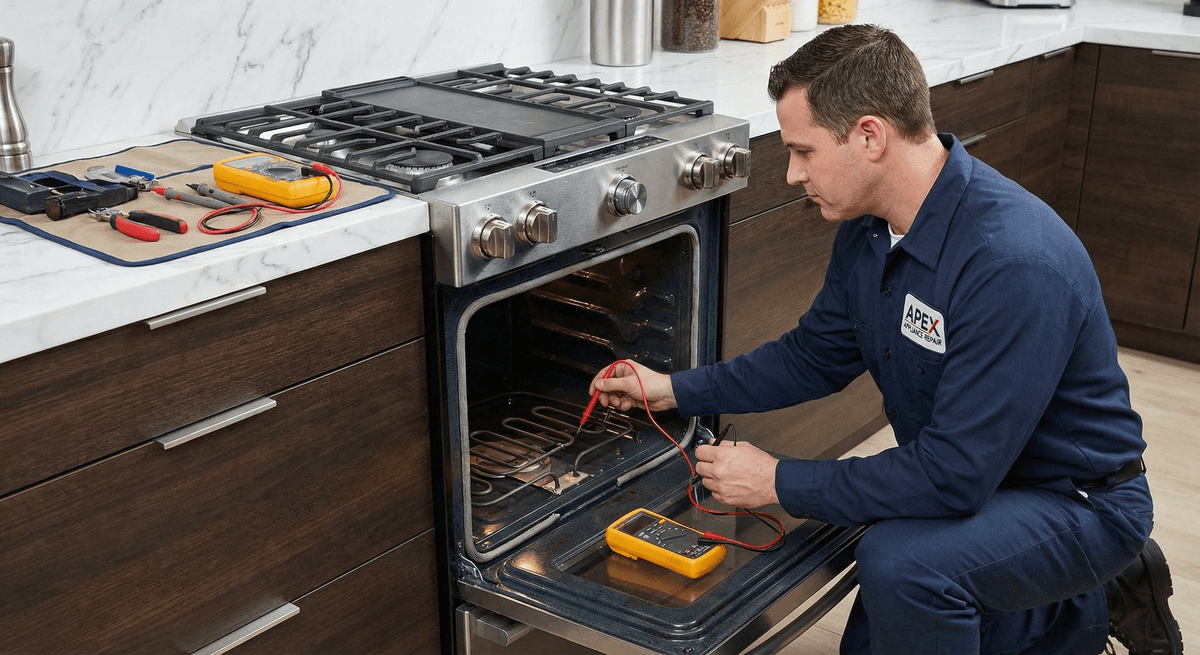

Oven Repair in Foster City
Professional oven repair service in Foster City, San Mateo County
Same-Day Service
90-Day Warranty
Fixed or It's Free
Typical Cost: $120-$500
How Much Does Oven Repair Cost in Foster City?
Oven repair in Foster City typically costs $100-$500. EasyBear provides same-day oven repair in Foster City with free diagnosis, 90-day warranty, and certified technicians.
- •Gas igniter replacement: $150-$250
- •Electric heating element: $150-$300
- •Temperature sensor: $150-$200
- •Control board: $250-$500
- •Door hinge / lock: $100-$200
Oven Repair Cost in Foster City
$265
Average Cost
$145 - $410
Typical Range
Prices include parts and labor. Free diagnostic when you proceed with repair.
What Are the Most Common Oven Problems?
Not heating up or won't reach temperature
Temperature inaccurate or uneven heating
Broiler not working
Door won't open after self-clean
Self-clean cycle not working
Gas burner won't ignite or keeps clicking
Control panel not responding or display blank
Convection fan not working
Oven light not working
Gas smell when oven is on or off
Takes too long to preheat
Error codes on display (F1-F9)
What Oven Issues Do We Fix?
Oven Not Heating
high priorityAn oven that won't heat up makes meal preparation impossible. A faulty bake element, a defective igniter, or a broken temperature sensor are common causes in both gas and electric ovens. Our technicians test all heating components and restore full cooking capability.
Faulty bake elementDefective igniterBroken temperature sensor
Cost: $150-$400Time: 45-90 minutes
Oven Heating Unevenly
medium priorityHot spots and cold zones inside your oven result in unevenly cooked food. A failing convection fan, a partially burned-out element, or a miscalibrated thermostat are typical causes. We calibrate and repair the heating system for consistent, even cooking.
Failing convection fan motorPartially burned-out elementMiscalibrated thermostat
Cost: $150-$350Time: 45-90 minutes
Oven Door Not Closing Properly
medium priorityAn oven door that won't close completely leaks heat, wastes energy, and poses a burn risk. Worn door hinges, a broken door spring, or a damaged latch assembly are the usual culprits. We repair or replace door hardware to restore a secure, tight fit.
Worn door hingesBroken door springDamaged latch assembly
Cost: $100-$300Time: 30-75 minutes
Oven Self-Clean Not Working
low priorityWhen the self-clean cycle fails to start or complete, a faulty door lock motor, a blown thermal fuse, or a defective control board is often to blame. Our technicians restore the self-cleaning function so you can keep your oven sparkling without harsh chemicals.
Faulty door lock motorBlown thermal fuseDefective control board
Cost: $150-$350Time: 45-90 minutes
Oven Temperature Inaccurate
medium priorityIf your oven runs too hot or too cold compared to the set temperature, food comes out over- or undercooked. A failing oven sensor, a drifting thermostat, or a damaged control board can cause this. We recalibrate or replace components for precise temperature control.
Failing oven temperature sensorDrifting thermostatDamaged control board
Cost: $125-$350Time: 30-75 minutes
Oven Broiler Not Working
medium priorityA non-functioning broiler limits your cooking options. In electric ovens, a burned-out broil element is the primary cause. In gas ovens, a faulty igniter or safety valve may be responsible. We replace the failed component for full broiling capability.
Burned-out broil elementFaulty igniterDefective safety valve
Cost: $125-$350Time: 30-75 minutes
Oven Not Turning On
high priorityAn oven that shows no signs of life when powered on could have a wiring issue, a failed control board, or a blown fuse. Gas ovens may also have ignition system failures. Our technicians safely test all electrical pathways to identify and fix the problem.
Failed control boardBlown thermal fuseWiring issue
Cost: $150-$400Time: 45-90 minutes
Oven Producing Gas Smell
high priorityA gas smell from your oven requires immediate attention for your safety. While a brief smell when the oven first ignites is normal, a persistent odor indicates a gas leak, a faulty igniter, or a defective safety valve. Call us immediately for emergency inspection and repair.
Gas line leakFaulty igniter not lighting gasDefective gas safety valve
Cost: $150-$400Time: 45-90 minutes
Why Choose EasyBear in Foster City?
Same-Day Service
Most repairs completed same day
90-Day Warranty
Comprehensive coverage
No Diagnostic Fee
Free inspection
Serving Foster City:
94404
About Oven Repair in Foster City
Foster City is a unique planned community built on reclaimed land in the San Francisco Bay. Developed primarily in the 1960s-1970s, the city is defined by its lagoon system, waterfront living, and consistent architectural character. This waterfront environment is the dominant factor in Foster City's appliance service landscape.
The constant proximity to water — both the Bay and the lagoon system — means Foster City homes experience higher ambient humidity than inland Peninsula communities. This moisture accelerates mold growth in washing machine gaskets and drums, promotes corrosion on metal appliance components, and keeps dryer exhaust systems perpetually damp. Front-load washer maintenance is particularly important in Foster City.
Frequently Asked Questions
Oven repair costs range from $100-$600, averaging $300 in the Bay Area. Common repairs include igniter replacement for gas ovens ($150-$250), heating element for electric ovens ($150-$300), and temperature sensor ($150-$200).
For electric ovens, check for broken heating elements (visible cracks or breaks), faulty temperature sensor, or control board issues. For gas ovens, the most common cause (60-70% of cases) is a weak or failed igniter. Check the circuit breaker (electric) or gas supply (gas) first.
Ovens average 16 years, with a range of 13-20 years. Gas ovens typically last slightly longer than electric. Proper use (minimal self-cleaning cycles) and prompt spill cleanup extends oven lifespan.
If you're comfortable turning off gas supply, working inside the oven, and handling fragile parts, yes. However, gas appliances involve safety risks. When in doubt, call a professional. Igniters are very fragile and require careful handling.
Common causes include a weak igniter (gas ovens), a failing heating element (electric ovens), a faulty temperature sensor, or a broken convection fan. Most ovens should preheat to 350°F in 10-15 minutes. If it takes significantly longer, professional diagnosis is recommended.
Oven repairs typically cost between $150 and $500, with the average around $300. Igniter replacement (gas ovens) costs $150–$300, heating element replacement (electric) costs $150–$350, and control board replacement runs $200–$500. Built-in wall ovens generally cost 10–15% more to repair than freestanding ranges.
For gas ovens, a faulty igniter is the most common cause — it glows but can't reach the temperature to open the gas valve. For electric ovens, a burned-out bake or broil element is typical. Other causes include a faulty temperature sensor, a blown thermal fuse, or a defective control board. Igniter/element replacement costs $150–$300.
An oven that runs too hot or cold usually has a failing temperature sensor (thermistor), a worn-out calibration, or a faulty control board. Use an oven thermometer to verify — a variance of 25°F or more indicates a problem. Temperature sensor replacement costs $100–$250. Some ovens allow manual temperature calibration in the settings menu.
Most oven repairs take 1–2 hours. Igniter and heating element replacements take 45 minutes to 1 hour. Control board replacement takes 1–1.5 hours. Self-cleaning lock mechanism repairs can take up to 2 hours. About 80% of oven repairs are completed in a single visit with common parts on hand.
If the igniter clicks but doesn't light, the most likely cause is a dirty or misaligned burner, moisture on the igniter from cleaning, or a weak igniter that glows but can't reach ignition temperature (1,800°F+). Clean the burner ports with a pin, ensure the igniter is dry, and if the glow is orange rather than white-hot, the igniter needs replacement ($150–$250).
Self-cleaning is generally safe but runs the oven at 800–900°F for 2–4 hours, which can stress older components and occasionally blow a thermal fuse. Remove racks and any heavy spills beforehand, ensure good kitchen ventilation, and never leave the house during a self-clean cycle. Avoid using it on ovens older than 10 years.
Smoking is usually caused by food residue on the bottom or heating elements, grease splatters on the interior walls, or a new oven burning off manufacturing oils. Clean the oven thoroughly and check for visible residue on the elements. If smoking persists with a clean oven, a failing element or wiring issue may be the cause.
Yes, this is a common issue caused by a failed door lock motor or a blown thermal fuse. The lock mechanism engages during self-cleaning and sometimes fails to release. Don't force the door open — this can break the latch. The repair involves replacing the door lock assembly ($100–$250) and typically takes about an hour.
Gas ovens typically last 15–20 years, while electric ovens last 13–18 years. Ranges with cooktops tend to have similar lifespans. Wall ovens can last 15–20+ years with proper maintenance. High-end brands like Viking and Wolf may last even longer. Regular cleaning and avoiding overuse of the self-clean feature extend oven life.
Slow preheating (more than 15–20 minutes to reach 350°F) usually indicates a weak igniter (gas), a failing heating element (electric), or a faulty temperature sensor. A worn door gasket can also allow heat to escape. Igniter degradation is gradual — if preheat time has slowly increased over months, the igniter likely needs replacement.
Yes, we can replace both the inner and outer oven door glass panels. The glass itself costs $50–$150 depending on the model, with labor adding $100–$150. Double-pane glass replacement costs slightly more. Don't use the oven with cracked glass — heat can escape and the damaged glass may shatter further.
Uneven heating can be caused by a faulty convection fan (in convection ovens), a partially burned-out element, a blocked vent, or a warped baking rack. In standard ovens, the top and bottom naturally have different temperatures — use the middle rack for even cooking. Convection fan replacement costs $150–$300.
At 15 years, an oven is approaching the end of its expected lifespan. Simple repairs under $200 (like an igniter or element) are still worthwhile. However, major repairs like a control board ($300+) or multiple component failures make replacement the smarter choice. Newer ovens offer better energy efficiency and safety features.
Warning signs include inconsistent temperatures, taking longer than 15 minutes to preheat, unusual noises or smells, the door not sealing properly, error codes on the display, the oven not turning on or off, and visible damage to elements or interior surfaces. Don't ignore gas smells — turn off the gas and call for emergency service immediately.
Clean spills promptly to prevent baked-on residue, use oven liners to catch drips, and avoid using the self-clean feature more than twice a year. Check and replace the door gasket if it's loose or torn. For gas ovens, keep the burner ports clear of debris. Have the oven professionally inspected every 2–3 years.
A gas smell without ignition is a serious safety concern. Turn off the gas supply, ventilate the area, and do not use any electrical switches. The most likely cause is a failed igniter that can't reach the 1,800°F needed to open the safety valve, allowing gas to accumulate before igniting. Call for same-day repair — never ignore a gas odor.
Need Oven Repair in Foster City?
Book your same-day repair service now
Book Oven RepairAverage repair time: 90 minutes · 90-day warranty