Whirlpool Refrigerator Temperature Not Right — Troubleshooting Guide
When your Whirlpool refrigerator does not maintain correct temperatures — too warm, too cold, or fluctuating — the cooling system, sensors, or airflow management has a component failure. Whirlpool WRF and WRS series use Accu-Chill temperature management on select models, providing rapid cooling and precise temperature control when functioning correctly.
Whirlpool Recommended Temperature Settings
- Refrigerator compartment: 37F (Whirlpool's default recommendation)
- Freezer compartment: 0F
Settings above or below these values affect food safety and energy consumption.
Do You Have the Right Tools?
Refrigerant gauges ($200+), vacuum pump ($250), leak detector ($150), and EPA-certified recovery equipment. Our technician arrives with $15K+ in professional tools — your diagnostic is free.
Licensed & Insured · 90-Day Warranty · Same-Day Service
Most Common Causes
1. Dirty Condenser Coils (25% of cases)
Dust-clogged condensers reduce heat dissipation efficiency. The compressor must run longer and harder, eventually unable to reach target temperatures.
Whirlpool condenser location: Behind the lower rear panel (French door) or underneath (some models). Remove the access panel (Phillips or Torx screws) and clean with a condenser brush and vacuum.
Fix: Clean coils every 6-12 months. Pet-owning households: every 3-4 months.
2. Evaporator Frost Buildup (22% of cases)
Failed Adaptive Defrost cycle allows ice to block evaporator airflow. Freezer gradually warms; refrigerator section follows.
Diagnosis: Remove freezer rear panel. If evaporator coils are covered in thick ice, the defrost system needs repair (heater, thermostat, or ADC board).
Fix: See our guide on Whirlpool Refrigerator Cycle Not Completing.
3. Door Gasket Seal Failure (15% of cases)
Warm air infiltration forces extended compressor runtime. On Whirlpool French door models, both the perimeter gaskets AND the center magnetic seal between the two doors must seal properly.
Dollar bill test: Close the door on a bill — should resist pulling. Test all edges.
Parts Cost: $40-$120 (gasket) Professional Repair Cost: $120-$200
4. Temperature Sensor/Thermistor Failure (12% of cases)
Whirlpool uses multiple thermistors — one per compartment minimum. If a sensor drifts or fails, the control board receives incorrect temperature data and responds inappropriately.
Whirlpool diagnostic mode: Electronic-control models display real-time sensor readings in service mode. Compare displayed temperature to an independent thermometer placed in the compartment for 24 hours.
Parts Cost: $10-$30 Professional Repair Cost: $120-$180
5. Damper Door Malfunction (10% of cases)
The damper (motorized or thermally actuated) controls cold airflow from the freezer evaporator to the refrigerator compartment. Stuck closed = warm fridge. Stuck open = frozen fridge items.
Whirlpool damper location: Upper rear of refrigerator compartment. Listen for motor sound when cooling is called for. If silent, test motor operation.
Parts Cost: $30-$80 Professional Repair Cost: $130-$220
6. Evaporator Fan Motor Failure (8% of cases)
If the fan does not circulate cold air, temperatures rise unevenly (areas near the evaporator stay cold while distant areas warm). Fan motors can be heard running when the door is closed — open the door and press the door switch to test.
Parts Cost: $30-$70 Professional Repair Cost: $140-$230
7. Compressor or Sealed System Issue (5% of cases)
Variable-speed inverter compressor running but not cooling effectively = possible refrigerant leak or compressor valve failure.
Signs: Compressor runs continuously, condenser coil is barely warm (should be warm to hot), temperatures slowly climb over days.
Professional Repair Cost: $250-$600+
8. Control Board Failure (3% of cases)
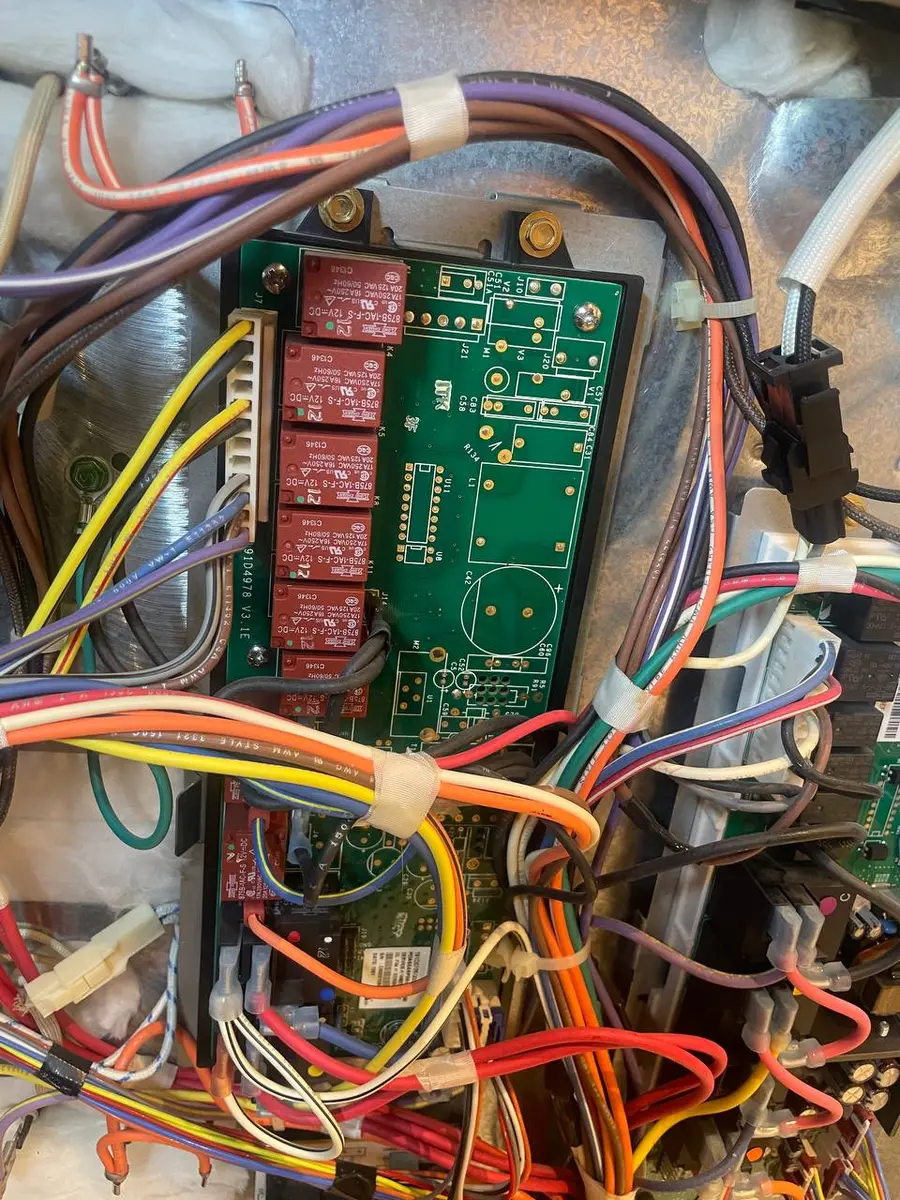
The main board manages all temperature regulation. Failed boards may produce incorrect relay commands — running the compressor when not needed (too cold) or not running it when needed (too warm).
Whirlpool Accu-Chill Temperature Management
Select Whirlpool models feature Accu-Chill — a quick-cooling burst that rapidly lowers temperature after door openings or fresh food loading. If Accu-Chill activates excessively, a sensor or board issue may be over-triggering the feature.
Same-Day Appliance Repair
Fixed or It's Free
$89 → $0 Service Call & Diagnosis — offer ends May 25
Safety First — Know the Risks
Refrigerant (R-134a/R-600a) requires EPA certification to handle. Improper discharge is a federal violation and health hazard. Our techs are licensed and insured — let them handle the risk.
Licensed & Insured · 90-Day Warranty · Same-Day Service
Whirlpool Diagnostic Mode for Temperature
Electronic-control Whirlpool models display sensor readings in diagnostic mode:
- Ambient temperature sensor
- Refrigerator compartment sensor
- Freezer compartment sensor
- Evaporator sensor (defrost monitoring)
Compare all readings to independent thermometers. Discrepancies greater than 5F indicate sensor drift.
FAQ
Q: Why is my Whirlpool refrigerator too cold — items are freezing?
Most common: damper stuck open (flooding fridge with freezer air), or temperature sensor reading warmer than reality (board over-cools to compensate). Check damper operation and verify sensor accuracy.
Q: My Whirlpool fridge is warm but freezer is fine — what is wrong?
Damper stuck closed (fridge not receiving cold air), or evaporator fan failure (cold air not circulating to fridge). If the freezer is properly cold, the cooling system itself is working — the distribution to the fridge compartment is blocked.
Q: How long should it take a Whirlpool refrigerator to reach temperature after unplugging?
24 hours to reach stable operating temperature after being unplugged. Do not add food until both compartments verify at target temperatures with a thermometer.
Q: What temperature should I set my Whirlpool refrigerator to?
Whirlpool recommends 37 degrees F for the refrigerator and 0 degrees F for the freezer. These settings balance food safety (FDA recommends below 40F) with energy efficiency. Setting significantly colder wastes energy without improving food preservation. Use an independent thermometer to verify — the built-in display reads the control board's target, not necessarily the actual compartment temperature.
Q: My Whirlpool refrigerator temperature fluctuates by 5 degrees — is that normal?
Small fluctuations (3-5 degrees F) are normal and result from the compressor cycling on/off and door openings. The Accu-Chill system on applicable models minimizes these swings by providing rapid cooling bursts after door openings. Fluctuations greater than 8 degrees F or temperatures that drift steadily in one direction indicate a component issue (sensor, damper, or sealed system).
Whirlpool refrigerator temperature problems? Our technicians diagnose sensor, damper, and defrost system issues. Schedule service →