Whirlpool Refrigerator Not Dispensing Water — EveryDrop System Troubleshooting
Water dispensers on Whirlpool WRF French door and WRS side-by-side refrigerators rely on a pressurized water path that runs from the household supply through the EveryDrop filter, the water inlet valve, internal tubing through the door hinge area, and finally to the dispenser nozzle. A failure anywhere along this path stops water delivery — but the dispenser lever still moves and the display may still illuminate, making it seem like the dispenser should work.
Whirlpool's EveryDrop filtration system is a common source of dispenser problems: an expired filter that restricts flow, air trapped after filter replacement, or a cracked filter housing that loses pressure. However, multiple other components can fail independently. This guide walks through each cause from most to least common.
Quick Diagnostic: Narrowing the Problem
Before testing individual components, determine which part of the system has failed:
- Does the ice maker still get water? If yes, the water supply and inlet valve are working — the problem is in the dispenser-specific path (door tubing, dispenser switch, or dispenser solenoid). If no, the supply is restricted upstream of where ice maker and dispenser paths split.
- Do you hear the inlet valve buzz when pressing the dispenser lever? The valve produces an audible hum when energized. If you hear it but no water flows, the water path is frozen or blocked downstream. If no buzz, the dispenser switch or control board is not sending power to the valve.
- Was the filter recently replaced? Air locks after filter changes are the number-one cause of "new filter installed, dispenser stopped working" complaints.
Do You Have the Right Tools?
Refrigerant gauges ($200+), vacuum pump ($250), leak detector ($150), and EPA-certified recovery equipment. Our technician arrives with $15K+ in professional tools — your diagnostic is free.
Licensed & Insured · 90-Day Warranty · Same-Day Service
Most Common Causes
1. Expired or Clogged EveryDrop Filter (30% of cases)
Whirlpool's EveryDrop water filters (numbered Filter 1 through Filter 6 depending on model) have a service life of 6 months or 200 gallons — whichever comes first. Sacramento's municipal water from the American River carries moderate mineral content that can clog filter media before the 6-month mark, particularly during drought years when source water mineral concentration increases.
A progressively clogging filter first manifests as reduced flow rate (the dispenser stream gets thinner over weeks), then eventually restricts flow entirely. The dispenser lever still activates the valve, you hear the buzzing, but water barely trickles or does not flow at all.
Diagnosis: Remove the EveryDrop filter (twist counterclockwise quarter-turn). With the filter removed, press the dispenser lever — water should flow freely (unfiltered) directly from the inlet valve. If flow is strong without the filter, the filter was the restriction. If still no flow, the problem is upstream or downstream of the filter location.
DIY Difficulty: Easy Parts Cost: $25–$55 (genuine EveryDrop); $12–$25 (aftermarket) Professional Repair Cost: $80–$150
Key detail: After installing any new filter, flush 3-4 gallons through the dispenser. Air trapped in the filter cartridge creates an airlock that blocks water flow. Many "filter did not fix it" callbacks are resolved by proper purging.
2. Frozen Water Line in Door (25% of cases)
The water supply line routes through the refrigerator body and enters the door through the hinge area via a small-diameter tube. On Whirlpool French door models, this tube runs through the left door hinge housing. The tube diameter is narrow enough that even a small ice crystal can create a complete blockage.
Freezing occurs when the thermostat setting is too cold (below recommended), when the tube routing brings it too close to the freezer compartment wall, or when the door is frequently left ajar (warm air enters and condensation inside the tube freezes when the door closes).
Diagnosis: Disconnect the water tube at the door inlet (usually accessible by removing the lower hinge cover). If water flows from the refrigerator-side tube when the dispenser valve is activated, the blockage is inside the door. If no flow from the refrigerator side, the freeze is in the body tubing.
DIY Difficulty: Easy to Moderate Parts Cost: Free (thaw with warm cloth or hair dryer) Professional Repair Cost: $100–$180
Repair Steps:
- Unplug the refrigerator.
- Locate the water tube where it enters the door at the hinge area.
- Apply warm (not hot) compresses or a hair dryer on low setting to the tube and hinge area.
- Continue for 15-20 minutes until ice melts.
- If the tube freezes repeatedly, verify the thermostat is set to manufacturer-recommended levels (37 degrees F refrigerator, 0 degrees F freezer) and check that the tube is not routed against the freezer wall.
3. Water Inlet Valve Failure (20% of cases)
Whirlpool uses a dual-solenoid inlet valve — one solenoid feeds the ice maker, the other feeds the dispenser. These solenoids operate independently, so one can fail while the other continues working. If the dispenser does not work but the ice maker still receives water, the dispenser-side solenoid has failed.
The valve also requires a minimum of 20 PSI water pressure to open fully. In Sacramento apartment buildings (upper floors) or homes with undersized supply lines, pressure may be marginal — sufficient for the ice maker's 7-second fill but not for sustained dispenser flow.
Diagnosis: Listen for the valve buzz when pressing the dispenser lever. No buzz = no power to the solenoid (switch or board problem). Buzz but no water = solenoid opens but water is blocked (frozen line, kinked supply, low pressure). Test household water pressure at the supply valve — it should be above 20 PSI (40-60 PSI is normal).
DIY Difficulty: Moderate Parts Cost: $30–$80 Professional Repair Cost: $140–$280
4. Dispenser Switch or Actuator Failure (15% of cases)
The dispenser lever activates a microswitch that tells the control board to energize the water valve. On Whirlpool models, this switch assembly is built into the dispenser housing behind the front panel. Over thousands of uses, the switch contacts wear or the actuator mechanism that connects the external lever to the internal switch cracks.
Whirlpool's dispenser panels on WRS side-by-side models integrate the switch, actuator, and sometimes an LED indicator into one assembly. On WRF French door models with Measured Fill (a specific water volume dispensing feature), the switch mechanism is more complex and failure manifests as either no response or the Measured Fill solenoid sticking open.
Diagnosis: Press the dispenser lever firmly and listen for the inlet valve buzz from the rear of the unit. If pressing harder or at a slightly different angle produces the buzz (and water), the switch or actuator has worn and is making intermittent contact.
DIY Difficulty: Moderate Parts Cost: $20–$60 Professional Repair Cost: $120–$240
5. Control Board Not Activating Dispenser Circuit (10% of cases)
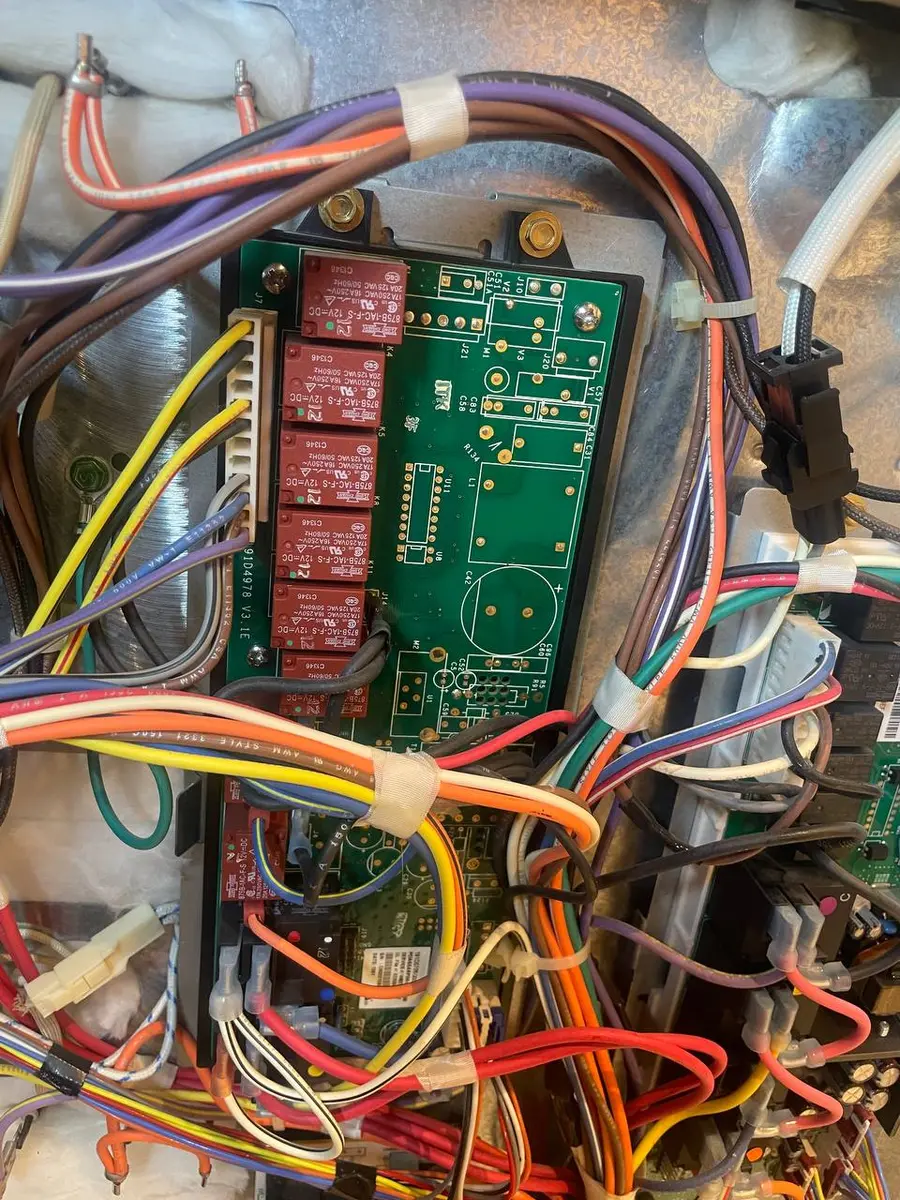
The main control board contains the relay that powers the dispenser water valve. If this relay fails (burnt contacts, damaged driver circuit), pressing the lever produces no valve activation even though the switch sends the signal correctly. This is confirmed when the ice maker works (its valve relay is separate) but the dispenser relay does not fire.
On Whirlpool models with a child lock feature, accidentally activating the lock disables the dispenser. Check the control panel for a lock icon before assuming board failure.
Diagnosis: Check for child lock activation first (press and hold the lock button for 3 seconds to toggle). If not locked, and the switch is verified good, the board's dispenser relay has failed. Board replacement is typically the only solution — individual relay replacement on the board is technically possible but impractical without soldering equipment.
DIY Difficulty: Moderate (board swap) Parts Cost: $50–$200 Professional Repair Cost: $180–$400
Diagnostic Sequence
- Check for child lock activation (lock icon on display).
- Verify household water supply is on (check shut-off valve under sink).
- Listen for inlet valve buzz when pressing dispenser lever.
- Remove the EveryDrop filter — does water flow without it?
- Check if ice maker receives water (if yes, supply is good up to the split point).
- If valve buzzes but no water: frozen line or blocked path.
- If no valve buzz: switch, actuator, or control board issue.
Safety First — Know the Risks
Refrigerant (R-134a/R-600a) requires EPA certification to handle. Improper discharge is a federal violation and health hazard. Our techs are licensed and insured — let them handle the risk.
Licensed & Insured · 90-Day Warranty · Same-Day Service
Cost Comparison
| Cause | Parts Cost | Professional Cost | Repair Time |
|---|---|---|---|
| EveryDrop Filter | $25–$55 | $80–$150 | 5 min |
| Frozen Water Line | Free | $100–$180 | 20 min |
| Water Inlet Valve | $30–$80 | $140–$280 | 35 min |
| Dispenser Switch | $20–$60 | $120–$240 | 25 min |
| Control Board | $50–$200 | $180–$400 | 30 min |
Same-Day Appliance Repair
Fixed or It's Free
$89 → $0 Service Call & Diagnosis — offer ends May 25
Prevention
- Replace EveryDrop filter every 6 months — do not wait for complete blockage.
- Flush 3-4 gallons after every filter change — purges air locks that cause immediate no-flow.
- Keep thermostat at recommended settings — overcooling promotes internal tube freezing.
- Verify water pressure annually — pressure below 20 PSI causes valve performance issues.
- Dispense water daily — regular flow through the lines prevents stagnation and freezing.
The Real Cost of DIY
Average DIY attempt: $150-400 in tools you may use once, plus the risk of further damage. Our diagnostic visit costs $0 — we find the problem and give you an honest quote.
Licensed & Insured · 90-Day Warranty · Same-Day Service
FAQ
Q: I just replaced the EveryDrop filter and now no water comes out ��� what went wrong?
Air is trapped in the new filter. Dispense water for 3-4 minutes continuously (expect sputtering initially) to purge the air. If the filter was not twisted a full quarter-turn into the locked position, it may not be sealed properly — remove and reseat it.
Q: The water dispenser works intermittently — sometimes it flows, sometimes it does not.
Intermittent flow suggests a partially frozen water line (ice forms and melts repeatedly) or a worn dispenser switch making inconsistent contact. If the problem is worse in the morning (after overnight with door closed), frozen line is more likely.
Q: Ice maker works but water dispenser does not — are they connected?
They share the same water supply and inlet valve body, but use separate solenoids. A working ice maker confirms the supply line, pressure, and filter are adequate. The failure is in the dispenser-specific solenoid, switch, or control circuit.
Water dispenser not responding? Our technicians diagnose the exact failure point and carry inlet valves, filters, and dispenser assemblies for same-visit repair. Schedule a repair →