Whirlpool Refrigerator Not Defrosting — Adaptive Defrost Circuit Diagnosis
Whirlpool's Adaptive Defrost system represents a significant engineering improvement over fixed-timer defrost cycles used by many competitors. Instead of blindly activating the defrost heater every 6-8 hours regardless of frost conditions, Whirlpool tracks compressor run-time and door-opening patterns to calculate the optimal defrost interval. This intelligence means your WRF, WRS, or WRT model defrosts only when actually needed — saving energy and maintaining more consistent temperatures.
However, when this system fails, the consequences are more abrupt. There is no mechanical timer backstop that would provide even partial defrost function. Complete defrost failure leads to rapid ice accumulation on the evaporator coils, reduced airflow, warming compartment temperatures, and eventually a refrigerator that cannot maintain safe food storage conditions.
The defrost circuit contains four components in series — if any one fails, the entire defrost function ceases. This guide walks through each component in diagnostic order, from most common to least common failure.
Understanding the Defrost Circuit
Whirlpool's defrost circuit operates as a simple series loop when activated:
Adaptive Defrost Board (sends defrost signal) → Defrost Thermostat/Bi-Metal (closes circuit when cold enough) → Defrost Heater (produces heat to melt frost) → Timer/Board (terminates cycle after temperature threshold reached)
All Whirlpool refrigerators — whether using the older mechanical ADC (Adaptive Defrost Control) board or the newer electronic main control board with integrated defrost logic — follow this same electrical path. The difference is only in how the defrost interval is calculated, not how the heater is energized.
Do You Have the Right Tools?
Refrigerant gauges ($200+), vacuum pump ($250), leak detector ($150), and EPA-certified recovery equipment. Our technician arrives with $15K+ in professional tools — your diagnostic is free.
Licensed & Insured · 90-Day Warranty · Same-Day Service
Quick Diagnostic: Is the Defrost System Actually Failed?
Before testing individual components, confirm the defrost system is truly not operating:
- Check for thick frost on the evaporator coils — remove the freezer rear panel (4-6 Phillips screws). If you see a solid sheet of ice coating the aluminum coil fins, defrost has not operated recently.
- Listen for the defrost cycle — during defrost, the compressor shuts off and you should hear a faint sizzling or hissing as ice melts off the heater. If you never hear this quiet period (compressor runs 24/7), defrost is not initiating.
- Check error codes — Whirlpool models with displays show error code 01 for defrost bi-metal failure. Enter diagnostic mode (model-specific 3-button sequence found on the tech sheet inside the console or toe panel) to pull stored codes.
- Forced defrost test — in diagnostic mode, most Whirlpool models allow you to force a defrost cycle. If the heater activates during forced defrost but never runs during normal operation, the control board's timing logic has failed rather than the heating components.
Most Common Causes
1. Defrost Heater Burned Out (30% of cases)
The defrost heater on Whirlpool models is a resistive element — usually a glass-tube calrod type mounted in an aluminum channel beneath the evaporator coils. These elements have a finite lifespan as the internal resistance wire gradually thins from repeated heating cycles. Once the wire breaks or the glass tube cracks (allowing moisture ingress that shorts the element), no heat is produced regardless of the signal from the defrost board.
Whirlpool uses different heater wattages depending on model size — WRS side-by-side units typically use a 300-watt element while WRF French door models may use 250 watts due to the smaller freezer evaporator surface area. Always match the replacement wattage to your specific model to ensure adequate defrost performance.
Testing: Disconnect one heater wire terminal and measure resistance across the heater with a multimeter set to ohms. A working heater shows 20-60 ohms (varies by wattage rating). Open circuit (infinite resistance or OL on the meter) means the heater element has broken internally.
DIY Difficulty: Moderate — requires removing the freezer rear panel and handling glass elements carefully Parts Cost: $30–$75 Professional Repair Cost: $150–$300
Repair Steps:
- Unplug the refrigerator. If thick ice covers the evaporator, allow 24 hours to melt or carefully use a hair dryer on low heat setting.
- Remove all freezer shelves, bins, and the ice bucket.
- Remove the Phillips screws holding the freezer rear panel and carefully pull it forward — ice may bond it in place.
- Photograph wiring connections for reference before disconnecting anything.
- Remove the heater from its mounting clips — some models use spring clips that compress and slide, others use screw-mounted brackets.
- Disconnect wire terminals from the heater ends.
- Position the new heater in the same orientation beneath the evaporator coils and secure the mounting clips.
- Reconnect wire terminals firmly.
- Reassemble the rear panel, shelves, and restore power.
2. Defrost Thermostat Stuck Open (25% of cases)
The defrost thermostat (also called the bi-metal or defrost limit) is a temperature-activated switch clipped directly to the evaporator tubing. It serves dual purposes: it must be closed (conducting) to allow current to reach the heater when evaporator temperature is below approximately 30 degrees F, and it must open (interrupt current) when temperature rises above approximately 47 degrees F to terminate the defrost cycle and prevent overheating.
When this component fails in the open position — by far the most common failure mode — it permanently breaks the defrost circuit. The heater can never receive power, even when the Adaptive Defrost board correctly signals a defrost cycle. Whirlpool encodes this failure as error code 01 on models equipped with diagnostic displays.
Whirlpool uses standard disc-type bi-metal thermostats with specific temperature ratings. The replacement must match the exact temperature specs for your model — using a thermostat rated for a different opening temperature can cause incomplete defrost (opens too early) or evaporator damage (opens too late).
Testing: Remove the thermostat from the evaporator tubing and disconnect its wires. At room temperature, it should show open circuit (no continuity) since room temperature exceeds its closing threshold. Place it in a freezer or hold against a bag of frozen vegetables for 5-10 minutes — it should now show continuity (closed). If it remains open when cold, it has failed and needs replacement.
DIY Difficulty: Moderate Parts Cost: $15–$40 Professional Repair Cost: $130–$250
Repair Steps:
- Unplug and defrost the freezer as described above.
- Remove the rear freezer panel to expose the evaporator.
- Locate the thermostat — a small disc or oval device clipped to one of the evaporator's refrigerant tubes, usually near the top or side of the coil assembly.
- Note its exact mounting location — placement on the correct tube is critical for accurate temperature sensing.
- Squeeze or unclip the thermostat from the tube.
- Disconnect the two wire terminals.
- Clip the new thermostat in the identical position on the same tube.
- Reconnect terminals and reassemble.
3. Adaptive Defrost Control Board Failure (25% of cases)
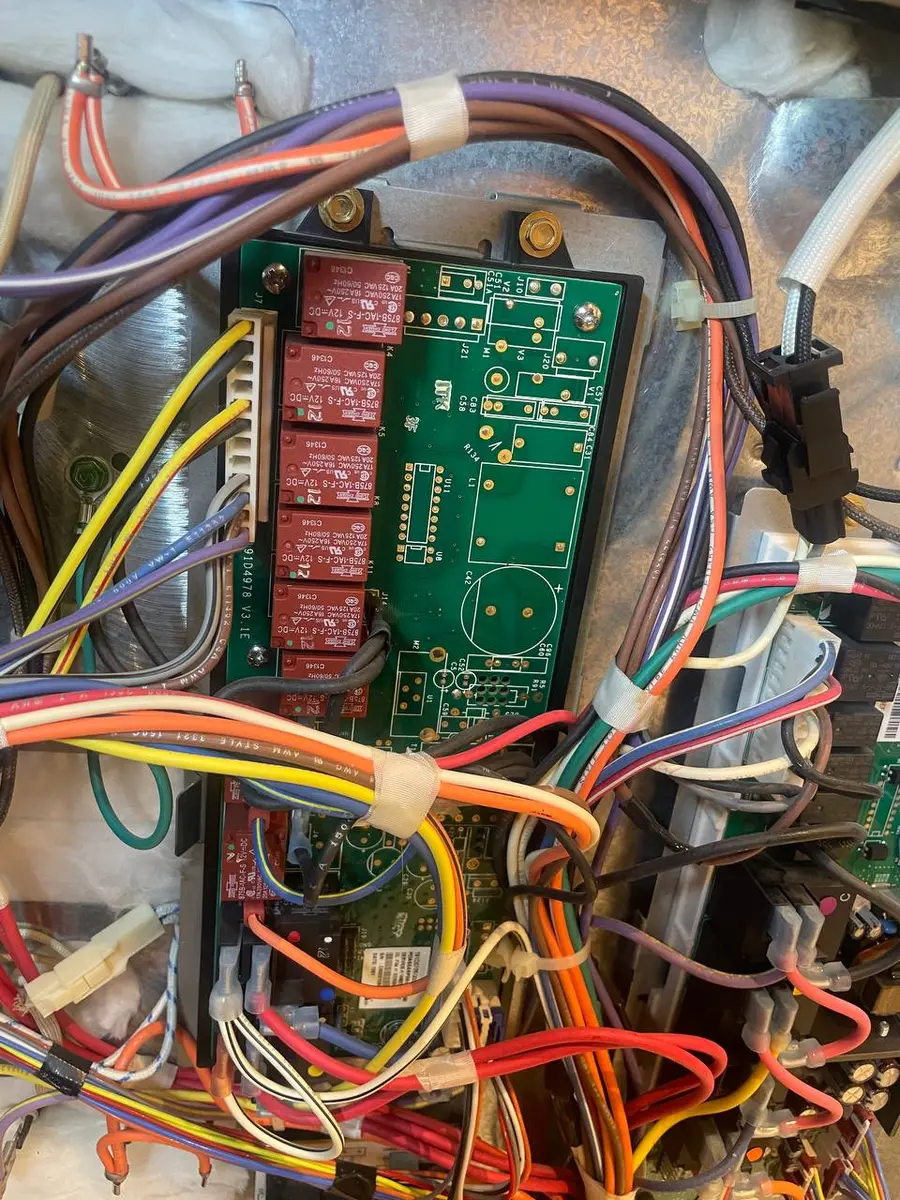
The defrost control board is the brain that decides when to initiate and terminate defrost cycles. On older Whirlpool models (pre-2015), this is a separate small circuit board — the ADC (Adaptive Defrost Control) — mounted in the control housing. On newer models, defrost logic is integrated into the main electronic control board.
Board failures can manifest in several ways:
- Never initiates defrost — the board has lost its ability to track compressor hours or fails to output the defrost relay signal
- Initiates but terminates immediately — the board's defrost cycle timer malfunctions
- Random defrost behavior — partial logic failure causes unpredictable timing
Unlike the heater and thermostat which can be definitively tested with a multimeter, the defrost board requires process-of-elimination diagnosis: if the heater and thermostat both test good but defrost never occurs during normal operation, the board is the remaining suspect.
On models with diagnostic capability, entering service mode and running a forced defrost verifies the heater circuit works when manually commanded — proving the board's automatic logic has failed rather than the heating components.
DIY Difficulty: Moderate (board replacement is straightforward; diagnosis is the challenge) Parts Cost: $40–$130 Professional Repair Cost: $180–$350
4. Defrost Timer Motor Failure (15% of cases — older models only)
Some older Whirlpool refrigerators (typically WRT top-freezer models manufactured before 2012) use a mechanical defrost timer rather than the Adaptive Defrost board. This timer is a small motor-driven device with a cam that physically rotates contacts into the defrost position at fixed intervals (typically every 8-10 hours of compressor run-time).
When the timer motor burns out or the cam mechanism sticks, the timer never rotates into the defrost position. You can verify this by manually advancing the timer — turn the dial slowly clockwise until you hear a click. The compressor should shut off and the defrost heater should energize. If manually advancing to defrost works but the timer never gets there on its own, the timer motor has failed.
The defrost timer location varies by model: some mount behind the temperature control dial in the refrigerator section, others mount behind a panel in the compressor compartment.
DIY Difficulty: Easy to Moderate (location-dependent) Parts Cost: $25–$60 Professional Repair Cost: $120–$220
Repair Steps:
- Locate the defrost timer (check behind the temperature control panel in the refrigerator section first, then behind the compressor area access panel).
- Unplug the refrigerator.
- Disconnect the timer's wire harness connector.
- Remove the mounting screws (typically 1-2 Phillips screws).
- Install the new timer in the same orientation — the wiring connector only fits one way.
- Secure mounting screws and restore power.
Safety First — Know the Risks
Refrigerant (R-134a/R-600a) requires EPA certification to handle. Improper discharge is a federal violation and health hazard. Our techs are licensed and insured — let them handle the risk.
Licensed & Insured · 90-Day Warranty · Same-Day Service
Systematic Diagnostic Sequence
- Confirm defrost failure — check for heavy evaporator frost and continuous compressor operation.
- Access the evaporator — remove freezer rear panel after defrosting.
- Test the heater — multimeter continuity test (expect 20-60 ohms if good).
- Test the thermostat — continuity when cold (below 30 degrees F), open when warm.
- If both pass — the control board or timer is not sending the defrost signal.
- Forced defrost in diagnostic mode — if heater works during forced defrost, confirms board/timer failure.
- Error code 01 — specifically indicates defrost bi-metal thermostat failure.
- Error code 02 — indicates communication failure between the main board and defrost board.
Same-Day Appliance Repair
Fixed or It's Free
$89 → $0 Service Call & Diagnosis — offer ends May 25
Cost Comparison
| Component | Parts Cost | Professional Cost | Repair Time |
|---|---|---|---|
| Defrost Heater | $30–$75 | $150–$300 | 45 min |
| Defrost Thermostat | $15–$40 | $130–$250 | 30 min |
| Adaptive Defrost Board | $40–$130 | $180–$350 | 35 min |
| Defrost Timer (mechanical) | $25–$60 | $120–$220 | 25 min |
The Real Cost of DIY
Average DIY attempt: $150-400 in tools you may use once, plus the risk of further damage. Our diagnostic visit costs $0 — we find the problem and give you an honest quote.
Licensed & Insured · 90-Day Warranty · Same-Day Service
Prevention
- Do not block the evaporator air path — overstuffing the freezer restricts airflow across the coils, creating uneven frost distribution that stresses the defrost system.
- Maintain door gasket integrity — a leaking gasket introduces moisture that accelerates frost accumulation beyond what the Adaptive Defrost system is designed to handle.
- Address unusual ice patterns early — thin frost appearing on the freezer rear panel is the first warning sign. Acting before thick ice forms prevents the defrost heater from having to melt excessive accumulation, which can overwhelm the drain and cause secondary problems.
- Annual condenser coil cleaning — dirty coils increase compressor run-time, which changes the Adaptive Defrost calculation and may cause premature defrost wear.
FAQ
Q: Why does Whirlpool use Adaptive Defrost instead of a simple timer?
Adaptive Defrost saves significant energy by only defrosting when needed. A fixed timer wastes electricity defrosting when coils are already frost-free (common in winter or low-usage periods). However, this means there is no mechanical backstop — when the system fails, it fails completely rather than partially.
Q: Can I add a manual defrost timer to bypass the failed Adaptive Defrost board?
Technically yes — some technicians install aftermarket mechanical timers as a lower-cost alternative to expensive control boards. However, this eliminates the energy-saving benefits and may cause the refrigerator to defrost too frequently (warming food) or not frequently enough. The proper repair is replacing the Adaptive Defrost board.
Q: How often should a Whirlpool refrigerator defrost?
With Adaptive Defrost, the interval varies based on usage. A heavily-used refrigerator (many door openings, frequent food additions) may defrost every 8-10 hours. A lightly-used unit may go 16-24 hours between defrosts. The system self-adjusts — there is no fixed schedule to monitor.
Q: My Whirlpool refrigerator defrosts but frost comes back within a day — what is wrong?
If defrost is occurring but frost returns quickly, check for a gasket seal leak (introducing humidity), an overpacked freezer blocking airflow, or a partially-working defrost thermostat that opens too early (before all frost is fully melted from the coils).
Defrost system failures worsen daily. Our technicians carry Whirlpool defrost heaters, thermostats, and Adaptive Defrost boards on every service call. Schedule a repair →