Your Whirlpool refrigerator cycle not completing could indicate anything from a simple maintenance issue to a component failure — here is how to tell the difference. Whirlpool WRF and WRS series refrigerators use Adaptive Defrost technology — a system that defrosts based on usage patterns rather than a fixed timer — making defrost cycle failures less obvious but potentially more damaging when they occur.
Quick Answer#
Your Whirlpool refrigerator cycle not completing could indicate anything from a simple maintenance issue to a component failure — here is how to tell the difference.
Do You Have the Right Tools?
Refrigerant gauges ($200+), vacuum pump ($250), leak detector ($150), and EPA-certified recovery equipment. Our technician arrives with $3,000+ in professional tools — your diagnostic is free.
Licensed & Insured · 90-Day Warranty · Same-Day Service
How Whirlpool Adaptive Defrost Works#
Unlike older refrigerators with fixed-interval defrost timers (every 8-12 hours regardless of use), Whirlpool's Adaptive Defrost system monitors door openings, compressor runtime, and internal temperatures to determine optimal defrost timing. This reduces energy consumption by defrosting only when ice buildup actually warrants it.
Adaptive Defrost components:
- Electronic Adaptive Defrost Control (ADC) — the brain that determines defrost timing
- Defrost heater — mounted behind the evaporator panel, melts accumulated frost
- Defrost thermostat (bi-metal) — opens to cut the heater when evaporator reaches target temp (~50F)
- Defrost thermistor — provides temperature data to the ADC for timing decisions
When any component in this chain fails, the defrost cycle either never initiates or terminates prematurely — ice accumulates on the evaporator until airflow is completely blocked.
Symptoms of Incomplete Defrost Cycle#
- Refrigerator compartment gradually warms over days/weeks
- Freezer temperature is acceptable but fridge section is warm
- Unusual noise increase (fan hitting ice buildup)
- Frost visible on inside of freezer rear panel
- Compressor runs continuously trying to compensate for blocked airflow
Safety First — Know the Risks
Refrigerant (R-134a/R-600a) requires EPA certification to handle. Improper discharge is a federal violation and health hazard. Our techs are licensed and insured — let them handle the risk.
Licensed & Insured · 90-Day Warranty · Same-Day Service
What Are the Most Common Causes?#
1. Defrost Heater Failure (35% of cases)#
The defrost heater is a glass-tube or calrod element mounted directly on or near the evaporator coils. When it burns out, no heat is available to melt frost during the defrost cycle.
Our repair teams consistently find wear on the primary failure component as the leading trigger for this issue on Whirlpool appliances.
Whirlpool-specific part numbers:
- WRF/WRS French door: WPW10292571 or WP4391913
- WRS side-by-side: WP67004402
Testing: Unplug refrigerator. Access evaporator (behind freezer rear panel, 4-8 Phillips screws). Disconnect heater leads. Multimeter on resistance — normal: 15-40 ohms. OL = burned out.
2. Defrost Thermostat (Bi-Metal) Failure (25% of cases)#
The defrost thermostat closes the circuit to the heater when evaporator temperature drops below approximately 30F, and opens (cuts heater) when temperature rises to approximately 50F. If it fails open, the heater never receives power.
Testing: At room temperature (above 50F), the thermostat should be open (OL). Cool it below 30F (place in freezer for 10 minutes) — should show continuity when cold. If it remains open when cold, it has failed.
3. Adaptive Defrost Control Board Failure (20% of cases)#
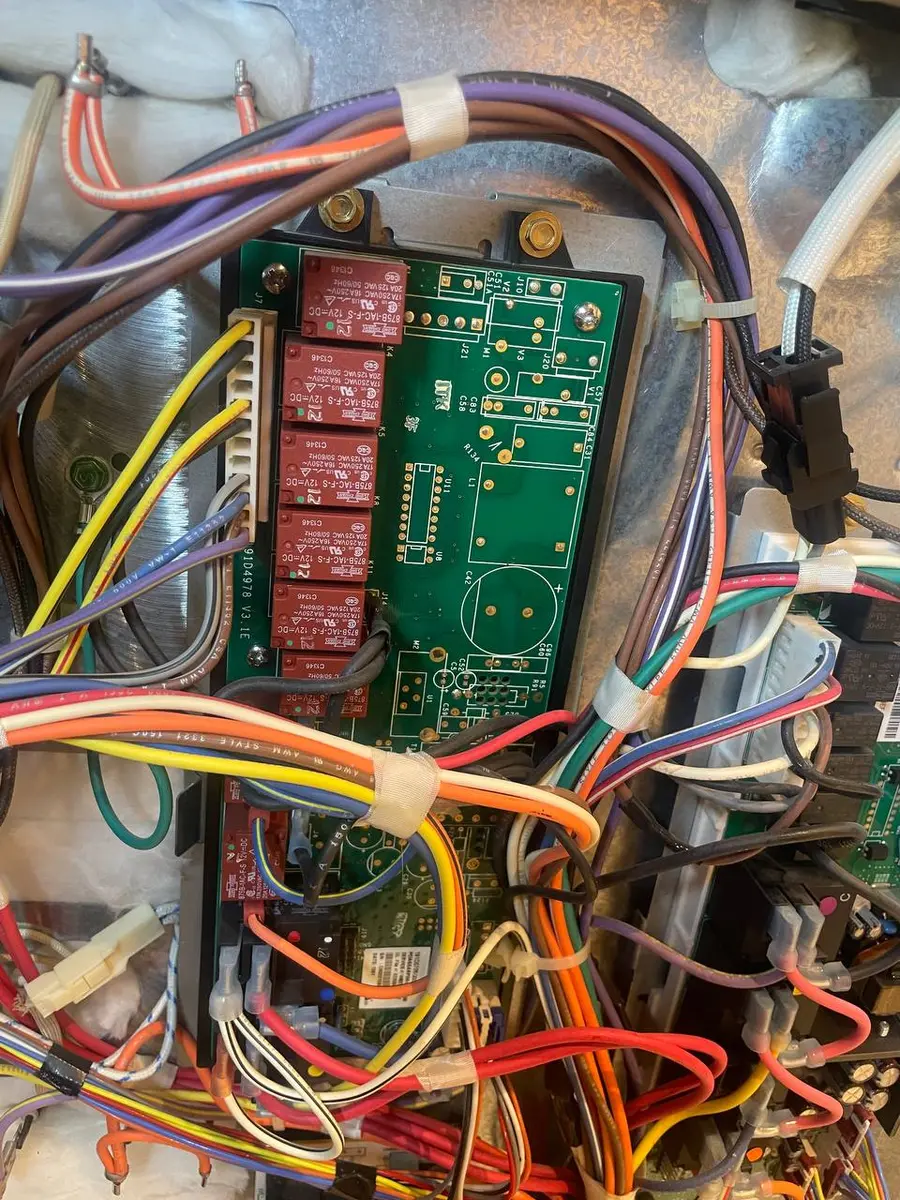
The ADC board determines when to initiate defrost. If it fails, defrost cycles never begin regardless of ice accumulation. On Whirlpool models, this board is typically located at the back of the refrigerator near the compressor or inside the control housing at the top.
Whirlpool diagnostic mode: On electronic-control models, enter diagnostic mode (varies by model — check tech sheet). The board should show defrost timer status and last defrost timestamp. If the system shows no recent defrost activity, the ADC may have failed.
4. Defrost Thermistor Drift (12% of cases)#
The thermistor provides temperature data to the ADC. If it reads inaccurately (reporting warmer temperatures than actual), the ADC may calculate that defrost is not needed when it actually is.
5. Wiring Harness Damage (8% of cases)#
The wires connecting defrost components route through the freezer cavity — a sub-zero environment. Over years, insulation becomes brittle and wire connections corrode. An intermittent open in the defrost circuit prevents reliable cycling.
Whirlpool Forced Defrost Procedure#
To manually force a defrost cycle for diagnosis:
Electronic control models: Enter diagnostic/service mode (model-specific — check tech sheet taped inside the unit). Navigate to the forced defrost test. The heater should energize and ice should begin melting within minutes.
Mechanical timer models (older): Advance the defrost timer manually using a flathead screwdriver on the timer dial. The compressor should stop and the defrost heater should energize.
If forced defrost works (ice melts, temperatures normalize), the defrost components themselves are functional — the ADC timing logic has failed.
The Real Cost of DIY
Average DIY attempt: $150-400 in tools you may use once, plus the risk of further damage. Our diagnostic visit costs $0 — we find the problem and give you an honest quote.
Licensed & Insured · 90-Day Warranty · Same-Day Service
Whirlpool Adaptive Defrost vs. Fixed-Timer Defrost#
| Feature | Adaptive (current models) | Fixed Timer (older models) |
|---|---|---|
| Defrost frequency | Based on usage patterns | Every 8-12 hours |
| Energy efficiency | Higher | Lower |
| Failure detection | Harder (irregular intervals) | Easier (predictable timing) |
| Control component | Electronic ADC board | Mechanical timer |
| Typical failure mode | Board logic failure | Timer motor failure |
EveryDrop Filter Connection#
A severely clogged EveryDrop water filter does not directly cause defrost cycle failure, but it can indirectly contribute: restricted water flow causes the ice maker to work harder and longer, generating additional heat and frost in the freezer that overwhelms the normal defrost schedule. Replace EveryDrop filters every 6 months per Whirlpool's recommendation.
Don't Void Your Warranty
Opening your appliance yourself may void the manufacturer warranty. Our repair comes with a 90-day guarantee, and we document everything for warranty compliance.
Licensed & Insured · 90-Day Warranty · Same-Day Service
How Can You Prevent This?#
- Do not block airflow vents inside the freezer — obstructed vents concentrate frost.
- Replace EveryDrop water filters every 6 months.
- Ensure door gaskets seal properly — warm air ingress increases frost accumulation.
- Minimize door open time and frequency.
- Check the condenser coils annually — dirty coils force longer compressor runtime, increasing frost.
FAQ#
Q: How do I know if my Whirlpool refrigerator has Adaptive Defrost?
All Whirlpool refrigerators manufactured after approximately 2005 use Adaptive Defrost. Older models have a mechanical defrost timer (visible dial usually near the temperature control). If your model has electronic controls (digital display), it uses Adaptive Defrost.
Q: My Whirlpool refrigerator has frost on the back wall of the freezer — is the defrost cycle failing?
Light frost on the rear panel is normal and will be cleared during the next defrost cycle. Heavy ice (1/4 inch or more) or ice covering the entire rear panel indicates the defrost cycle is not completing. Check the defrost heater and thermostat.
Q: How often should Whirlpool Adaptive Defrost run?
It varies by usage. Heavy-use households (frequent door openings, large families) may see defrost every 8-12 hours. Light-use situations may go 24-48 hours between defrosts. The ADC optimizes automatically.
Your Whirlpool refrigerator issue is likely a straightforward repair. Our [Sacramento](/sacramento/sacramento) and Bay Area technicians can diagnose it today. Schedule your repair
Lead Appliance Repair Technician · 12 years experience
Experienced technician with 12 years specializing in washing machine and dryer repairs across all major brands.