Whirlpool Refrigerator Burning Smell — Electrical Fault Identification
A burning smell from any appliance demands immediate attention. In Whirlpool refrigerators, this odor almost always originates from an electrical component overheating — either a motor winding breaking down, a relay arcing internally, or a control board component shorting. The smell may be acrid (electrical insulation burning), plasticky (wire coating melting), or oily (motor lubricant overheating). Each has a distinct character that helps locate the source.
Important safety note: if you see smoke, sparks, or discoloration on the power cord, unplug the refrigerator immediately and do not restore power until the fault is identified and repaired. Electrical smells without visible smoke are less urgent but should still be diagnosed within 24 hours.
Identifying the Source by Smell Location
Whirlpool WRF, WRS, and WRT refrigerators have electrical components in three distinct zones. Narrowing the smell to a zone identifies the suspect components:
Rear Bottom (Behind Access Panel)
This area contains the compressor, start relay, condenser fan motor, and their associated wiring. Burning smells from here account for approximately 70% of all refrigerator burning-odor complaints.
Inside the Freezer Compartment
The evaporator fan motor and defrost heater live behind the freezer rear panel. Burning smells detected when opening the freezer suggest fan motor bearing failure or a defrost heater contacting its wiring insulation.
Top Front (Behind Control Panel)
The main control board and temperature control components are located behind the upper panel or inside the console area. A burning smell from the top of the unit suggests board-level failure — often triggered by power surges.
Do You Have the Right Tools?
Refrigerant gauges ($200+), vacuum pump ($250), leak detector ($150), and EPA-certified recovery equipment. Our technician arrives with $15K+ in professional tools — your diagnostic is free.
Licensed & Insured · 90-Day Warranty · Same-Day Service
Most Common Causes
1. Compressor Start Relay Failure (35% of cases)
The start relay is a small component mounted directly on the compressor that provides the initial high-current pulse needed to start the compressor motor. When the internal contacts in this relay weld or arc, they generate significant heat — enough to melt the relay housing and produce a distinctive acrid burning smell. This is the single most common source of burning odor in Whirlpool refrigerators.
You will notice two symptoms simultaneously: the burning smell from the rear bottom area, and a clicking sound every 2-5 minutes as the compressor attempts to start, fails, and the relay cuts power before resetting. The refrigerator stops cooling because the compressor cannot run.
Whirlpool's compressor start relay is a universal service part across their entire refrigerator line. The same relay design has been used for decades, making it one of the most widely-stocked replacement parts in the appliance industry.
Diagnosis: Unplug the refrigerator immediately. Remove the rear lower access panel (two 1/4-inch hex screws). Locate the start relay on the side of the compressor — it is a small rectangular or cylindrical component with wires attached. Pull it straight off the compressor pins. If the relay housing is melted, discolored, or smells burnt, it has failed. Shake the relay — a rattle inside also confirms failure (broken internal contacts).
DIY Difficulty: Easy — 5-minute repair Parts Cost: $15–$40 Professional Repair Cost: $100–$180
Repair Steps:
- Unplug the refrigerator.
- Remove the rear lower access panel.
- Pull the start relay straight off the compressor terminal pins.
- Note the orientation — the relay connects in a specific direction (the connector is keyed and only fits one way).
- Push the new relay firmly onto the compressor pins until seated.
- Replace the access panel and restore power.
- The compressor should start within 1-2 minutes. If it does not start and you hear clicking, the compressor itself may have seized.
2. Condenser Fan Motor Overheating (25% of cases)
The condenser fan motor pulls air across the condenser coils and compressor to dissipate heat. When the motor bearings dry out or the shaft seizes from debris wrapping (pet hair is the primary culprit in Sacramento homes with dogs or cats), the motor continues drawing electrical current but cannot spin freely. This electrical energy converts to heat in the motor windings, eventually melting the wire insulation and producing a burning smell.
A failing condenser fan motor typically provides warning signs before reaching the burning-smell stage: increased buzzing or humming from the rear bottom area, intermittent operation, or reduced airflow from the rear of the unit. By the time you smell burning, the motor windings may be permanently damaged.
Diagnosis: With the refrigerator unplugged, spin the condenser fan blade by hand. If it resists rotation, wobbles excessively on the shaft, or the motor housing is hot to the touch (even after being unplugged for 30 minutes), the motor has been overheating. Inspect the motor for discoloration or melted wire insulation visible through the housing.
DIY Difficulty: Easy Parts Cost: $25–$65 Professional Repair Cost: $120–$240
Repair Steps:
- Unplug the refrigerator.
- Remove the rear lower access panel.
- Disconnect the fan motor wire harness connector.
- Remove the two mounting screws holding the motor bracket.
- Slide the fan blade off the old motor shaft (some are press-fit, some have a clip).
- Transfer the blade to the new motor shaft.
- Mount the new motor, reconnect the harness, and verify the blade spins freely without contacting anything.
3. Evaporator Fan Motor Bearing Failure (15% of cases)
The evaporator fan motor operates inside the freezer compartment behind the rear panel. Unlike the condenser fan which operates at room temperature, the evaporator fan runs in sub-zero conditions. When lubricant in the sealed bearings degrades (typically after 10-12 years), friction increases progressively. The motor draws more current to maintain speed, heating the bearings further, eventually producing a burnt-oil smell that you notice when opening the freezer door.
If the Adaptive Defrost system has also failed, ice may be forcing the fan blade while the motor fights against it — dramatically accelerating the overheating condition. You may smell burning AND hear grinding/scraping simultaneously.
Diagnosis: Open the freezer and press the door switch (light switch) to activate the fan. Listen for grinding, squealing, or unusual sounds. A burnt smell specifically when the freezer door is open confirms the source is inside the freezer compartment. Remove the rear panel to inspect the motor directly.
DIY Difficulty: Moderate Parts Cost: $30–$75 Professional Repair Cost: $130–$260
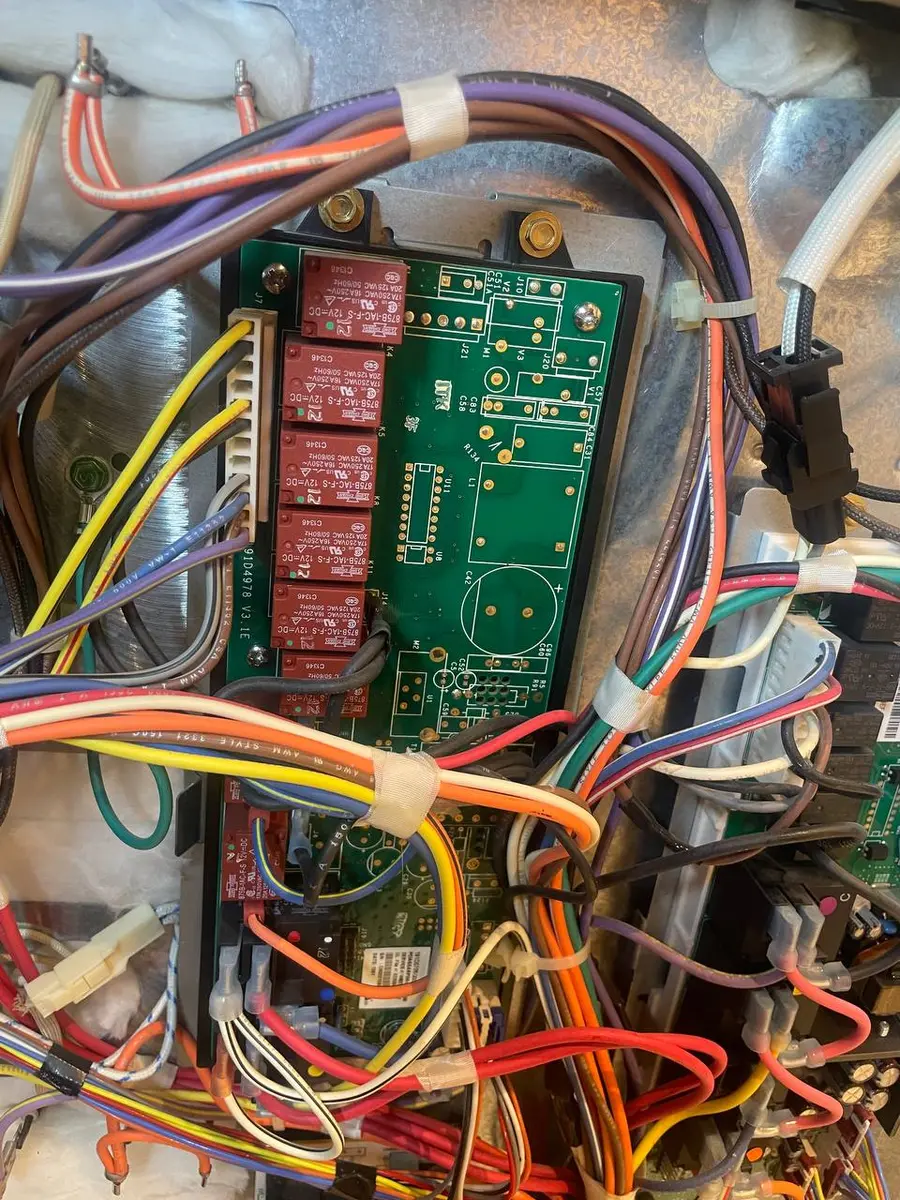
4. Control Board Component Failure (15% of cases)
Whirlpool refrigerator control boards contain electrolytic capacitors, relay coils, and voltage regulator components that can fail catastrophically — especially after power surges. When a capacitor vents (releases its electrolyte), it produces a sharp chemical/burnt smell. A shorted relay coil on the board smells like burnt wire insulation.
Power surges during Sacramento summer thunderstorms and PGE load-switching events are common triggers. Whirlpool control boards are particularly vulnerable because refrigerators are powered continuously and cannot be turned off during storms.
Diagnosis: Locate the control board (behind the temperature control panel inside the refrigerator section, or behind the upper console panel on French door models). Inspect for: bulging or leaking capacitors (cylindrical components with X-shaped vent marks on top), burnt or discolored areas on the board surface, melted connector pins, or obviously charred components.
DIY Difficulty: Moderate (diagnosis) to Easy (board swap) Parts Cost: $50–$200 (model-specific) Professional Repair Cost: $180–$400
5. Defrost Heater Wire Insulation Contact (10% of cases)
The defrost heater is positioned beneath the evaporator coils inside the freezer. Its wire connections pass through the freezer wall insulation. If these wires shift during service or from vibration, they may contact the hot heater element during defrost cycles. The insulation melts, producing a burning smell you notice when opening the freezer.
This is intermittent — the smell only appears during or immediately after an Adaptive Defrost cycle (every 8-24 hours depending on usage). If the burning smell comes and goes on a regular cycle rather than being constant, this is the likely source.
Diagnosis: Access the evaporator by removing the freezer rear panel. Inspect the defrost heater wire connections for melted insulation, discoloration, or proximity to the heater element. Look for wire strands that have shifted from their designed routing.
DIY Difficulty: Moderate Parts Cost: $10–$30 (wire repair) or $30–$75 (heater replacement) Professional Repair Cost: $130–$250
Immediate Safety Steps
- If you see smoke or sparks: Unplug immediately. Do not restore power until professionally inspected.
- If you smell burning but see no smoke: Unplug within 15 minutes. Active overheating will worsen.
- Locate the smell zone: Rear bottom, inside freezer, or top/front.
- After unplugging, wait 30 minutes then inspect the zone for heat, discoloration, or melted components.
- Do not restore power until the failed component is identified and replaced.
Same-Day Appliance Repair
Fixed or It's Free
$89 → $0 Service Call & Diagnosis — offer ends May 25
Safety First — Know the Risks
Refrigerant (R-134a/R-600a) requires EPA certification to handle. Improper discharge is a federal violation and health hazard. Our techs are licensed and insured — let them handle the risk.
Licensed & Insured · 90-Day Warranty · Same-Day Service
Prevention
- Clean the condenser area every 6 months — debris causes fan motor overload.
- Install a surge protector — protects the control board from voltage spikes.
- Do not use extension cords — voltage drop makes motors run hotter.
- Listen for changing motor sounds — increasing noise often precedes the burning stage by days.
- Check the start relay proactively — during condenser cleaning, shake the relay. If it rattles, replace it preemptively.
FAQ
Q: Is a burning smell from my Whirlpool refrigerator dangerous?
It indicates active electrical overheating. The immediate fire risk is low (components have thermal protection), but you should unplug and identify the source within 24 hours. Never ignore a persistent burning smell.
Q: The burning smell only appears when I open the freezer — what does this mean?
The source is inside the freezer: either the evaporator fan motor bearings or the defrost heater wiring. If the smell appears on a regular cycle (every 8-24 hours), it correlates with the Adaptive Defrost cycle.
Q: Can a power surge cause a burning smell in my refrigerator?
Yes. Surges cause immediate capacitor failure on the control board, producing a sharp burnt-chemical odor. The board typically needs replacement after a surge event that produces burning smell.
Burning smell from your Whirlpool refrigerator? Unplug and call for diagnosis. Our technicians carry start relays, fan motors, and control boards for same-visit repair. Schedule a repair →