Most Likely Cause#
On a Samsung refrigerator that is completely dead — no interior light, no panel, no fans — the single most common failure is the main control board (PCB), which we trace in roughly 35% of no-power cases. The reason is structural: Samsung routes wall power through one board that converts AC to DC and then feeds every other component, so when that board dies the whole unit goes dark at once. Before you condemn it, though, four cheaper faults can look identical from the front of the fridge.
A truly dead Samsung is a different problem from one that hums but won't cool. If the interior light still comes on when the door opens, or the panel shows any segment at all, you are not looking at total power loss — jump to the demo-mode and control-lock checks below. Everything else in this guide assumes nothing on the unit responds.
Fault Map: Cause by What You See#
| What you observe | Most likely cause | How often | Part to look at |
|---|---|---|---|
| Nothing at all — no light, no panel, no fans | Main control board (PCB) failure | ~35% | DA92-00384B (RF28), DA41-00651A (RS), DA92-00233D (RF263) |
| Dead right after the fridge was moved or pushed back | Power cord unseated or pinched at the strain relief | ~25% | wall cord / NEMA 5-15 plug |
| Kitchen circuit or GFCI keeps tripping | Breaker or GFCI tripped by startup inrush | ~20% | 15A / 20A branch circuit |
| Panel lights up but the compressor never starts | Compressor start relay open | ~12% | DA35-00099A |
| Runs, then clicks off; coils caked with dust | Compressor overload protector latched | ~8% | overload / relay pack |
Do You Have the Right Tools?
Refrigerant gauges ($200+), vacuum pump ($250), leak detector ($150), and EPA-certified recovery equipment. Our technician arrives with $3,000+ in professional tools — your diagnostic is free.
Licensed & Insured · 90-Day Warranty · Same-Day Service
Five-Minute Checks Before You Open Anything#
Work these in order — most "dead" Samsungs are solved here without tools.
- Prove the outlet. Plug a lamp or a phone charger into the same receptacle. A healthy Samsung draws only 2-6 amps while running but demands a brief 15-20 amp inrush the instant the compressor kicks in, which is more than enough to trip a tired GFCI. If the outlet itself is dead, the fridge never stood a chance.
- Reseat the cord. French-door Samsungs weigh 280-340 lbs and creep on smooth floors; the cord exits low at the back and works loose or kinks against the wall. Pull the unit out, unplug it, inspect the cord for crushing at the strain relief where it leaves the cabinet, then push the plug fully home.
- Rule out demo mode. If the display does wake and reads "OF OF" or "O FF" while nothing else runs, the unit is in showroom demo mode, not broken. Hold Energy Saver + Lighting for about 10 seconds (some models use Fridge + Freezer instead) and the compressor should spin up within 30-60 seconds.
- Clear a control lock. A held Child Lock (about 3 seconds) disables the whole panel and can read as a frozen display. Toggle it off before you assume the electronics have failed.
- Power-cycle once. Unplug for a full 60 seconds and plug back in. That clears a latched protection state or a stuck fault code; if the fridge comes back to life, the trigger was a transient power event rather than dead hardware.
Diagnosing the Control Board#
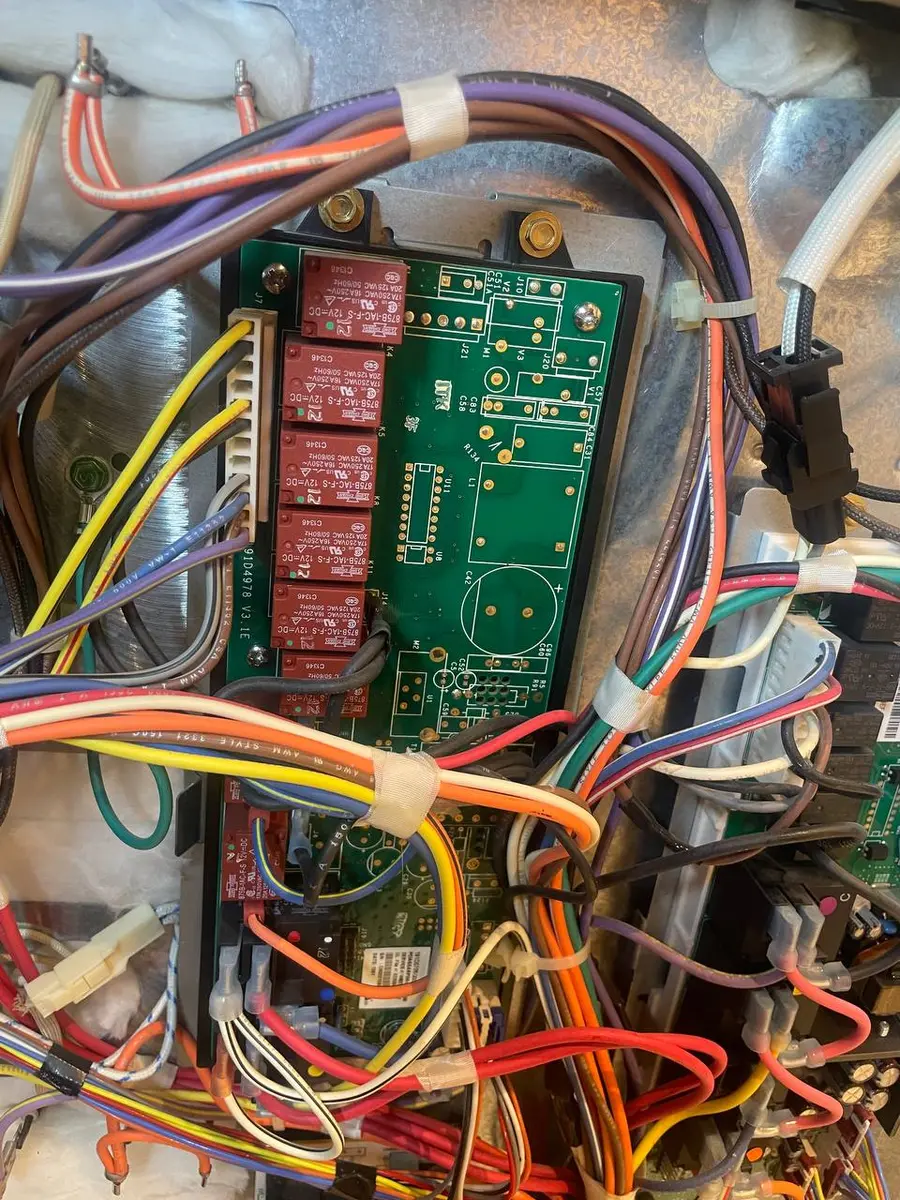
Reach the board through the rear lower access panel — four Phillips screws. Samsung mounts the main PCB close to the compressor. Look first for the obvious: a blown glass fuse on the board, scorched components, or a capacitor with a domed top. Then, with a meter, confirm that 120V AC is actually arriving at the board's line-input terminals. If line voltage is present but nothing leaves the board, the PCB is the fault. Some boards carry a small onboard LED that lights when power is received; no LED with good input voltage is another board-dead tell.
Samsung PCBs are notoriously surge-sensitive — a single spike can burn one trace and kill an otherwise healthy fridge, which is why storm-related deaths so often turn out to be the board. Match the replacement to your cabinet: DA92-00384B for the RF28 french-door line, DA41-00651A for RS side-by-side, and DA92-00233D for the RF263 family. The connectors are keyed and plug-and-play, which is what keeps a board swap a moderate job rather than an expert one — the risk is in mapping the connectors correctly, not in soldering.
Safety First — Know the Risks
Refrigerant (R-134a/R-600a) requires EPA certification to handle. Improper discharge is a federal violation and health hazard. Our techs are licensed and insured — let them handle the risk.
Licensed & Insured · 90-Day Warranty · Same-Day Service
When It's the Compressor Start Relay#
The start relay clips onto the side of the compressor and gives it the initial kick to start turning. When it opens, the compressor stays silent even though the panel and lights work normally — so at a glance the fridge looks alive but simply "won't start." Pull the relay off and shake it: an internal rattle means the contact has broken. A meter should read continuity between the start and run terminals. Across most RF and RS models the Samsung part is DA35-00099A, and it is one of the easiest components on the whole appliance to change.
One wrinkle is specific to Samsung: on some boards a locked-rotor condition — relay dead, compressor straining and drawing hard — is interpreted as a fault, and the board shuts the entire unit down to protect it. That makes a failed relay masquerade as a dead board, so test the relay before you spend on electronics.
The Breaker Rule You Must Not Ignore#
If the breaker trips immediately when the fridge is plugged in, do not keep resetting it — that points to a short circuit, most often in the PCB or compressor wiring, and repeated resets can turn a repair into a fire. A breaker that holds for a while and then trips is usually a shared-circuit problem; Samsung specifies a dedicated 15A circuit for the refrigerator. GFCI receptacles nuisance-trip on fridges, and where local code allows a non-GFCI dedicated circuit, moving the refrigerator off the GFCI ends the silent, food-spoiling trips.
The Real Cost of DIY
Average DIY attempt: $150-400 in tools you may use once, plus the risk of further damage. Our diagnostic visit costs $0 — we find the problem and give you an honest quote.
Licensed & Insured · 90-Day Warranty · Same-Day Service
Dead-Fridge Diagnostic Sequence#
When you want one path to follow instead of a scatter of checks, work this top to bottom and stop at the first failure you find:
- Is there power at the outlet? Test it with another device. No power means the fault is upstream — the breaker, GFCI, or outlet, not the refrigerator itself.
- Does the panel light at all? A panel reading "OF OF" is demo mode; a normal panel with no cooling is a compressor or relay problem; a completely dark panel points at the board or the cord.
- Does the interior lamp come on with the door? A lamp but no panel or cooling suggests a partial board failure; no lamp anywhere means power is simply not reaching the unit.
- With the back panel off, is 120V present at the board input? Voltage arriving but nothing leaving condemns the board.
- Does the start relay rattle or fail a continuity check? If it does, replace the relay before you spend anything on electronics.
Cost and Repair-or-Replace#
These five faults span a very wide cost range. A start relay is one of the cheapest parts in the entire appliance and a genuinely easy fix; a reseated cord or a reset breaker costs nothing at all. A main control board sits at the top of the range and is the one repair worth pricing against the age of the unit. The practical rule: a relay, cord, or breaker fix is always worth doing, while a board replacement on a fridge already past warranty is where you weigh repair against a new unit. If you would rather not pull the fridge out and open the back, you can schedule a visit and we'll bring the common Samsung boards and relays with us.
Don't Void Your Warranty
Opening your appliance yourself may void the manufacturer warranty. Our repair comes with a 90-day guarantee, and we document everything for warranty compliance.
Licensed & Insured · 90-Day Warranty · Same-Day Service
Preventing Another Power Death#
- Add a refrigerator-rated surge protector. The PCB is the sacrificial part in a surge, so protecting it is the cheapest insurance against the most expensive repair.
- Give it a dedicated 15A circuit instead of sharing with a microwave or toaster that can trip the breaker on inrush.
- Route the cord clear so it can't pinch or kink when the cabinet is pushed back against the wall.
- Vacuum the condenser coils twice a year so the compressor never overheats into an overload lockout in the first place.
Senior Appliance Repair Technician · 15 years experience
EPA-certified technician with 15 years of experience specializing in refrigerator and cooling system repairs.