A Samsung refrigerator that trips the breaker is telling you something failed — most often a shorted compressor start relay, a compressor winding leaking to ground, a shorted main board, or simply too many appliances sharing the circuit. How fast it trips after you reset is the clearest clue, and an immediate trip means stop resetting and diagnose.
What a Samsung Fridge Actually Draws#
Context makes the fault obvious. At cruise, the Digital Inverter Compressor sips only a few amps at 120V; startup inrush spikes to eight to fifteen amps for a second or two, and an active defrost heater adds several more, so the worst-case combined draw is well under twenty amps when the compressor kicks in mid-defrost. On its own dedicated 15A circuit, a healthy Samsung refrigerator should never trip. If yours does, either something inside has shorted or the circuit is carrying more than the fridge.
Do You Have the Right Tools?
Refrigerant gauges ($200+), vacuum pump ($250), leak detector ($150), and EPA-certified recovery equipment. Our technician arrives with $3,000+ in professional tools — your diagnostic is free.
Licensed & Insured · 90-Day Warranty · Same-Day Service
Let the Timing Name the Fault#
Before opening anything, note the pattern. A trip the instant you plug in — before the compressor even tries to start — points at an always-live short in the main board or a compressor winding faulted to ground. A trip a second or few after plug-in, as the compressor attempts to start, points at the start relay. A trip only after several minutes points at compressor overheating from dirty coils. A trip only when the microwave or toaster also runs points at a shared circuit, not the fridge at all. And a random, occasional trip points at a sensitive GFCI. That single observation routes the rest of your diagnosis.
The Causes, Most Common First#
Shared-circuit overload (about 30%)#
The most frequent "trip" is not a fault at all. Samsung specifies a dedicated 15A or 20A circuit, and when the fridge instead shares a line with a microwave, toaster, or [dishwasher](/blog/repair-or-replace-dishwasher), running them together easily tops the breaker. The test is simple: does it only trip when other kitchen appliances are on? Move the fridge to a different circuit temporarily to confirm, then have an electrician run a dedicated line — code allows that circuit to be non-GFCI in many areas.
Compressor start relay short (about 25%)#
Samsung's compact start relay (part DA35-00099A) is supposed to energize the compressor's start winding briefly and then drop out. When it shorts internally it keeps that winding energized continuously, drawing far too much current — sometimes over twenty amps — and tripping the breaker within seconds of plug-in, often with a burning smell. Confirm it by unplugging, pulling the relay straight off the compressor's side terminals, and plugging back in: if the breaker now holds but the compressor doesn't run, the relay was your short. It's an inexpensive, easy swap.
Compressor winding short to ground (about 20%)#
The compressor motor windings can break down and short to the metal housing, drawing a massive surge the instant the compressor energizes. With the start relay removed, meter from each compressor terminal to the housing — any reading below about one megohm means the insulation has failed. This one is not a DIY fix: it needs a compressor replacement by an EPA-certified technician for the refrigerant, though Samsung's Digital Inverter Compressor carries a ten-year warranty that may cover the part.
Main board short (about 15%)#
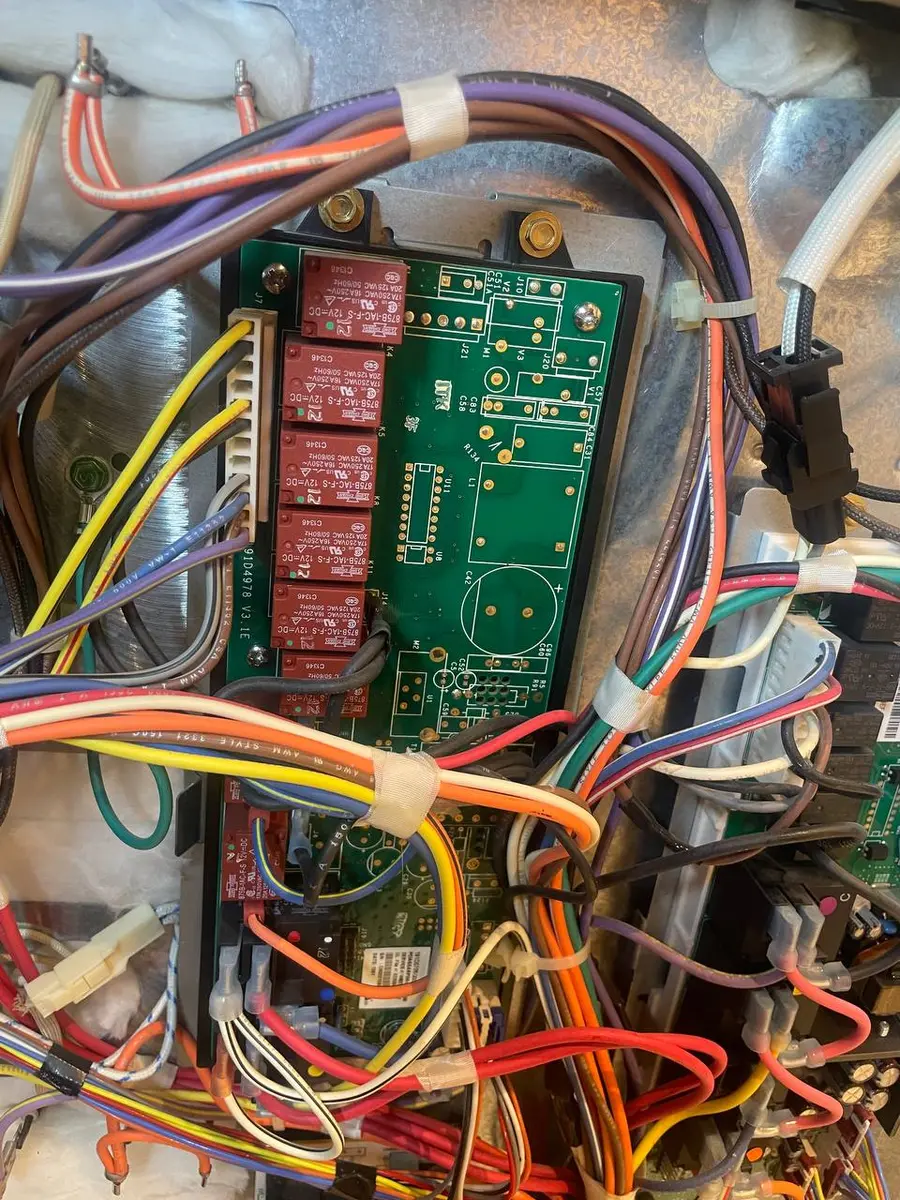
A power surge can fry a component on the main PCB into a dead short that draws current the moment power is applied, so the breaker trips immediately at plug-in just like a compressor ground fault. The difference is where the burn shows: pull the lower rear panel and look at the board (part DA92-00384B on RF28 models, DA41-00651A on RS models) for a blackened or scorched area that pinpoints the short.
GFCI sensitivity (about 10%)#
Samsung's inverter drive generates high-frequency switching noise that a sensitive GFCI can read as a ground fault, tripping on as little as five milliamps of apparent imbalance even with nothing wrong. Samsung specifically does not recommend GFCI outlets for their refrigerators for this reason. If everything tests clean and the trips are random, a non-GFCI dedicated circuit — where code permits — is the cure.
Compressor overheating from dirty coils#
One more pattern deserves its own note because it masquerades as an electrical fault: a trip that only comes after the fridge has run for several minutes. When the condenser coils are choked with dust, the compressor cannot shed heat, so it works harder, draws more current, and eventually trips the breaker as it overheats — and repeated overheating is exactly what degrades the start relay and winding insulation into the shorts above. Pull the fridge out, vacuum the coils at the back or beneath the unit, and give it clearance to breathe. If clean coils stop the delayed trips, you caught the problem before it turned into a relay or compressor replacement.
Safety First — Know the Risks
Refrigerant (R-134a/R-600a) requires EPA certification to handle. Improper discharge is a federal violation and health hazard. Our techs are licensed and insured — let them handle the risk.
Licensed & Insured · 90-Day Warranty · Same-Day Service
Dangerous or Just a Nuisance?#
Sort the pattern by severity. An immediate trip at plug-in is the dangerous kind — a real short in the board or compressor — and you must not keep resetting it, because each trip arcs the breaker contacts and three rapid resets can wreck the breaker itself. A trip within a few seconds is the start relay, moderate and cheap. A trip after several minutes is usually overheating from dirty condenser coils — clean them. A trip only alongside other appliances is an overloaded shared circuit, and a random occasional trip is GFCI sensitivity. Diagnose before you reset, every time.
Prevent repeats with a surge protector to spare the board, a dedicated non-GFCI circuit to end overloads, and clean condenser coils so the compressor never overheats and cooks its own relay and windings. Related reading: a Samsung refrigerator that won't start and Samsung refrigerator error codes.
Samsung [refrigerator repair](/bay-area/services/refrigerator-repair) across [Sacramento](/sacramento/sacramento) and the Bay Area — relay, board, and compressor diagnostics in one visit. Book a technician.
Senior Appliance Repair Technician · 15 years experience
EPA-certified technician with 15 years of experience specializing in refrigerator and cooling system repairs.