LG Refrigerator Frost and Ice Buildup — Defrost System Failures Explained
Frost accumulation inside an LG refrigerator signals a failure in the automatic defrost cycle, a door seal breach allowing humid air infiltration, or an overcooling condition caused by the Linear Compressor's variable-speed operation. LG's frost-free refrigerators rely on a timed defrost cycle that activates the evaporator heater approximately every 8-12 hours, melting accumulated frost from the evaporator coils and draining the melt water through a drain tube to an evaporation pan near the compressor. When any component in this chain fails, ice accumulates rapidly on the evaporator coils, eventually blocking airflow and causing both temperature irregularities and unusual sounds.
How LG's Defrost System Works
LG French Door and Side-by-Side refrigerators use an adaptive defrost system controlled by the main PCB (printed circuit board). Unlike older timer-based systems that defrost on a fixed schedule regardless of conditions, LG's system monitors door opening frequency, compressor run time, and temperature sensor data to determine optimal defrost timing.
The defrost cycle involves three key components working in sequence:
- Defrost Heater — A resistance heating element mounted directly beneath or alongside the evaporator coils. When activated, it raises the evaporator temperature above 32°F to melt accumulated frost.
- Defrost Thermostat (bi-metal) — A temperature-sensitive safety switch mounted on the evaporator that terminates the defrost cycle when the coil temperature reaches approximately 50°F, preventing overheating.
- Defrost Drain Assembly — A tube and trough system that collects melt water and routes it to the evaporation pan near the compressor. LG uses a drain strap heater on many models to prevent the drain itself from freezing.
Do You Have the Right Tools?
Refrigerant gauges ($200+), vacuum pump ($250), leak detector ($150), and EPA-certified recovery equipment. Our technician arrives with $15K+ in professional tools — your diagnostic is free.
Licensed & Insured · 90-Day Warranty · Same-Day Service
Primary Causes of Frost Buildup
1. Defrost Heater Failure (30% of cases)
The defrost heater is the most common failure point in LG's defrost system. It is a glass-enclosed resistance wire element that operates at high temperatures during defrost cycles. Over time, the heating element develops hot spots and eventually burns through, creating an open circuit that prevents any heating during the defrost cycle.
On LG French Door models (LRMVS, LRFXS series), the defrost heater is located behind the rear panel inside the freezer compartment. Accessing it requires removing the ice maker (1 Phillips screw), the ice duct, and the rear freezer panel (6-8 Phillips screws plus 2-3 clips).
Diagnosis:
- Heavy frost accumulation concentrated on the evaporator coils (visible behind the freezer rear panel).
- The refrigerator may display error code Er dH (defrost heater) indicating a failed heater circuit.
- Use a multimeter to test continuity across the heater terminals — an open circuit (infinite resistance) confirms heater failure.
- The refrigerator compartment gradually warms while the freezer remains cold (frost blocks the evaporator airflow that feeds the refrigerator section).
DIY Difficulty: Moderate to Difficult — extensive panel removal, electrical connections Parts Cost: $40-100 Professional Repair Cost: $200-380
2. Defrost Thermostat Failure (20% of cases)
The defrost thermostat (bi-metal cutoff) is a safety device that serves dual functions: it prevents the defrost heater from activating when the evaporator is already warm (preventing wasted energy), and it terminates the defrost cycle when coil temperature reaches the safe upper limit. When this thermostat fails in the open position, it breaks the defrost heater circuit entirely — the heater cannot receive power regardless of the defrost timer's commands.
LG mounts the defrost thermostat directly on the evaporator coil assembly, typically at the top of the evaporator. It is connected in series with the defrost heater, so a failed thermostat has the same symptom as a failed heater: no defrost occurs, and frost accumulates continuously.
Diagnosis:
- Symptoms are identical to defrost heater failure (heavy evaporator frost, Er dH code possible).
- Test the thermostat separately: at room temperature, it should show continuity (closed circuit). If open at room temperature, it is failed.
- Replacement requires the same freezer panel removal as the defrost heater — both components are typically replaced together during a service call.
DIY Difficulty: Moderate — same access as defrost heater Parts Cost: $15-40 Professional Repair Cost: $180-320 (often combined with heater replacement)
3. Defrost Drain Blockage (20% of cases)
The defrost drain tube routes melt water from the evaporator trough to the external evaporation pan. In LG refrigerators, this drain tube passes through the freezer wall into the machine compartment. The tube's exit point is prone to freezing because it transitions from the warm defrost environment to the sub-zero freezer wall temperature. When this tube freezes shut, melt water from subsequent defrost cycles has nowhere to go — it refreezes on the evaporator coils, accumulates in the drain trough, and eventually overflows as ice buildup inside the freezer compartment or water leaking onto the floor below.
LG includes a drain strap heater on many newer models to combat this issue, but the heater itself can fail or its wiring can become disconnected during service.
Diagnosis:
- Ice forming specifically at the bottom of the freezer compartment (drain trough area) rather than uniformly across the evaporator.
- Water leaking from the freezer onto the floor below the unit.
- The defrost cycle may be functioning normally (heater works) but water is refreezing in the drain rather than exiting the unit.
- Pour a small amount of warm water into the drain opening — if it pools rather than flowing through, the drain is blocked.
DIY Difficulty: Moderate — hot water flushing may clear the blockage; persistent freezing requires drain heater repair Parts Cost: $10-30 (drain strap heater) or $0 (manual defrost with hot water) Professional Repair Cost: $150-280
4. Door Gasket Seal Failure (15% of cases)
LG's Door-in-Door and InstaView configurations use more complex gasket geometry than standard single-door designs. The InstaView panel adds an additional seal surface that must maintain contact when the outer door-in-door section is closed. Warm, humid air leaking past a compromised gasket introduces moisture continuously into the freezer environment, where it deposits as frost on the evaporator coils faster than the defrost system can manage.
In the San Francisco Bay Area's humid coastal climate, gasket degradation accelerates frost problems because incoming air carries significantly more moisture than in drier inland regions. Even a small gasket gap admits enough humidity to overwhelm the defrost cycle during extended periods of coastal fog.
Diagnosis:
- Frost accumulation is gradual and progressive over weeks/months rather than sudden.
- Close the door on a dollar bill at various points around the gasket perimeter — the bill should require moderate force to pull free. Easy removal at any point indicates a seal gap.
- Inspect the gasket visually for tears, deformation, or debris embedded in the magnetic strip area.
- On Door-in-Door models, check both the main gasket AND the door-in-door section's inner seal.
DIY Difficulty: Easy to Moderate — gasket replacement is straightforward; door-in-door alignment may require adjustment Parts Cost: $50-120 (main door gasket) Professional Repair Cost: $130-280
5. Evaporator Fan Icing (10% of cases)
When frost accumulates on the evaporator coils due to any of the above causes, it eventually reaches the evaporator fan blade. The fan strikes the ice during rotation, producing audible scraping sounds and reducing airflow. In advanced cases, the ice encases the fan blade entirely, stalling the motor. Error code Er FF (freezer fan failure) may appear even though the motor itself is functional — it is simply trapped in ice.
Diagnosis:
- Scraping or clicking sounds from inside the freezer wall that stop when the door is opened (door switch deactivates the fan).
- Error code Er FF displayed on the control panel.
- Removing the freezer rear panel reveals ice encasing the fan assembly.
DIY Difficulty: Moderate — panel removal plus manual defrost; must also address root cause Parts Cost: $0 (manual defrost) to $40-80 (fan motor if damaged by icing) Professional Repair Cost: $150-300
6. Main Control Board Defrost Logic Failure (5% of cases)
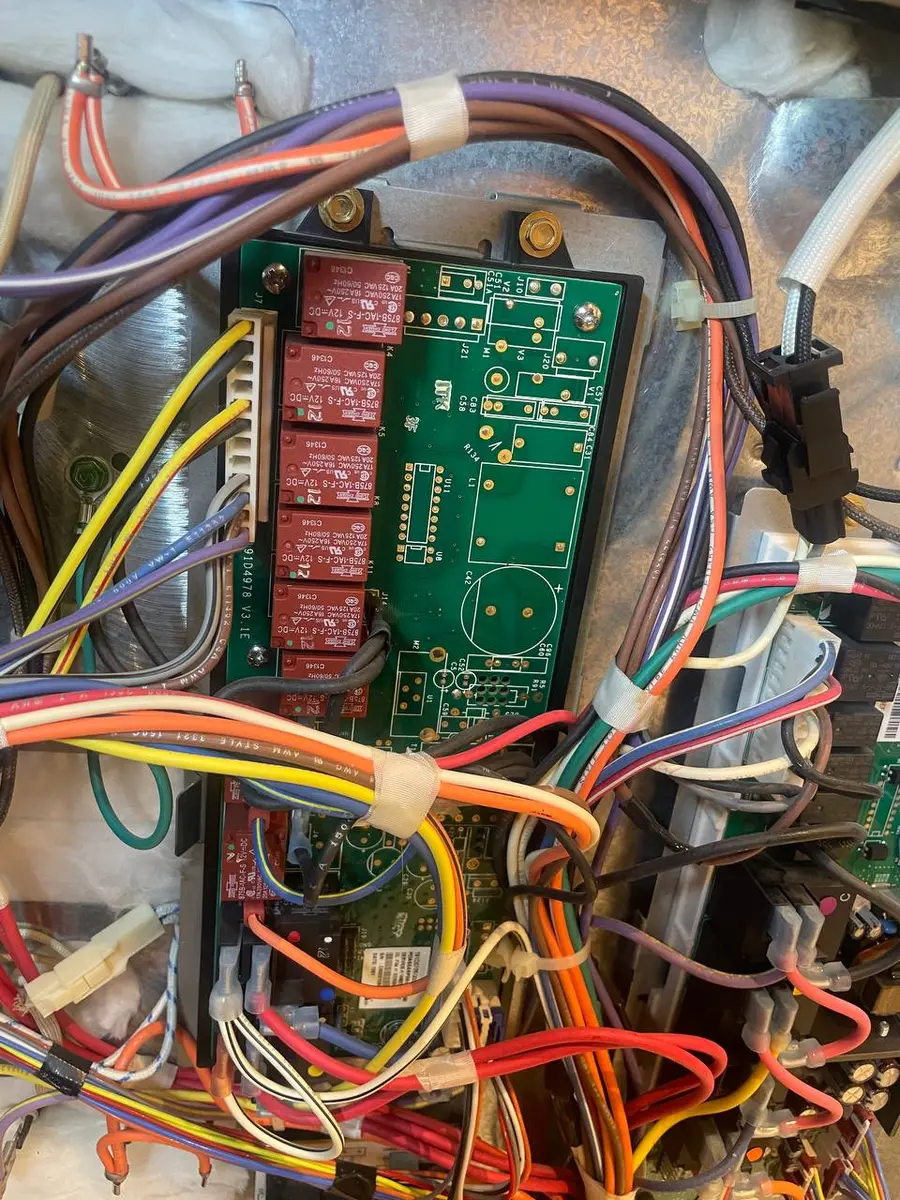
The main PCB controls defrost timing. When the board's defrost relay or timer circuit fails, the system never initiates a defrost cycle regardless of accumulated compressor run time. This is the most difficult frost buildup cause to diagnose because there is no visible component failure — the heater, thermostat, and drain all test normal, but defrost simply never activates.
LG's boards are sensitive to voltage spikes, particularly during Sacramento's summer thunderstorm season when brief power surges can damage relay contacts on the PCB.
Diagnosis:
- All defrost components test good individually (heater has continuity, thermostat closes, drain is clear) but frost still accumulates.
- Force a manual defrost cycle through the service mode (press and hold Freezer + Refrigerator temp buttons simultaneously for 5 seconds on most models). If the heater activates during manual defrost but never on its own, the board's automatic defrost logic has failed.
- Check the board visually for burned relay contacts or discolored components.
DIY Difficulty: Moderate — board is accessible behind the rear upper panel; requires disconnecting multiple wire harnesses Parts Cost: $100-250 Professional Repair Cost: $250-450
Emergency Manual Defrost Procedure
If frost has accumulated to the point of blocking airflow (symptoms: freezer extremely cold, refrigerator warm, scraping fan noise):
- Remove all food from the freezer and refrigerator compartments.
- Unplug the refrigerator completely.
- Place towels on the floor around the base and inside the freezer floor to catch melt water.
- Leave doors open for 12-24 hours (or use a hair dryer on LOW heat from 12+ inches away to accelerate — never use high heat or direct steam near electronics).
- Once all ice has melted, clean the drain trough and drain opening with warm water.
- Plug the unit back in and set temperatures to factory recommendations (37°F refrigerator, 0°F freezer).
- If frost returns within 1-2 weeks, a defrost system component has failed and requires repair.
Safety First — Know the Risks
Refrigerant (R-134a/R-600a) requires EPA certification to handle. Improper discharge is a federal violation and health hazard. Our techs are licensed and insured — let them handle the risk.
Licensed & Insured · 90-Day Warranty · Same-Day Service
LG Error Codes Related to Frost Buildup
| Code | Meaning | Component |
|---|---|---|
| Er dH | Defrost heater circuit open | Heater or thermostat |
| Er FS | Freezer sensor fault | Temperature sensor |
| Er FF | Freezer fan failure | Fan motor or ice obstruction |
| Er CO | Communication error | Main board to compressor board |
Same-Day Appliance Repair
Fixed or It's Free
$89 → $0 Service Call & Diagnosis — offer ends May 25
Prevention Strategies
- Minimize door opening frequency and duration — each opening introduces humid air (particularly important during Sacramento's humid winter fog events and Bay Area coastal conditions).
- Verify door gasket integrity every 6 months using the dollar-bill test.
- Keep the freezer stocked at least 75% capacity — thermal mass stabilizes temperature during door openings and reduces frost formation.
- Do not set the freezer below -2°F — overcooling increases strain on the defrost system without improving food preservation.
- Schedule annual professional inspection of the defrost system components before Sacramento's monsoon-humidity summer months.
The Real Cost of DIY
Average DIY attempt: $150-400 in tools you may use once, plus the risk of further damage. Our diagnostic visit costs $0 — we find the problem and give you an honest quote.
Licensed & Insured · 90-Day Warranty · Same-Day Service
Frequently Asked Questions
Q: Why does my LG refrigerator keep icing up after defrosting?
Recurring frost after manual defrost indicates a failed defrost system component. The most common is the defrost heater (30% of cases), followed by the thermostat and drain blockage. Manual defrosting treats the symptom but not the cause — the frost will return within 1-3 weeks until the failed component is replaced.
Q: What does Er dH mean on my LG refrigerator?
Er dH indicates the defrost heater circuit is open (broken). This means either the heater element itself has burned through or the defrost thermostat (bi-metal) has failed in the open position. Both components should be tested with a multimeter. Many technicians replace both together since they share the same labor for access.
Q: Can I just chip the ice off my LG freezer coils?
Never use sharp tools to chip ice from evaporator coils. The aluminum coil fins are extremely thin and easily punctured, which would release refrigerant and require a sealed-system repair costing $500-900. Always use the gradual thaw method or low-heat hair dryer from a safe distance.
Persistent frost buildup in your LG refrigerator? Our technicians carry defrost heaters, thermostats, and drain kits for same-visit repair. We diagnose and resolve the root cause so frost does not return. Book a repair →