KitchenAid Refrigerator Won't Start — Power & Compressor Diagnosis
A KitchenAid refrigerator that will not start — no lights, no fans, no compressor operation — represents either a power delivery failure or a critical control board issue. Unlike a unit that runs but does not cool (which still has power), a completely dead KitchenAid requires a different diagnostic approach focused on electrical supply and the control system.
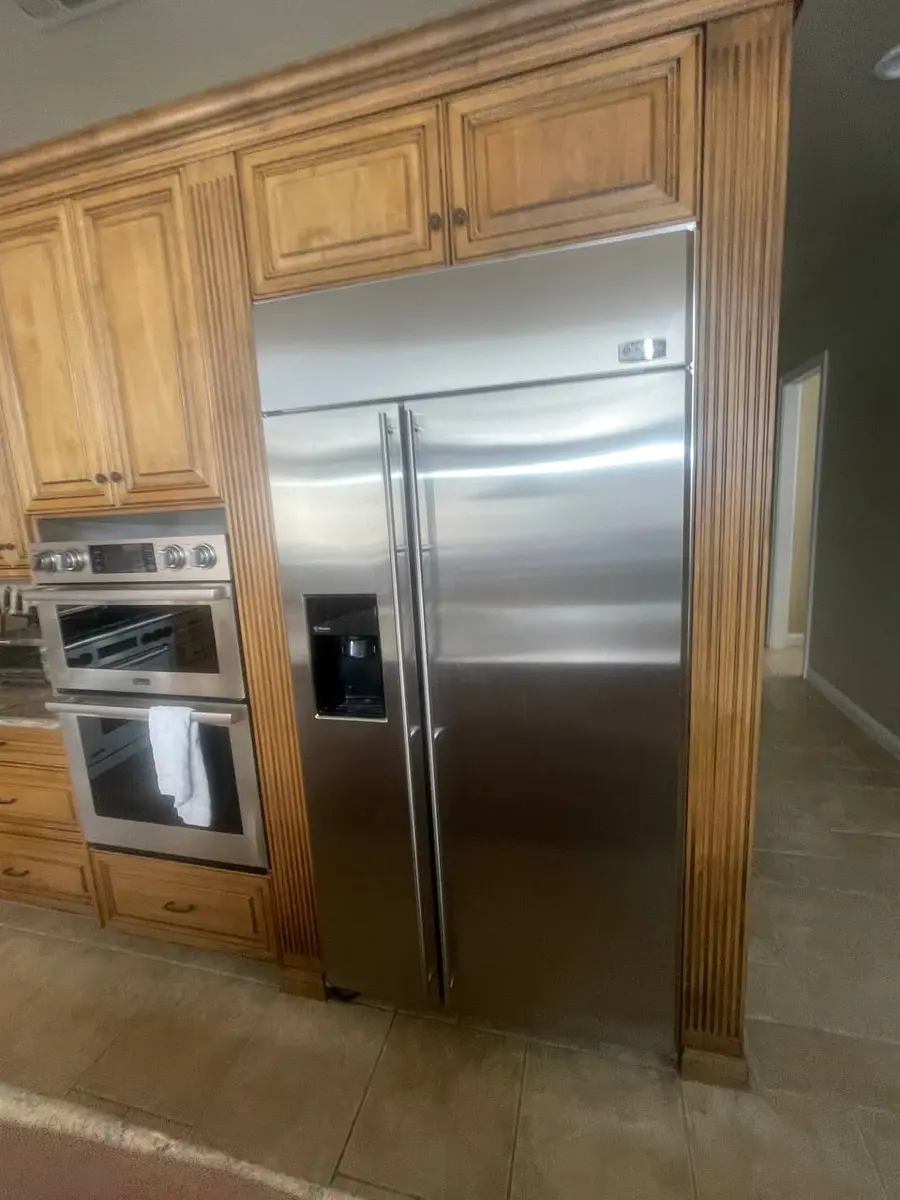
KitchenAid's premium models add complexity to this diagnosis because KBSD built-in installations often have the power cord in an inaccessible location, and the sophisticated control boards can fail in ways that simulate complete power loss even when electricity is reaching the unit.
Immediate Checks (Before Diagnosing)
Before assuming the refrigerator has failed, verify basic power delivery:
- Check the outlet. Plug a lamp or phone charger into the same outlet. If it works, the outlet has power.
- Check the circuit breaker. KitchenAid refrigerators should be on a dedicated 15A or 20A circuit. A tripped breaker shows the handle in the middle position — reset it firmly to ON.
- GFCI outlets. Some kitchen installations place the refrigerator on a GFCI-protected circuit (code requirement in some jurisdictions). The GFCI may have tripped — press the reset button on the outlet itself or on the first outlet in the GFCI chain.
- KBSD built-in models: The plug is typically behind or below the unit and not readily visible. Have someone confirm power at the outlet with a voltage tester rather than assuming.
Do You Have the Right Tools?
Refrigerant gauges ($200+), vacuum pump ($250), leak detector ($150), and EPA-certified recovery equipment. Our technician arrives with $15K+ in professional tools — your diagnostic is free.
Licensed & Insured · 90-Day Warranty · Same-Day Service
Most Common Causes (Ranked by Likelihood)
1. Tripped Circuit Breaker or GFCI (25% of cases)
The most common reason a KitchenAid refrigerator appears dead is simply a power supply interruption that the owner has not yet identified. Compressor start-up draws momentary surge current (3-5x running current) that can trip an undersized or aging breaker. KitchenAid specifies a dedicated 15A circuit — if the circuit is shared with other kitchen appliances, the combined load during simultaneous operation can trip the breaker.
GFCI-protected outlets add another failure mode. Moisture near the outlet (common with refrigerator installations near sinks or where condensation forms on supply lines) can trip the GFCI ground fault sensor.
Diagnosis: Check the breaker panel for a tripped breaker on the kitchen circuit. Check all GFCI outlets in the kitchen for tripped indicators.
DIY Difficulty: Easy Parts Cost: $0 Professional Repair Cost: $0 (self-service)
Repair Steps:
- Locate your home breaker panel.
- Find the kitchen refrigerator circuit — flip it fully OFF then back ON.
- If it trips again immediately, there is a short in the unit or wiring — do not keep resetting.
- Check all GFCI outlets in the kitchen and garage (the circuit may route through an unexpected location).
- If the breaker holds and the refrigerator restarts, monitor for 24 hours. Repeated tripping indicates a component issue (see cause #5 below).
2. Start Relay Failure (22% of cases)
When the start relay fails, the compressor cannot start — but unlike a gradual failure (clicking/buzzing), a completely burned relay can prevent the control board from initializing the cooling cycle entirely. On some KitchenAid models, a failed relay triggers a protective shutdown that makes the unit appear dead: no fans, no lights, and no compressor.
This is particularly common after power surges — the relay absorbs the initial surge and burns out, protecting the more expensive compressor.
Diagnosis: If the outlet has power and the breaker is good, listen at the compressor area. Complete silence (no click, no buzz, nothing) combined with a dead display suggests a relay or board issue. On models where the display works but nothing else operates, the relay is a strong suspect.
DIY Difficulty: Easy Parts Cost: $15-45 Professional Repair Cost: $95-195
Repair Steps:
- Unplug the refrigerator.
- Access the compressor area (bottom rear or through toe-kick on built-in models).
- Remove the start relay from the compressor pins.
- Shake it — rattling confirms failure. Inspect for burn marks or melted plastic.
- Install the new relay and restore power.
- The unit should begin operating within 60 seconds if the relay was the sole issue.
3. Main Control Board Failure (20% of cases)
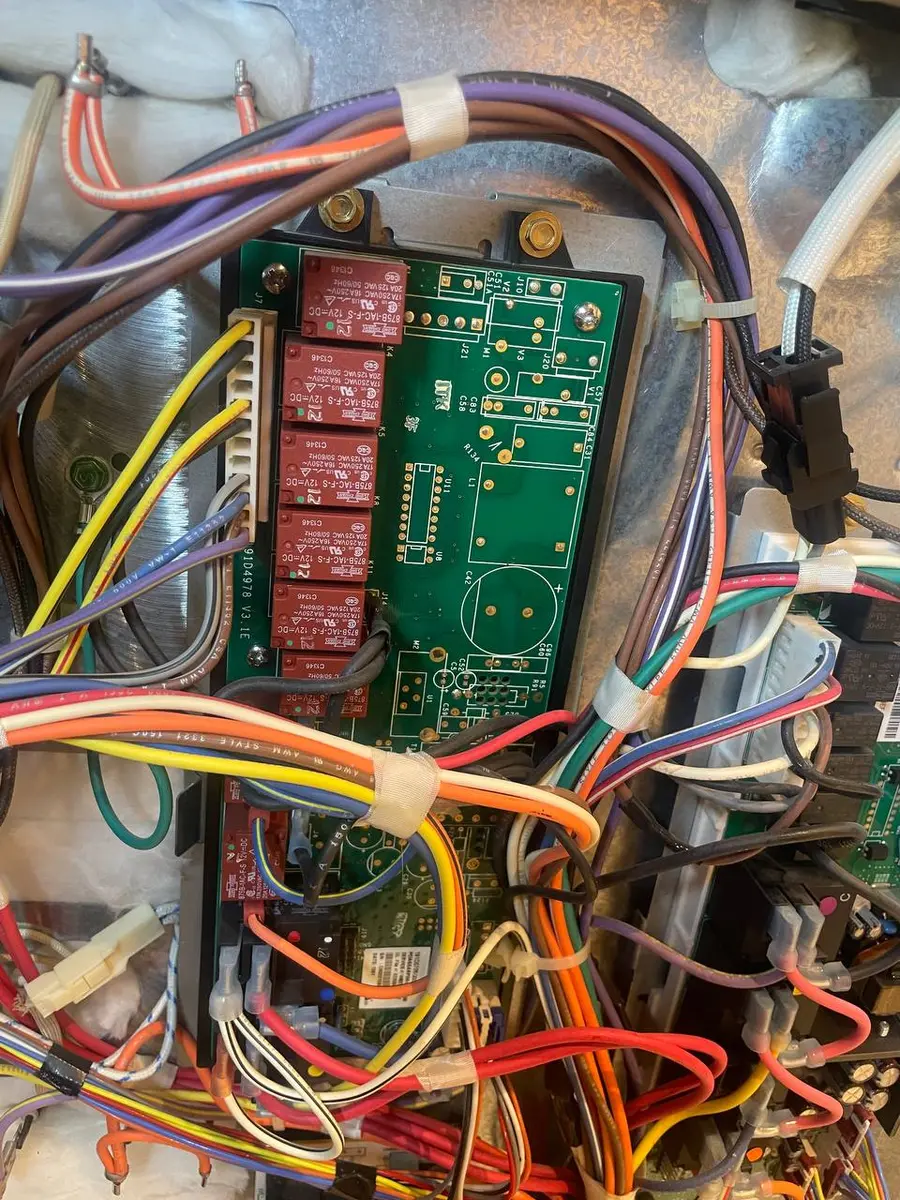
KitchenAid's main control board is the brain of the unit — it manages power distribution to the compressor, fans, lights, and defrost system. A catastrophic board failure (blown fuse on-board, failed voltage regulator, or surge-damaged processor) renders the entire unit inoperative. The board receives power but cannot distribute it to any subsystem.
On KitchenAid models, the control board is typically behind the rear access panel at the lower back of the unit. Power surges are the leading cause of board failure, particularly in older homes without surge protection.
Diagnosis: Check if the display shows anything at all. If no display, no lights, and no fan operation — but the outlet has power — the board is the primary suspect. If the display works but nothing else operates, the board's output relays may have failed while the display section (separate voltage rail) survives.
DIY Difficulty: Difficult Parts Cost: $150-380 (model-specific) Professional Repair Cost: $300-575
Repair Steps:
- Unplug for safety.
- Remove the rear lower access panel to expose the control board.
- Visually inspect for burned components, swollen capacitors, or blown fuses.
- If a board-mounted fuse is blown, it can sometimes be replaced ($2 part) without replacing the entire board — but the underlying surge damage often returns.
- For full board replacement: photograph all wire connections, remove mounting screws, disconnect harnesses, and install the new board in reverse order.
- After replacement, the unit may take 30-60 minutes to initialize all systems.
4. Compressor Overload Protector Tripped (18% of cases)
The compressor overload protector is a thermal safety device that cuts power to the compressor if it draws excessive current or overheats. Once tripped, it must cool down before resetting — this can take 30-60 minutes. On some KitchenAid models, a tripped overload also cuts power to the fans and control systems as a protective measure.
Common triggers: dirty condenser coils (compressor overheats from poor heat dissipation), locked compressor rotor (mechanical seizure), or ambient temperatures above the unit's design limit in the compressor cavity.
Diagnosis: If the unit went from working to completely dead suddenly (not after a power outage), unplug it and wait 60 minutes. Replug — if it starts normally, the overload tripped from temporary overheating. Repeated overload trips indicate an underlying thermal management problem.
DIY Difficulty: Easy (wait and reset) / Moderate (if overload device itself has failed) Parts Cost: $0 (reset) or $15-35 (overload protector replacement) Professional Repair Cost: $95-195
5. Power Cord or Outlet Damage (10% of cases)
The power cord can develop internal breaks from being pinched between the refrigerator and the wall — especially on counter-depth KitchenAid models that sit very close to the rear wall. The cord may flex at the same point repeatedly when the unit is pulled for cleaning, eventually breaking internally while appearing intact externally.
On KBSD built-in models, the cord routes through the cabinet toe-kick area and can be damaged during adjacent cabinet work or pest activity.
Diagnosis: If possible, inspect the power cord for kinks, pinch points, or visible damage. Use a voltage tester at the outlet to confirm power. If the outlet has power and the cord appears intact, the break may be internal.
DIY Difficulty: Moderate (cord replacement is straightforward but requires access) Parts Cost: $25-55 Professional Repair Cost: $95-175
6. Compressor Seizure (5% of cases)
A completely seized compressor motor draws locked-rotor current immediately upon start attempt, tripping the overload protector. The repeated cycle (attempt — trip — cool — attempt — trip) eventually results in permanent overload trip or relay burnout. At this point, the unit appears completely dead.
Compressor seizure is typically the end stage of a long-developing problem — gradual refrigerant loss leading to insufficient oil circulation, or bearing wear from years of operation.
Diagnosis: After eliminating power, relay, and board causes — if the compressor receives power (verified with a meter) but produces only a brief hum followed by immediate shutdown, the motor is seized.
DIY Difficulty: Not DIY (requires EPA certification and specialized equipment) Parts Cost: $400-900 (compressor + refrigerant + labor-intensive) Professional Repair Cost: $700-1,500
Diagnostic Sequence
- Verify power at the outlet — plug in another device.
- Check breaker and GFCI — reset if tripped.
- Wait 60 minutes (if unit died suddenly) — overload protector may need cooling time.
- Check for display activity — any light or display confirms power is reaching the unit, pointing to relay or specific board issue.
- Listen at the compressor — any click/buzz suggests relay. Complete silence suggests board or power cord.
- Access and inspect the control board for visual damage.
- Test the start relay by removing and shaking.
Safety First — Know the Risks
Refrigerant (R-134a/R-600a) requires EPA certification to handle. Improper discharge is a federal violation and health hazard. Our techs are licensed and insured — let them handle the risk.
Licensed & Insured · 90-Day Warranty · Same-Day Service
DIY vs Professional Repair
| Issue | DIY? | Parts Cost | Professional Cost |
|---|---|---|---|
| Breaker/GFCI reset | Yes | $0 | $0 |
| Start relay | Yes | $15-45 | $95-195 |
| Control board | Difficult | $150-380 | $300-575 |
| Overload protector | Easy-Moderate | $0-35 | $95-195 |
| Power cord | Moderate | $25-55 | $95-175 |
| Compressor seizure | No | $400-900 | $700-1,500 |
Same-Day Appliance Repair
Fixed or It's Free
$89 → $0 Service Call & Diagnosis — offer ends May 25
Prevention
- Dedicated circuit — ensure your KitchenAid is on its own 15A or 20A breaker, not shared with other kitchen appliances.
- Surge protector — a refrigerator-rated surge protector (1,000+ joules) prevents the power events that destroy control boards and relays.
- Clean condenser coils every 6 months — prevents the overheating that triggers overload protection.
- Avoid rapid power cycling — after a power outage, wait 5 minutes before allowing the refrigerator to restart. Some KitchenAid models have built-in delay, but older ones do not.
- KBSD owners: Ensure adequate ventilation in the built-in cavity to prevent compressor overheating.
The Real Cost of DIY
Average DIY attempt: $150-400 in tools you may use once, plus the risk of further damage. Our diagnostic visit costs $0 — we find the problem and give you an honest quote.
Licensed & Insured · 90-Day Warranty · Same-Day Service
FAQ
Q: My KitchenAid is completely dead — should I wait or call for repair immediately?
Wait 60 minutes first. If it died suddenly during operation (not during a power outage), the overload protector likely tripped and needs cooling time. If it does not restart after an hour, and you have confirmed power at the outlet, schedule a service call.
Q: The display works but nothing else operates — what does this mean?
The display typically runs on a separate low-voltage circuit from the board. If the display illuminates but no fans or compressor operate, the board's output relays have likely failed — it can power the display but not the high-current components. This requires board replacement.
Q: How much is a new compressor for a KitchenAid refrigerator?
Compressor replacement ranges from $700-1,500 including parts, refrigerant, and labor. For a KBSD built-in (which represents a $5,000-12,000 appliance investment), compressor replacement is usually worthwhile. For a freestanding KRFF unit over 12 years old, the economics favor replacement.
Q: Can power surges kill a KitchenAid refrigerator instantly?
Yes. A significant surge (from lightning strike or transformer failure) can simultaneously destroy the control board, start relay, and user interface board. This is why a surge protector is strongly recommended for any KitchenAid model — the control electronics represent $300-700 in replacement cost.
KitchenAid completely dead? Our technicians carry control boards, relays, and diagnostic equipment for same-day resolution of startup failures. Schedule emergency repair →