A KitchenAid refrigerator that trips its breaker is pulling more current than the circuit allows, and the pattern of when it trips tells you why. These fridges run on a 120V/15A or 20A circuit, drawing a steady 3-5 amps with a brief 8-12 amp startup surge — so a failing start relay or compressor, an overloaded shared circuit, or a defrost-heater ground fault is what pushes it past the breaker.
Causes Ranked by Frequency#
| Cause | Share | When it trips |
|---|---|---|
| Start relay failure | 30% | at compressor start |
| Compressor failure | 25% | immediately or at start |
| Shared circuit overload | 20% | only with other kitchen loads |
| Defrost heater ground fault | 10% | every 8-16 hours |
| Condenser fan motor short | 10% | whenever the compressor runs |
1. Start relay failure (30%)#
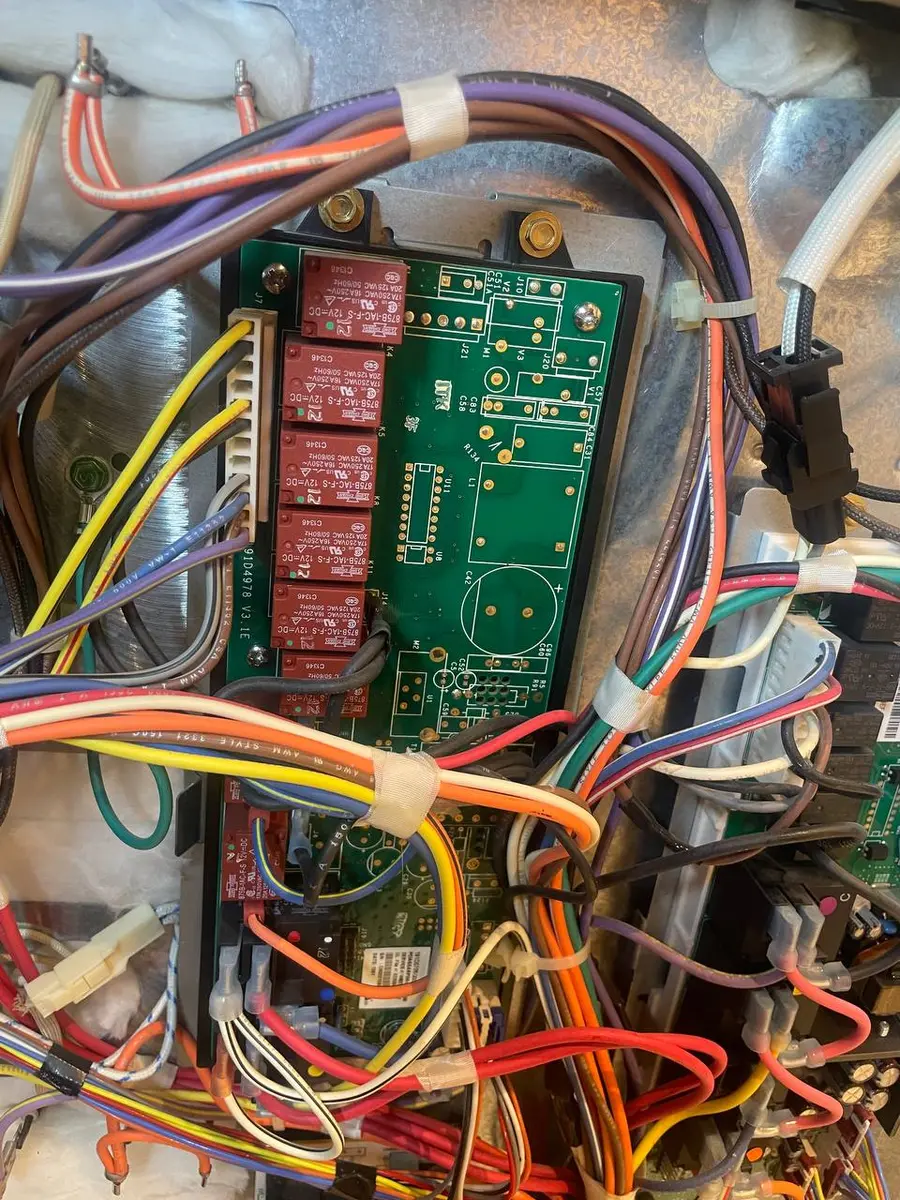
The start relay gives the compressor the extra current it needs to break from a dead stop. When it fails, the compressor pulls locked-rotor current — five to eight times normal — for several seconds before its internal overload reacts, and that spike can trip the house breaker first. The classic tell is a click, a two-to-three-second buzz, a click, repeating every 3-5 minutes, sometimes with a burning smell at the relay. Unplug the fridge, pull the relay off the compressor, and shake it — a rattle means the internal contact has broken loose. The KitchenAid/Whirlpool relay is model-specific (W10613606, WPW10197428, or equivalent).
2. Compressor failure (25%)#
If the compressor windings short to the case, current runs straight to ground and trips the breaker instantly; a fully seized compressor draws locked-rotor current until the breaker gives up. Pull the relay and meter the windings: start-to-common should read 5-20 ohms and run-to-common 3-10 ohms, but any terminal to the case (ground) must be open — any reading at all is a ground fault. Check coverage first, since Whirlpool provides a 5-year sealed-system warranty on many models.
3. Shared circuit overload (20%)#
A fridge should have its own circuit, but plenty of older homes share it with the kitchen counter. When the compressor's 12A surge lands while a microwave or toaster is running, the combined load trips the 15A breaker. The tell is simple: it only trips when other kitchen devices are on. Move the fridge to a different outlet to confirm, then have an electrician add a dedicated 20A circuit.
4. Defrost heater ground fault (10%)#
The defrost heater works in a wet environment, and as its insulation breaks down it can short to the grounded housing — so the breaker trips during the defrost cycle, roughly every 8-16 hours on the adaptive system. That regular, not random, interval is the clue. Unplug the fridge, disconnect the heater leads, and test each lead to the housing; continuity means a ground fault.
5. Condenser fan motor short (10%)#
A shorted condenser-fan winding draws excess current whenever the compressor runs, and because the two start together it is easily mistaken for a compressor fault. Meter the fan motor separately before condemning the compressor.
Do You Have the Right Tools?
Refrigerant gauges ($200+), vacuum pump ($250), leak detector ($150), and EPA-certified recovery equipment. Our technician arrives with $3,000+ in professional tools — your diagnostic is free.
Licensed & Insured · 90-Day Warranty · Same-Day Service
Find It by When It Trips#
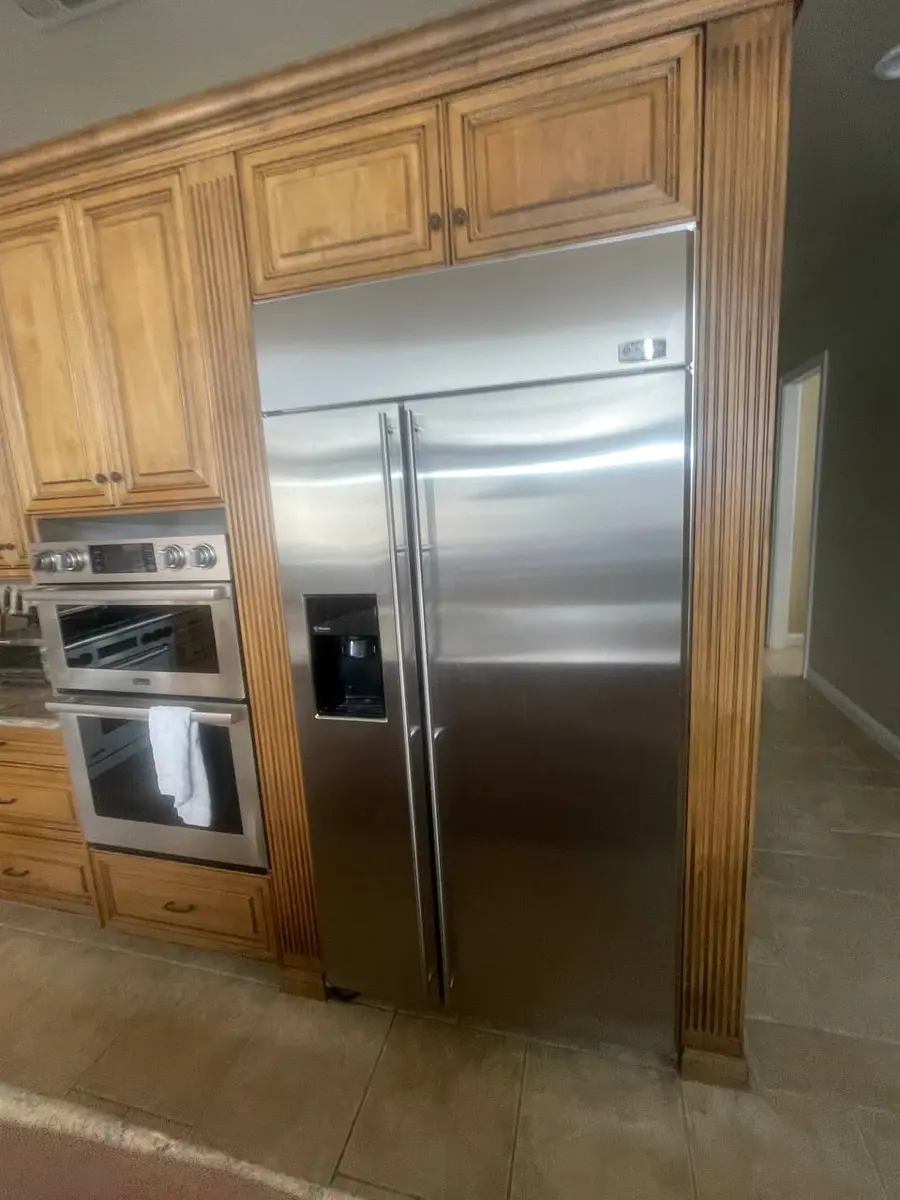
Work it in order: unplug the fridge and reset the breaker, then plug it back in without opening the doors and let the compressor settle. A trip the instant you plug in is a power-cord or internal wiring short; a trip when the compressor starts (usually within 5-10 minutes) is the relay or compressor; a trip only every 8-16 hours is the defrost heater; and a trip only when other kitchen devices are running is the shared circuit. Built-in KBSD and KBSN models are hardwired or on a concealed outlet, so a breaker trip on one of those justifies immediate professional service.
Safety First — Do Not Work Around This#
- Never upsize the breaker to stop the trips — a 15A breaker on 14-gauge wire is correct, and a 20A breaker on that wire is a fire hazard. The breaker protects the wiring in your walls.
- Do not put the fridge on a GFCI outlet unless code requires it — compressor startup nuisance-trips GFCIs and can spoil your food unnoticed.
- Do not leave a fridge that repeatedly trips running unattended, since the fault can worsen.
KitchenAid fridge tripping the breaker at compressor start? Our technicians test the relay and compressor safely and get it back on one circuit across [Sacramento](/sacramento/sacramento) and the Bay Area. Request a technician.
Appliance Repair Technician · 11 years experience
Experienced technician with 11 years specializing in Frigidaire and Electrolux refrigerator and dryer repair with a focus on safety.