When a KitchenAid refrigerator stops defrosting, one test cuts the diagnosis in half: command a manual defrost in diagnostic mode. If the heater fires on command, the adaptive board's timing has failed; if it doesn't, the defrost heater or its termination thermostat is dead. Those three parts — heater, thermostat, board — cause the overwhelming majority of frost-encased evaporators.
How KitchenAid's Adaptive Defrost Works#
Rather than defrosting on a fixed schedule, KitchenAid's control board runs an adaptive algorithm: it tracks cumulative compressor run time and how often the doors open — more openings mean more moisture and more frequent defrost — and energizes the defrost heater only when its thresholds are met. A termination thermostat on the evaporator watches the coil temperature and opens the heater circuit once the coil warms to roughly 40°F, and the board records the cycle to refine its timing. That intelligence saves energy but adds failure modes, because a break at any step halts defrost entirely and frost builds unchecked. On Preserva dual-system models, each compartment defrosts independently, so you can see the freezer frosting while the fresh-food side stays clear — a failure in one doesn't touch the other.
Do You Have the Right Tools?
Refrigerant gauges ($200+), vacuum pump ($250), leak detector ($150), and EPA-certified recovery equipment. Our technician arrives with $3,000+ in professional tools — your diagnostic is free.
Licensed & Insured · 90-Day Warranty · Same-Day Service
Before You Open It#
Disconnect power before reaching into the evaporator area, since ice around electrical connections is a shock risk. Never chip frost off the coils with a tool — the thin aluminum fins puncture easily and can release refrigerant. If you manually defrost by unplugging with the doors open, expect a lot of meltwater, so lay towels and a tray, and on built-in KBSD units confirm the drain path is clear first so water doesn't run into the cabinet.
The Causes, Most Common First#
Defrost heater burned out (about 35%)#
The leading cause. The glass-tube heater beneath the evaporator cycles from above 200°F during defrost to well below zero during cooling, and after eight to twelve years it eventually fails open, producing no heat so frost accumulates. Because KitchenAid shares the Whirlpool platform, the heater is one of a few common parts — WPW10165425, W10165425, or W10732801. Pull the freezer's rear evaporator panel (a handful of Phillips or Torx T20 screws); coils completely encased in more than a quarter inch of frost mean the defrost system has failed. Disconnect the heater plug at the base of the evaporator and meter across its terminals — no continuity confirms a burned-out heater. After replacing it, monitor for a couple of days to be sure frost doesn't return.
Termination thermostat failed open (about 25%)#
This bi-metal switch is clipped to the evaporator tubing and wired in series with the heater, so it does double duty: it ends defrost when the coil warms to a safe temperature, and it must be closed for the heater to get power at all. When it fails open, it perfectly mimics a burned heater — no defrost — which is why replacing only the heater is a classic misdiagnosis when the thermostat was the real culprit. Test it at room temperature: it should read continuity when cold and open only when heated past its rating, typically in the high-30s to high-40s Fahrenheit for KitchenAid. No continuity at room temperature means it has failed. Because both parts endure the same thermal stress, replacing the inexpensive thermostat alongside the heater is smart preventive work.
Adaptive defrost control board failure (about 20%)#
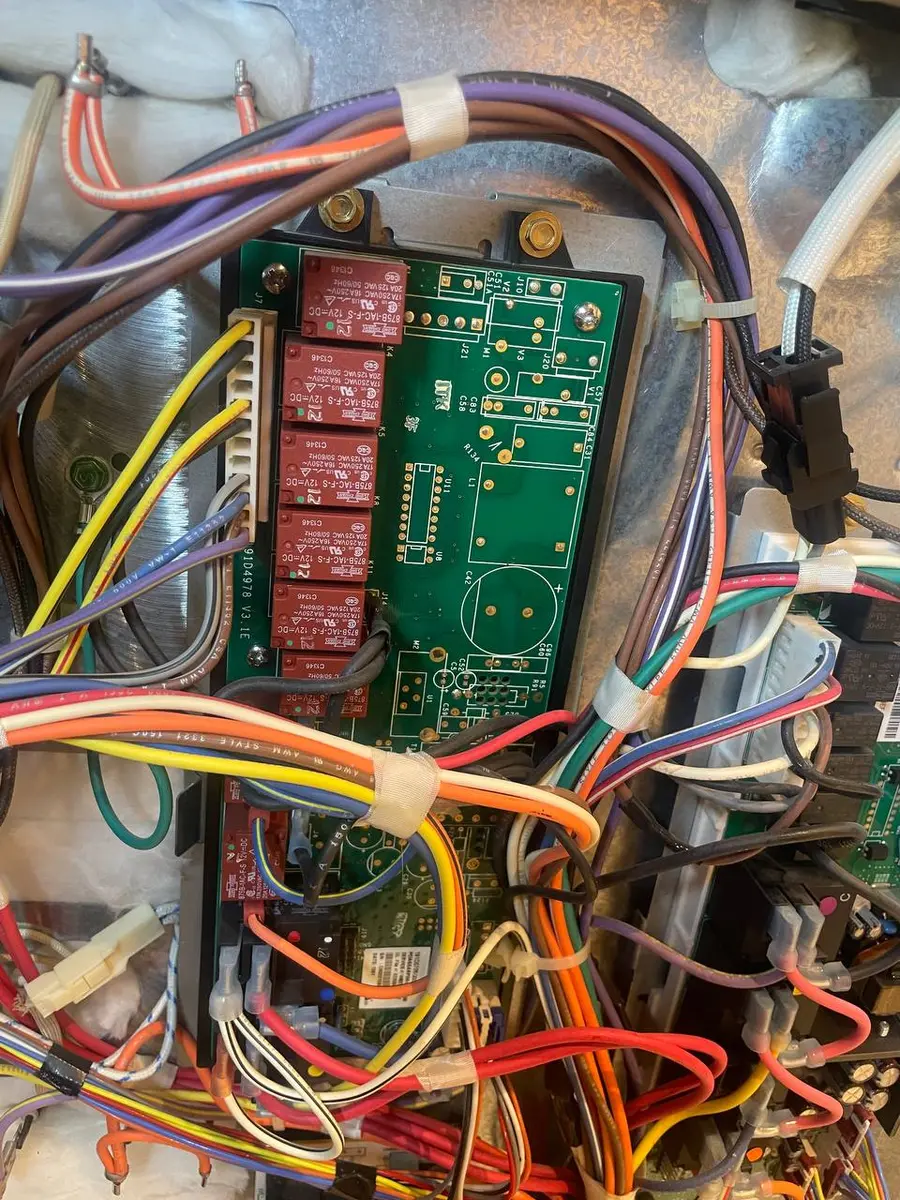
Here the heater and thermostat are fine but never get power, because the board's defrost relay failed or its adaptive data corrupted — common after a power outage or surge — so defrost simply stops being commanded. This is exactly where the manual-defrost test earns its keep: enter diagnostic mode (on most models, hold Temperature Up and Down together for a few seconds), navigate to the defrost test, and command a defrost. If the heater activates on command, the heater and thermostat are good and the board's automatic timing is the failure. If nothing happens even on command, you're back to the heater or thermostat.
Defrost heater wiring corrosion (about 12%)#
The heater's wire connector sits in the freezer, exposed to deep cold and defrost meltwater, and over years it corrodes until its resistance rises enough to starve the element of current — sometimes testing fine for continuity yet failing under load. Inspect the plug at the base of the evaporator frame for green corrosion, blackened terminals, or melted housing; even slight discoloration signals trouble. The fix is to cut out the old connector and splice in a new pigtail, sealing it with heat-shrink and routing it away from the meltwater path.
Defrost timer gear failure (about 8%, older models)#
KitchenAid units built before roughly 2012 may use a mechanical defrost timer whose motor advances continuously and periodically switches from cooling to defrost. When its gears strip or the motor stalls, it sticks in cooling and defrost never engages. Find the timer behind the fresh-food control housing or the toe-kick, and advance it manually with a flat screwdriver; if the heater fires when you advance it, the timer mechanism is the fault.
Safety First — Know the Risks
Refrigerant (R-134a/R-600a) requires EPA certification to handle. Improper discharge is a federal violation and health hazard. Our techs are licensed and insured — let them handle the risk.
Licensed & Insured · 90-Day Warranty · Same-Day Service
The Repair, Step by Step#
Replacing the heater or thermostat follows the same access. Unplug the refrigerator and empty the freezer, then remove the evaporator rear panel — if the frost is thick, you may need to partially thaw it just to reach the screws. Let the remaining ice melt or coax it with a hair dryer on low. For the heater, disconnect its plug at the base of the evaporator frame, release it from its mounting clips, and slide it out from under the coils, fitting the new one in the identical position and orientation before reconnecting and reinstalling the panel. For the thermostat, disconnect its two spade leads, squeeze the clip to free it from the tubing, and clip the replacement onto the same tube — polarity doesn't matter for this part. For a corroded connector, cut it off both sides, strip the wires, splice in a new pigtail with proper crimp connectors, and seal it with heat-shrink to keep moisture out. In every case, restore power and watch over the next day or two: a clean evaporator that stays frost-free confirms the fix. A methodical diagnostic order — assess the frost, test the heater, test the thermostat, inspect the connector, then command a manual defrost — reaches the answer without replacing good parts.
Keep It From Coming Back#
A few habits reduce the load on the defrost system so it isn't fighting excess moisture in the first place. Minimize unnecessary door openings, since each one lets in humid air that becomes frost between cycles, and check the door seals once a year, because a leaking gasket floods the evaporator with moisture faster than any defrost cycle can clear. After a power outage, the adaptive algorithm resets its learned timing, so a single manual defrost — unplugged for several hours — helps prevent buildup while the board recalibrates. And listen occasionally for the soft sizzle or hiss of frost melting, which should occur every several hours during normal operation; its absence over a long stretch is an early sign the defrost cycle has quietly stopped. On a Preserva model, remember that only the frosting compartment's defrost has failed — the other keeps working, and the repair is simply targeted to the affected side.
The Real Cost of DIY
Average DIY attempt: $150-400 in tools you may use once, plus the risk of further damage. Our diagnostic visit costs $0 — we find the problem and give you an honest quote.
Licensed & Insured · 90-Day Warranty · Same-Day Service
Why You Shouldn't Wait#
A non-defrosting KitchenAid fails on a predictable schedule, so early action matters. In the first week or two, thin frost forms on the evaporator with slightly reduced efficiency. Over the next few weeks the frost thickens and starts blocking airflow, and compartment temperatures creep up a few degrees. Within a month or two the coil is encased, the fan blades begin striking ice with a grinding noise, and the compressor runs nonstop. Past that, airflow is fully blocked and both compartments warm to unsafe food temperatures. Catching it when you first see frost on the back wall or hear that grinding prevents the whole cascade — and while you wait for parts, you can unplug the unit with both doors open for eight to twelve hours to melt the frost and restore cooling temporarily, though it will rebuild within a few weeks until the failed part is replaced, so treat the manual defrost as a stopgap that buys time rather than a real repair.
Related reading: KitchenAid refrigerator frost and ice buildup and a KitchenAid [refrigerator not cooling](/blog/refrigerator-not-cooling).
KitchenAid [refrigerator repair](/bay-area/services/refrigerator-repair) across [Sacramento](/sacramento/sacramento) and the Bay Area — heater, thermostat, and defrost-board diagnostics in one visit. Book a technician.
Appliance Repair Technician · 11 years experience
Experienced technician with 11 years specializing in Frigidaire and Electrolux refrigerator and dryer repair with a focus on safety.