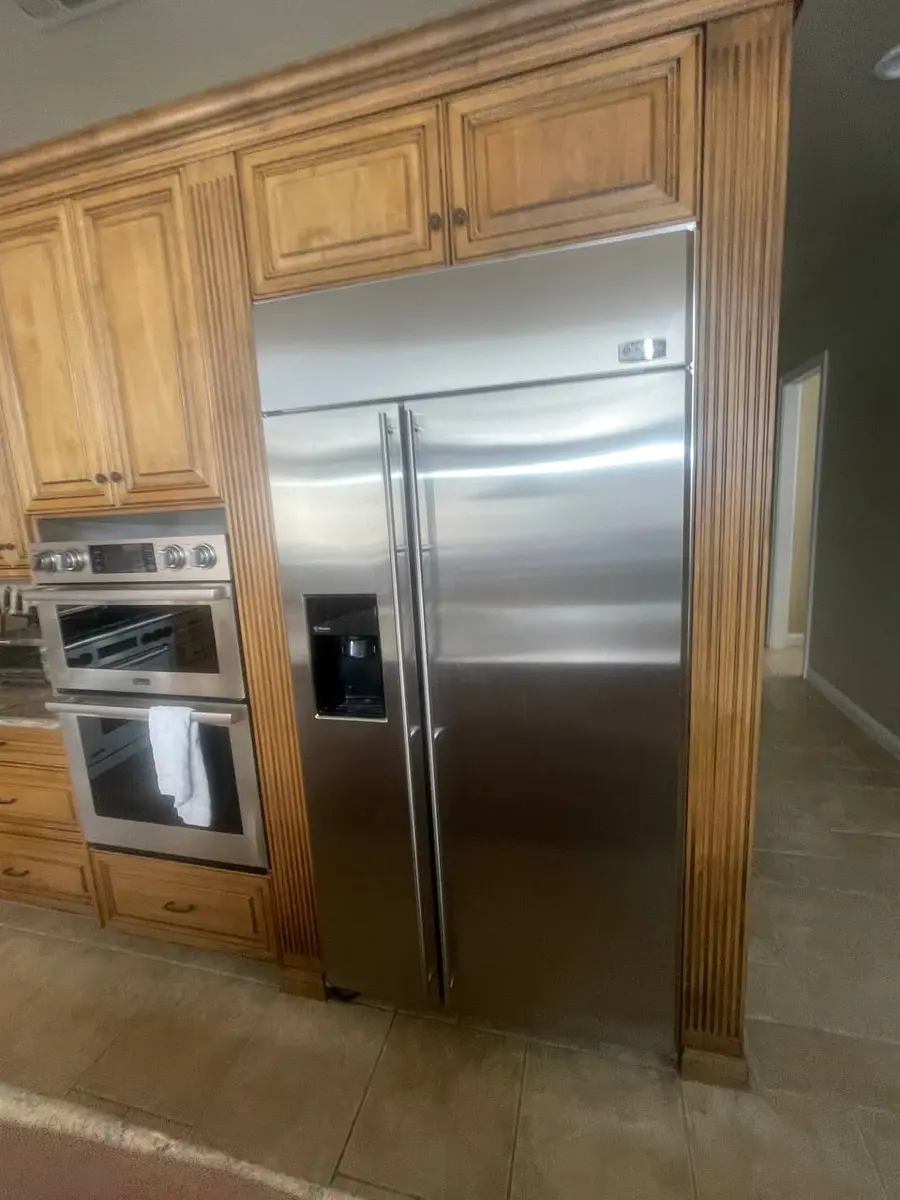
A noisy KitchenAid refrigerator is best diagnosed by sound type and one simple test: open the freezer door. Most models cut the evaporator fan when the door opens, so if the noise stops, it's the fan or its airflow path; if it continues, it's the compressor or condenser fan. A buzz-click-silence pattern every few minutes is a failing start relay, the most common fault.
Normal KitchenAid Sounds First#
These units have more moving parts than a basic refrigerator — the Preserva Food Care System runs dual independent cooling with two evaporator fans, sometimes two compressors on built-in KBSD models, and the ExtendFresh circulation — so they simply make more sound, and much of it is normal. Expect a low continuous hum from the compressor, a soft whoosh from the evaporator fans, periodic clicking every few hours as the adaptive defrost relay engages, gurgling as refrigerant flows through the expansion valve (especially after a door opening), a brief buzz of the ice-maker fill valve every hour and a half or so, and the occasional pop or crack of interior plastic expanding with temperature. None of those are faults. The sounds worth chasing are continuous loud buzzing, grinding, repetitive rapid clicking, a high whine, or heavy rattling.
Do You Have the Right Tools?
Refrigerant gauges ($200+), vacuum pump ($250), leak detector ($150), and EPA-certified recovery equipment. Our technician arrives with $3,000+ in professional tools — your diagnostic is free.
Licensed & Insured · 90-Day Warranty · Same-Day Service
The Door-Open Test#
Before anything else, do this: open the freezer door and listen. On most KitchenAid models the door switch cuts power to the evaporator fan, so a noise that stops when the door opens is coming from that fan or something in its airflow, while a noise that keeps going with the door open originates at the compressor or the condenser fan at the bottom. That one observation splits the entire diagnosis in half.
Problem Sounds by Type#
Loud continuous buzzing or humming (about 25%)#
A loud, persistent buzz from the bottom-rear means the compressor is trying to start and failing. The start relay energizes the compressor windings, but if the compressor can't turn or the relay is failing, it draws heavy locked-rotor current for several seconds until the overload protector trips — a repeating cycle of buzz, click, silence, buzz every few minutes, usually with a warming interior. Because KitchenAid shares the Whirlpool compressor platform, the start relay (the W10613606 family) is the first part to test: unplug, pull the relay off the compressor pins, and shake it — a rattle means it's failed. A new relay often restores smooth, continuous running.
Grinding or scraping (about 20%)#
Grinding from inside the freezer is the evaporator fan blade striking ice. When the defrost system is partially failing, frost builds unevenly on the coils and fan shroud — enough to catch the blades but not enough to throw a defrost fault — and the noise is intermittent because the fan cycles and the ice partly melts and refreezes. The door-open test nails it: if the grinding stops when you open the freezer, the fan is hitting ice. Clear the ice, inspect the blades, and crucially, find out why frost accumulated, because clearing ice without fixing the defrost system just brings the noise back in weeks.
Rapid clicking every few minutes (about 20%)#
Repetitive clicking from the compressor area is the audible precursor to the buzzing above — the start relay retrying and the overload tripping with a click. The key distinction is timing: a click once every few hours is normal defrost-relay operation, but clicking every few minutes with no compressor running between clicks means the relay or compressor is failing and cooling is about to stop.
High-pitched whine or squeal (about 15%)#
A continuous high whine from behind the freezer rear panel is an evaporator fan motor bearing wearing out — the shaft develops play and friction rises, and KitchenAid's higher-RPM ExtendFresh fans make it especially audible. On dual-system Preserva models, identify which compartment the sound comes from, since each has its own fan and only the failing one needs replacing. Again the door-open test helps: if the whine stops with the freezer door open, it's that evaporator fan.
Rattling or vibration (about 12%)#
Rattling from the rear or bottom is usually loose condenser coils or compressor mounting hardware, and counter-depth KRMF models are prone to it because the tight rear spacing lets the condenser tubing touch the back panel when the compressor runs. Put a hand on the side and top — if vibration jumps when the compressor starts, it's mount-related. Check underneath for a loose drain pan (a frequent rattler) and the condenser fan for debris, and confirm the leveling legs sit solid, since an unlevel unit amplifies everything.
Water dripping or running (about 8%)#
A dripping or running-water sound behind the rear panel is often perfectly normal — melted frost draining through the evaporator trough during and after a defrost cycle. It only signals trouble if it's excessive or comes with actual water on the freezer floor, which means the drain is partially clogged and water is pooling before it slowly drains, sometimes refreezing into sheets.
Safety First — Know the Risks
Refrigerant (R-134a/R-600a) requires EPA certification to handle. Improper discharge is a federal violation and health hazard. Our techs are licensed and insured — let them handle the risk.
Licensed & Insured · 90-Day Warranty · Same-Day Service
Fixing the Two Most Common Faults#
The start relay and the evaporator fan account for most noise repairs, and both are approachable. For the relay: unplug the refrigerator, remove the rear-lower panel or the toe-kick grille on a built-in, and find the small box plugged onto the side of the compressor. Pull it straight off the pins, shake it to confirm the rattle of broken internals, and press the replacement on in the same orientation before restoring power and listening for smooth, continuous compressor operation. For a fan iced or worn: unplug, remove the evaporator panel on the freezer rear wall (a handful of screws), and if ice encases the blades, let it thaw naturally over a few hours or coax it with a hair dryer on low. Once clear, spin the blade and inspect it — nicked or bent blades vibrate even without ice — and if the motor bearing is the source of a whine, disconnect the harness, unclip the mounting bracket, transfer the press-fit blade to the new motor, and reinstall. The one rule that saves a repeat visit: whenever ice caused the fan noise, fix the defrost system that let the frost build, or the ice and the grinding return within weeks.
When to Call a Professional#
Plenty of this is homeowner territory. Swapping a rattling start relay, clearing debris from the condenser fan, reseating a loose drain pan, leveling the unit, and adding anti-vibration pads are all straightforward, low-risk jobs. An evaporator fan motor is a moderate step up, comfortable for anyone willing to pull the freezer's rear panel and handle a wiring connector. The cases that lean professional are a compressor that buzzes and clicks but proves not to be the relay — a seized compressor is a sealed-system repair — and a recurring ice problem that points to a deeper defrost fault involving the heater, thermostat, or control board. A quick diagnosis is worth it when the sound is at the compressor and the interior is warming, because that combination is a cooling failure in progress, not merely a noise, and the sooner it's identified the more of your food you save.
The Real Cost of DIY
Average DIY attempt: $150-400 in tools you may use once, plus the risk of further damage. Our diagnostic visit costs $0 — we find the problem and give you an honest quote.
Licensed & Insured · 90-Day Warranty · Same-Day Service
Locate It, Then Judge Urgency#
Put the location together with the sound: bottom-rear points at the compressor, start relay, or condenser fan and is high urgency if it's clicking repeatedly; behind the freezer panel is the evaporator fan or defrost system; inside the fresh-food side is that fan or a damper motor; underneath is the drain pan or loose hardware. A little upkeep prevents most of it — clean the condenser coils twice a year so the compressor doesn't strain and run loud, replace the water filter on schedule so the fill valve doesn't buzz long, check the leveling yearly, and on built-in KBSD units add anti-vibration strips between the frame and cabinetry to stop transmitted noise. Above all, don't ignore a new grinding or whine, because a fan blade or bearing caught early is a cheap part, while the same fault left to run damages the motor and can eventually stop the airflow your food depends on.
Related reading: a KitchenAid refrigerator that runs constantly and KitchenAid refrigerator frost and ice buildup.
KitchenAid [refrigerator repair](/bay-area/services/refrigerator-repair) across [Sacramento](/sacramento/sacramento) and the Bay Area — relay, fan, and defrost diagnostics in one visit. Book a technician.
Appliance Repair Technician · 11 years experience
Experienced technician with 11 years specializing in Frigidaire and Electrolux refrigerator and dryer repair with a focus on safety.