KitchenAid Refrigerator Leaking Water — Source Identification & Repair
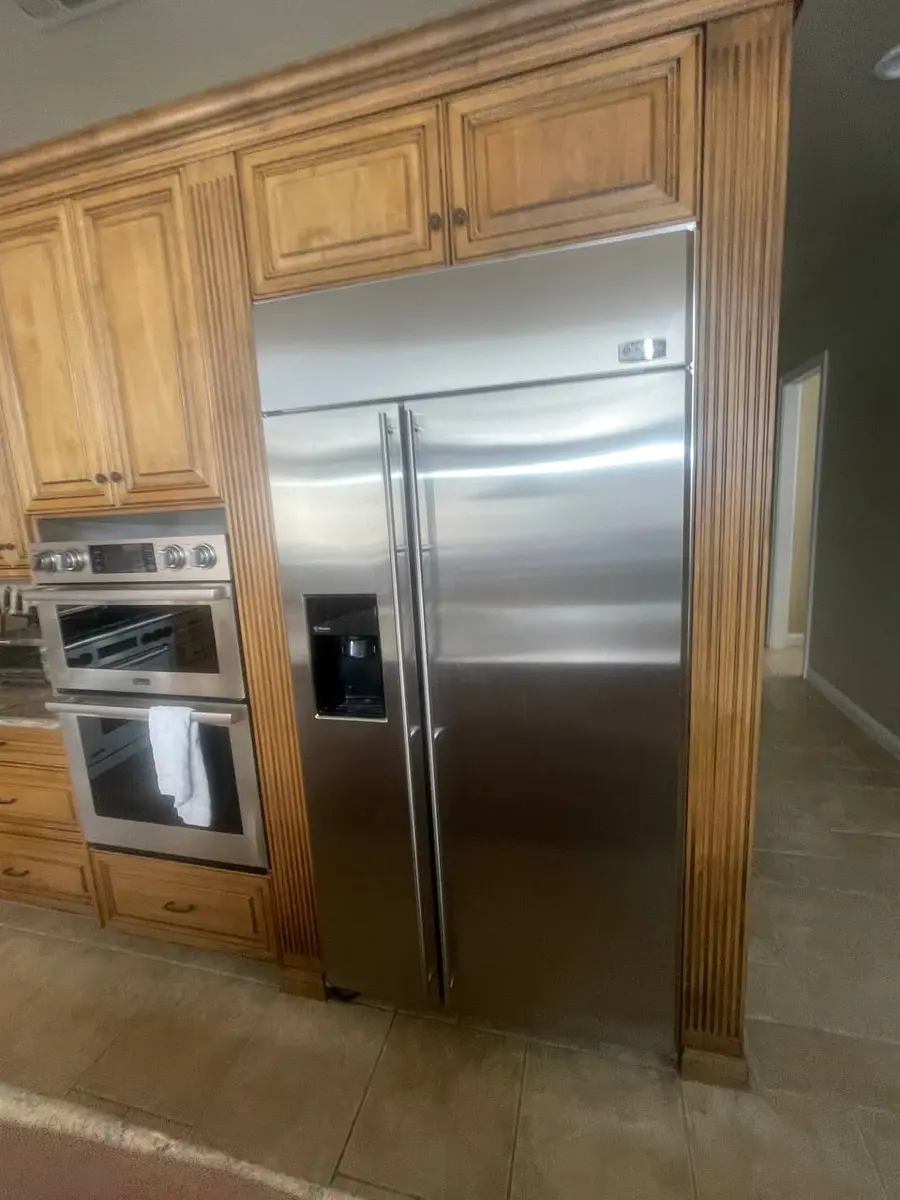
Water leaking from a KitchenAid refrigerator is particularly concerning for owners who have invested in premium kitchen installations. A KBSD built-in unit surrounded by custom cabinetry or a counter-depth KRMF sitting on hardwood flooring can cause thousands in collateral water damage before the leak source is identified. KitchenAid's multiple water-connected systems — the EveryDrop filtration, ice maker fill line, water dispenser, and defrost drain — each present unique leak possibilities.
This guide helps you trace the water to its source quickly, because with KitchenAid's premium installations, every hour of leaking multiplies the damage to surrounding materials.
Tracing the Leak Source
Before diving into causes, identify WHERE the water is appearing:
- Under the front of the refrigerator: Usually defrost drain overflow or door gasket condensation dripping down the front.
- Under the rear of the unit: Water supply line, inlet valve connection, or condensate pan overflow.
- Inside the fresh-food section (bottom): Clogged defrost drain backing up into the compartment.
- Inside the freezer (floor): Defrost drain frozen at the entry point — water pools and refreezes.
- Around the water filter area: Filter housing crack or improper filter seating.
- At the dispenser/ice maker door area: Internal water line within the door has shifted or cracked.
Do You Have the Right Tools?
Refrigerant gauges ($200+), vacuum pump ($250), leak detector ($150), and EPA-certified recovery equipment. Our technician arrives with $15K+ in professional tools — your diagnostic is free.
Licensed & Insured · 90-Day Warranty · Same-Day Service
Safety Precautions
- Shut off the water supply valve immediately if the leak is active and coming from a water connection. On most KitchenAid installations, the supply valve is behind the unit or under the adjacent sink.
- Disconnect power if standing water is near electrical components.
- For KBSD built-in models: Check if water is flowing behind adjacent cabinetry. Built-in installations can route leaks into concealed spaces where mold develops undetected.
- Place towels or a shallow tray to contain active leaks while diagnosing.
Most Common Causes (Ranked by Likelihood)
1. Defrost Drain Line Clogged or Frozen (30% of cases)
During each defrost cycle, melted frost flows from the evaporator trough through a drain channel and rubber tube to the condensate pan beneath the unit. On KitchenAid refrigerators, this drain is vulnerable to freezing at the transition point where it exits the freezer compartment. Food particles, ice fragments, and mineral deposits gradually narrow the drain opening until water backs up into the freezer floor and eventually overflows forward under the doors.
KitchenAid's adaptive defrost system compounds this issue — because defrost cycles are less frequent than fixed-timer systems, each cycle produces more meltwater that must drain through the channel in a shorter period.
Diagnosis: Remove the evaporator panel in the freezer. Look for ice accumulation around the drain opening at the base of the evaporator trough. Check the freezer floor for ice sheets — these indicate repeated overflow and refreeze cycles.
DIY Difficulty: Moderate Parts Cost: $5-25 (drain strap heater if needed) Professional Repair Cost: $125-225
Repair Steps:
- Unplug the refrigerator and remove the evaporator rear panel.
- Locate the drain opening at the lowest point of the evaporator trough.
- Use a turkey baster to flush warm water (not boiling) through the drain opening.
- If water does not flow through to the condensate pan below, the tube is frozen or clogged.
- Use a flexible pipe cleaner or small brush to gently clear the drain entrance.
- Flush again with a warm water and baking soda solution to remove debris.
- If the drain repeatedly refreezes, install a drain strap heater — a copper element that maintains the drain above freezing.
- Reassemble and monitor for 48 hours.
2. Water Supply Line Leak (20% of cases)
The water supply line connecting your home plumbing to the KitchenAid's inlet valve is a common leak source, especially on older installations using the original braided or copper tubing. Over time, compression fittings loosen from vibration, copper tubing develops stress cracks at bends, and braided lines can fail at the crimped ends.
On KBSD built-in models, the supply line is particularly difficult to inspect because the unit cannot be pulled forward. The line typically routes through the cabinetry to the valve at the unit's bottom rear.
Diagnosis: Look for water at the rear of the unit, specifically around the water connection point. Place a dry paper towel at each connection point and check after 30 minutes — even slow drips will be visible.
DIY Difficulty: Easy to Moderate Parts Cost: $15-45 (supply line replacement) Professional Repair Cost: $95-195
Repair Steps:
- Shut off the water supply valve completely.
- Access the rear connection area (pull unit forward or access through toe-kick on built-in models).
- Check the compression fitting at the inlet valve — tighten gently (1/4 turn maximum) with a wrench.
- Check the wall valve connection — tighten if loose.
- If tightening does not resolve the leak, replace the entire supply line with a new stainless braided line.
- Open the supply valve slowly and check all connections with a dry paper towel.
3. EveryDrop Water Filter Housing Leak (18% of cases)
KitchenAid's internal water filter housings can develop cracks over time, particularly around the O-ring seal area. An improperly seated filter or a filter of incorrect specification can also cause leaks. Water from a filter leak typically appears inside the fresh-food section, dripping from the ceiling area of the compartment onto food and shelves.
This issue is common after filter replacement — if the new filter is not turned fully into the locked position, or if the O-ring was dislodged during installation, water bypasses the seal under pressure.
Diagnosis: Open the fresh-food compartment and look for water dripping from the filter area (upper right interior on most KitchenAid French door models). Remove the filter and inspect the housing for visible cracks. Check the filter O-ring for damage or displacement.
DIY Difficulty: Easy Parts Cost: $0 (reseat filter) or $45-80 (housing assembly if cracked) Professional Repair Cost: $95-200
Repair Steps:
- Turn off the water supply as a precaution.
- Remove the current filter by turning counterclockwise.
- Inspect the filter O-ring — it should be smooth, in its groove, and lightly lubricated.
- Check the housing interior for cracks (use a flashlight).
- If the housing is cracked, it must be replaced as a unit — no patching.
- If intact, clean the housing opening, ensure the O-ring is seated, and reinstall the filter with a firm clockwise turn until it clicks.
- Restore water and place a paper towel beneath the filter for monitoring.
4. Condensate Pan Overflow or Crack (15% of cases)
The condensate pan sits beneath the refrigerator and collects defrost meltwater, which normally evaporates via heat from the compressor and condenser. If the pan cracks (from age or impact during moving), or if defrost produces more water than evaporation can handle (in humid environments), the pan overflows and water appears beneath the unit.
KitchenAid's counter-depth models have smaller condensate pans due to space constraints, making overflow more likely in humid Sacramento summers.
Diagnosis: Remove the toe-kick grille and shine a flashlight at the condensate pan. If water is overflowing the lip, the pan is either cracked, mispositioned, or overfilling due to excessive defrost water production.
DIY Difficulty: Easy Parts Cost: $15-40 (replacement pan) Professional Repair Cost: $95-175
5. Ice Maker Fill Tube Drip (12% of cases)
The ice maker fill tube can drip after each fill cycle if the water inlet valve does not close completely. A worn valve allows residual water to slowly drip from the fill tube into or around the ice mold, eventually overflowing the mold and creating ice buildup that melts and leaks during defrost. On KitchenAid French door models where the ice maker is in the upper freezer area, this drip can also freeze at the fill tube entrance and create an ice dam that redirects water outside the mold.
Diagnosis: Remove the ice bin and observe the fill tube area. If you see icicles forming below the fill tube or water stains on the ice maker frame, the inlet valve is dripping.
DIY Difficulty: Moderate Parts Cost: $35-75 (water inlet valve) Professional Repair Cost: $135-250
6. Door Gasket Condensation (5% of cases)
A failing door gasket allows warm, humid air to continuously enter the refrigerator compartment. This moisture condenses on cold interior surfaces and collects at the bottom, eventually dripping out below the door. On KitchenAid's PrintShield stainless models, condensation on the door exterior (sweating) can also drip to the floor and be mistaken for an internal leak.
Diagnosis: Inspect the gasket with the dollar-bill test. Also feel the exterior of the doors — if they are wet to the touch, the anti-condensation heater circuit in the door frame may have failed (this heater prevents sweating on stainless surfaces).
DIY Difficulty: Easy to Moderate Parts Cost: $45-125 (gasket) Professional Repair Cost: $130-275
Safety First — Know the Risks
Refrigerant (R-134a/R-600a) requires EPA certification to handle. Improper discharge is a federal violation and health hazard. Our techs are licensed and insured — let them handle the risk.
Licensed & Insured · 90-Day Warranty · Same-Day Service
Diagnostic Flow for Quick Identification
- Is the leak from fresh water (clear, no odor)? Supply line, filter, or ice maker fill system.
- Is the water slightly dirty or has debris? Defrost drain — it carries particles from the evaporator area.
- Does the leak correlate with defrost cycles (intermittent, every 8-16 hours)? Drain blockage or pan issue.
- Is the leak constant? Supply line under pressure — the leak never stops because water pressure is always present.
- Is the leak only when the ice maker cycles? Fill tube or inlet valve issue.
Same-Day Appliance Repair
Fixed or It's Free
$89 → $0 Service Call & Diagnosis — offer ends May 25
DIY vs Professional Repair
| Issue | DIY? | Parts Cost | Professional Cost |
|---|---|---|---|
| Defrost drain clog | Moderate | $5-25 | $125-225 |
| Supply line | Easy | $15-45 | $95-195 |
| Filter housing | Easy | $0-80 | $95-200 |
| Condensate pan | Easy | $15-40 | $95-175 |
| Ice maker fill drip | Moderate | $35-75 | $135-250 |
| Door gasket | Moderate | $45-125 | $130-275 |
The Real Cost of DIY
Average DIY attempt: $150-400 in tools you may use once, plus the risk of further damage. Our diagnostic visit costs $0 — we find the problem and give you an honest quote.
Licensed & Insured · 90-Day Warranty · Same-Day Service
KitchenAid-Specific Prevention
- Flush the defrost drain annually with warm water and baking soda. This prevents the gradual buildup that leads to blockages.
- Replace EveryDrop filters carefully — always verify the O-ring seated and the filter locked with an audible click.
- Inspect the supply line every 2 years. Replace any line older than 8 years regardless of visible condition.
- For KBSD built-in models: Place a moisture detector behind the unit (smart home sensors are ideal). Built-in installations conceal leaks until damage is extensive.
- Check the condensate pan during coil cleaning — it is accessible when the toe-kick grille is removed.
FAQ
Q: My KitchenAid is leaking but I cannot find the source — what should I do?
Place newspaper or large paper towels under and around the entire base of the unit for 24 hours. The water trail on the paper will trace back to the entry point. For built-in models where rear access is limited, remove the toe-kick and inspect from below with a flashlight.
Q: Can a leaking KitchenAid damage my hardwood floors?
Yes, rapidly. Even minor leaks pool beneath the unit where they are invisible. On KRMF counter-depth models that sit flush with cabinetry, water can wick under flooring edges for weeks before detection. If you suspect any leak, investigate immediately.
Q: My KitchenAid only leaks in summer — why?
High humidity causes two summer-specific issues: (1) excessive condensation overwhelming the condensate pan evaporation rate, and (2) sweating on stainless steel door surfaces when the door gasket heater is failing. Both are addressable — the pan may need a small fan installed, and the door heater circuit should be checked.
Q: Is a leaking water filter covered under KitchenAid warranty?
Filter-related leaks within the 1-year warranty period are typically covered if the housing is defective. Leaks caused by using non-genuine EveryDrop filters or improper installation are not covered. Document the leak with photos and contact KitchenAid Customer Care before attempting repair if within warranty.
Water leaking from your KitchenAid? Our technicians pinpoint the source and carry drain clearing tools, filter housings, and supply lines for same-visit resolution. Schedule leak repair →