KitchenAid Refrigerator Frost & Ice Buildup — Causes and Fixes
Frost accumulation in a KitchenAid refrigerator signals a malfunction in the defrost system — one of the most critical maintenance cycles in any frost-free unit. KitchenAid models with the Preserva Food Care System use adaptive defrost technology that adjusts cycle frequency based on usage patterns and door openings. When this system fails, frost builds rapidly on the evaporator coils, restricting airflow and eventually causing temperature problems throughout both compartments.
This issue is particularly consequential on KitchenAid's premium models because frost formation behind the rear panel can damage the Platinum Interior LED lighting array and interfere with the ExtendFresh Plus temperature sensors that maintain KitchenAid's tighter-than-average temperature tolerances.
Understanding KitchenAid's Adaptive Defrost System
Unlike basic refrigerators that defrost on a fixed timer (every 8-12 hours), KitchenAid employs an adaptive defrost algorithm controlled by the main board. The system monitors compressor run time, door openings, and ambient conditions to determine when defrost is actually needed. This reduces energy consumption but creates a potential failure mode: if the algorithm's inputs are corrupted (from a bad sensor or board glitch), defrost cycles may be skipped entirely.
On Preserva dual-system models, each compartment has its own defrost heater and termination thermostat. A defrost failure in one compartment does not affect the other — so you may see frost in the freezer while the fresh-food section remains frost-free, or vice versa.
Do You Have the Right Tools?
Refrigerant gauges ($200+), vacuum pump ($250), leak detector ($150), and EPA-certified recovery equipment. Our technician arrives with $15K+ in professional tools — your diagnostic is free.
Licensed & Insured · 90-Day Warranty · Same-Day Service
Safety Precautions
- Disconnect power before accessing the evaporator area. Ice around electrical components creates shock hazards.
- Do not use sharp tools to chip frost off the evaporator coils. The aluminum fins are fragile and easily punctured, potentially releasing refrigerant.
- On KBSD built-in models with custom panels, support the door weight before removing interior panels — the combined panel and door weight can exceed 80 lbs.
- Collect water during defrost. Place towels below the unit and inside the compartment before beginning manual defrost.
Most Common Causes (Ranked by Likelihood)
1. Defrost Heater Failure (28% of cases)
The defrost heater is a resistive element mounted beneath or alongside the evaporator coils. When energized during the defrost cycle, it heats the coils enough to melt accumulated frost, which drips into the drain pan below. On KitchenAid models, the heater is typically a glass tube element rated at 200-400 watts depending on model.
KitchenAid's defrost heater shares the same form factor as Whirlpool equivalents (parent company). Common part numbers include WPW10165425 and W10165425. The heater fails open-circuit, meaning it stops producing heat entirely rather than failing partially.
Diagnosis: Unplug the unit and access the evaporator (remove the rear panel inside the freezer — typically 6-8 screws). If the coils are completely encased in frost, the defrost system has failed. Use a multimeter to test the heater for continuity. No continuity = dead heater. On KitchenAid models, the heater terminals are accessible via a plug connector at the bottom of the evaporator assembly.
DIY Difficulty: Moderate Parts Cost: $30-75 Professional Repair Cost: $175-350
Repair Steps:
- Unplug the refrigerator. Remove all food from the freezer compartment.
- Remove the evaporator cover panel inside the freezer (Phillips or Torx T20 screws — KitchenAid uses both depending on model year).
- If frost is too thick to access the heater, allow natural defrost for 4-8 hours with towels in place, or use a hair dryer on low.
- Disconnect the heater wire plug (located at the base of the evaporator frame).
- Release the heater from its mounting clips — slide it out from beneath the coils.
- Install the new heater in the same orientation (it only fits one way).
- Reconnect the plug, reinstall the evaporator panel, and restore power.
- Monitor for 24-48 hours — frost should not reappear behind the panel.
2. Defrost Thermostat (Bi-Metal) Failure (22% of cases)
The defrost termination thermostat monitors evaporator temperature during the defrost cycle. When the coils reach approximately 38-47F, the thermostat opens the circuit to stop heating — preventing the compartment from warming too much. If this thermostat fails in the open position, it permanently interrupts the heater circuit regardless of temperature, effectively disabling defrost.
On KitchenAid refrigerators, the thermostat is clipped to the evaporator tubing near the top of the coil assembly. It is a small disc-shaped component with two wire leads.
Diagnosis: Access the evaporator (same process as heater access). Locate the thermostat on the coil tubing. Disconnect its leads and test with a multimeter at room temperature — it should show continuity (closed circuit). If open at room temperature, it has failed.
DIY Difficulty: Moderate Parts Cost: $15-35 Professional Repair Cost: $145-275
Repair Steps:
- Unplug and access the evaporator assembly.
- Locate the thermostat — small disc clipped to evaporator tubing near the top.
- Disconnect the wire leads (spade connectors).
- Squeeze the mounting clip to release the thermostat from the tubing.
- Clip the new thermostat in the same position on the tubing.
- Reconnect wires, reassemble, and restore power.
3. Defrost Control Board or Timer Issue (18% of cases)
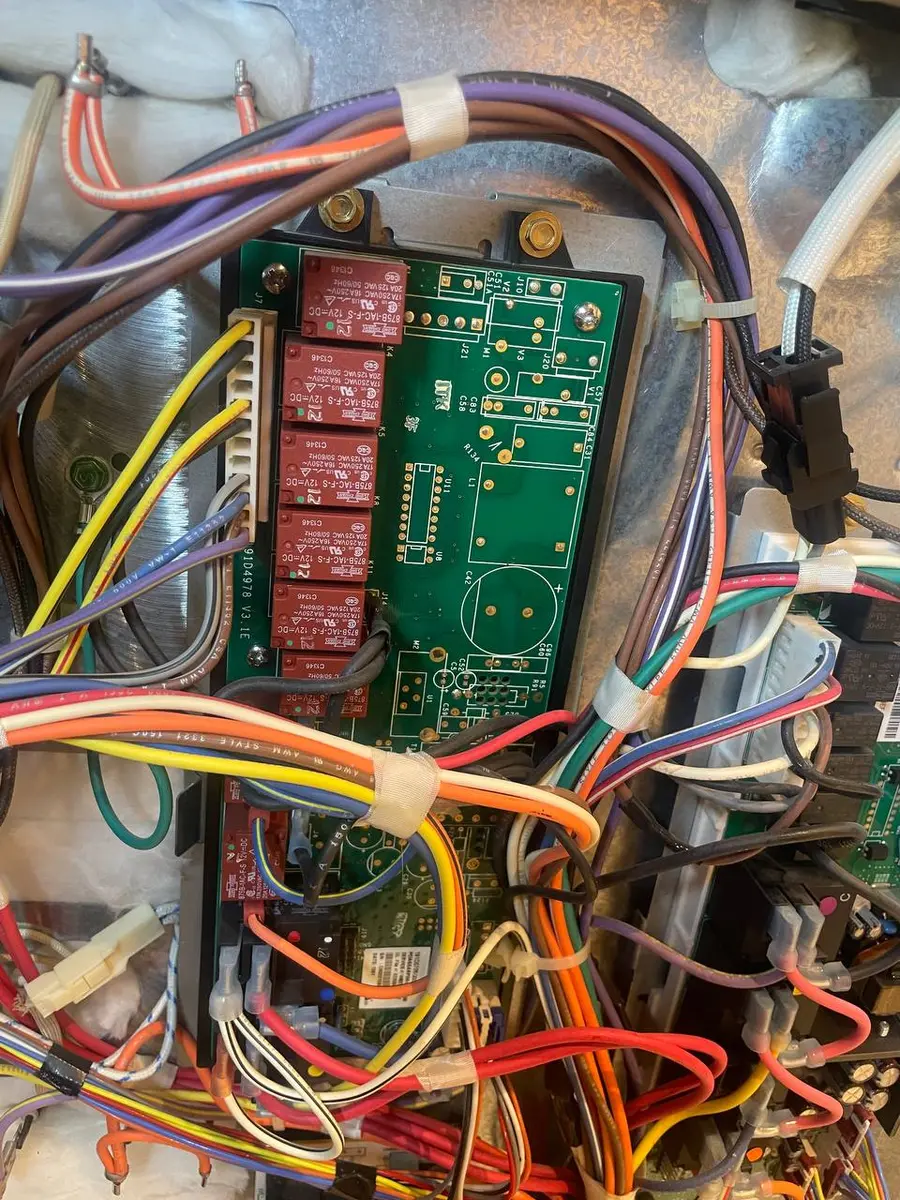
Modern KitchenAid refrigerators use the main control board to manage adaptive defrost timing. If the board's defrost relay fails or the adaptive algorithm loses its calibration data (common after power outages), defrost cycles stop occurring. Some older KitchenAid models (pre-2015) use a standalone ADC (Adaptive Defrost Control) board separate from the main board.
KitchenAid's diagnostic mode can reveal defrost-related error codes. On most models with digital displays, entering diagnostics (hold temperature buttons for 3 seconds) will show defrost cycle status and any logged failures.
Diagnosis: Enter diagnostic mode and look for defrost-related fault codes. Alternatively, monitor the unit over 24 hours — you should hear defrost cycles (a slight sizzling/hissing as frost melts) at least once every 12-16 hours during normal operation. Complete silence from the evaporator area over 24+ hours suggests the board is not initiating defrost.
DIY Difficulty: Difficult Parts Cost: $85-280 (main board) or $45-90 (standalone ADC board) Professional Repair Cost: $250-475
4. Evaporator Fan Icing — Door Seal Leak (15% of cases)
A compromised door gasket allows humid air to continuously enter the freezer compartment. This moisture freezes on the coldest surfaces — first the evaporator coils, then spreading to the fan blades and surrounding areas. The defrost system cannot keep up with continuous moisture influx, leading to progressive frost buildup even though defrost is functioning normally.
KitchenAid's counter-depth French door models (KRMF series) are particularly susceptible because the doors are wider and the gasket perimeter is longer, creating more potential leak points. The center seal between the French doors is a common failure point.
Diagnosis: Perform the dollar-bill test along the entire gasket perimeter. Slip a bill between the door and frame, close the door, and pull. If the bill slides out easily at any point, the seal is compromised. Pay special attention to the bottom corners and the center seal between French doors.
DIY Difficulty: Easy to Moderate Parts Cost: $45-125 (gasket) or $25-60 (center seal only) Professional Repair Cost: $130-275
Repair Steps:
- Order the correct gasket using your model number (located on the sidewall inside the fresh-food section).
- Start at one corner — pull the old gasket away from the door. KitchenAid gaskets fit into a retaining groove around the door perimeter.
- Working in sections, press the new gasket lip into the groove. Start at the top and work down both sides.
- For the center seal on French door models: pull the old seal strip from its channel and press the new one in place.
- Close the door and check alignment. Use a hair dryer on low to gently warm any sections that do not conform to the frame.
5. Drain Line Blockage (10% of cases)
Even when the defrost system works correctly, the meltwater must drain through a small channel at the base of the evaporator into a drain tube that leads to the condensate pan beneath the unit. On KitchenAid models, this drain channel frequently freezes over — especially at the entrance point where cold freezer air meets the drain opening. When the drain blocks, defrost water refreezes in the freezer floor, creating an ice sheet that grows with each cycle.
Diagnosis: If you see ice forming on the floor of the freezer compartment (rather than on the back wall or coils), the drain is blocked. You may also notice water leaking onto the floor below the refrigerator.
DIY Difficulty: Moderate Parts Cost: $5-20 (drain strap heater if needed) Professional Repair Cost: $125-225
Repair Steps:
- Unplug the unit and remove the evaporator panel.
- Locate the drain opening at the base of the evaporator trough.
- Pour warm water (not boiling) into the drain to melt any ice blockage. Use a turkey baster for precision.
- Once flowing, flush with a mixture of warm water and baking soda to clear debris.
- If the drain repeatedly refreezes, install a drain strap heater (a copper element that sits in the drain channel and prevents future freezing).
6. Defrost Timer Gear Failure (7% of cases)
Older KitchenAid models (pre-2012) use a mechanical defrost timer with internal gears that physically advance through cycles. The gear teeth can strip or the motor can stall, halting the timer in the cooling position and never advancing to defrost. Newer models eliminated this component in favor of electronic adaptive defrost.
Diagnosis: Locate the defrost timer (usually behind the toe-kick grille or in the fresh-food compartment behind the temperature control housing). Manually advance it with a screwdriver into the defrost position. If the heater activates, the timer was stuck and needs replacement.
DIY Difficulty: Moderate Parts Cost: $25-55 Professional Repair Cost: $125-225
Safety First — Know the Risks
Refrigerant (R-134a/R-600a) requires EPA certification to handle. Improper discharge is a federal violation and health hazard. Our techs are licensed and insured — let them handle the risk.
Licensed & Insured · 90-Day Warranty · Same-Day Service
Diagnostic Sequence
- Identify frost location. Back wall of freezer = evaporator/defrost issue. Floor of freezer = drain blockage. Around door edges = seal problem.
- Listen for defrost cycles. Normal operation includes periodic warming sounds from behind the rear panel.
- Enter diagnostic mode — note any defrost-related error codes.
- Check the defrost heater with a multimeter for continuity.
- Inspect the termination thermostat — should show continuity at room temperature.
- Examine door seals — dollar-bill test on entire perimeter.
- Check the drain line — pour warm water to verify flow.
Same-Day Appliance Repair
Fixed or It's Free
$89 → $0 Service Call & Diagnosis — offer ends May 25
DIY vs Professional Repair
| Issue | DIY? | Parts Cost | Professional Cost |
|---|---|---|---|
| Defrost heater | Moderate | $30-75 | $175-350 |
| Defrost thermostat | Moderate | $15-35 | $145-275 |
| Control board/ADC | No | $85-280 | $250-475 |
| Door gasket | Yes | $45-125 | $130-275 |
| Drain blockage | Moderate | $5-20 | $125-225 |
| Defrost timer | Moderate | $25-55 | $125-225 |
The Real Cost of DIY
Average DIY attempt: $150-400 in tools you may use once, plus the risk of further damage. Our diagnostic visit costs $0 — we find the problem and give you an honest quote.
Licensed & Insured · 90-Day Warranty · Same-Day Service
Prevention Tips for KitchenAid Models
- Minimize door open time. KitchenAid's adaptive defrost responds to usage — frequent openings introduce moisture that accelerates frost formation.
- Verify door seal integrity twice yearly. The Preserva system maintains tighter tolerances, making seal quality more critical than on basic refrigerators.
- Do not overfill the freezer. Blocked air channels prevent even frost distribution and can cause localized ice buildup around the evaporator fan.
- After power outages, allow the unit to complete a full defrost cycle before restocking. The adaptive defrost algorithm resets and may need one manual cycle to re-calibrate.
FAQ
Q: My KitchenAid has frost on the back wall inside the fresh-food section — is this the same problem?
Not exactly. Light frost on the rear interior wall of the fresh-food section is actually normal during heavy cooling periods. It should disappear during the next defrost cycle. If it persists and thickens, the defrost system for that compartment has failed. On Preserva dual-system models, each section defrosts independently.
Q: How often should a KitchenAid refrigerator defrost?
The adaptive defrost system typically runs every 8-16 hours depending on usage. Heavy-use households (frequent door openings) will see more frequent cycles. You cannot manually set the schedule — the control board determines timing automatically.
Q: Is frost buildup in a 2-year-old KitchenAid covered under warranty?
KitchenAid provides a 1-year full warranty. However, if the defrost heater or control board is defective (manufacturing defect rather than wear), KitchenAid occasionally extends coverage through their Customer Care line. Contact them with your model and serial number before paying for repair.
Q: I defrosted manually but frost came back within a week — why?
Manual defrost addresses the symptom but not the cause. If frost returns quickly, a component has failed (heater, thermostat, or board). Manual defrost should be a temporary measure while parts are ordered, not a permanent solution.
Frost problems in your KitchenAid? Our technicians diagnose defrost system failures on-site with multimeter testing and carry common defrost components for same-day repair. Schedule service →