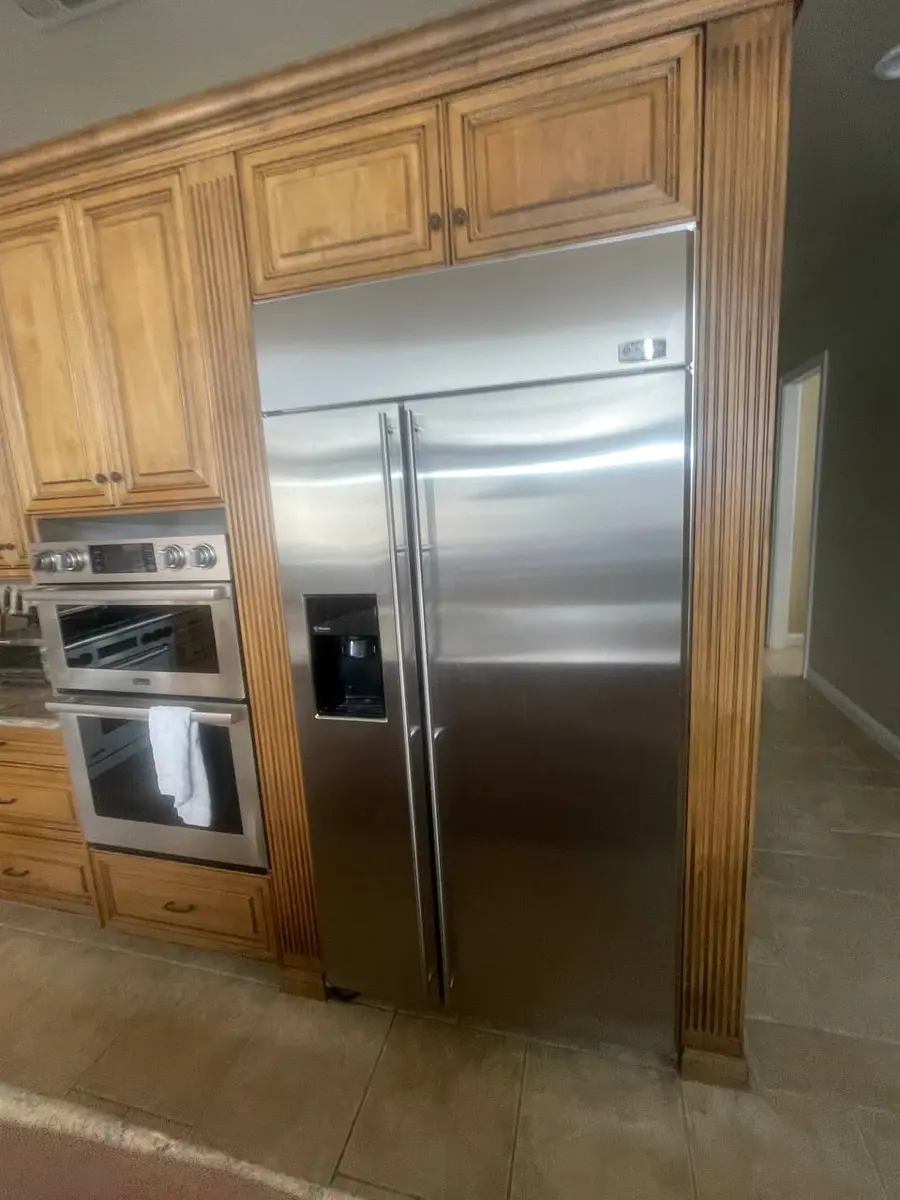
KitchenAid refrigerator owners frequently report fridge and freezer are too warm as an issue — here is what causes it and how to address each root cause. On KitchenAid models with the Preserva Food Care System (dual independent cooling), both compartments losing cooling simultaneously narrows the diagnosis significantly because each has its own evaporator. Only failures affecting the shared elements (control board, power, or both compressors on dual-compressor KBSD models) can take both compartments down at once.
Quick Answer#
KitchenAid refrigerator owners frequently report fridge and freezer are too warm as an issue — here is what causes it and how to address each root cause.
This is a food safety emergency — if both compartments are above safe temperatures (above 40F for fridge, above 0F for freezer for extended periods), food spoilage begins.
Do You Have the Right Tools?
Refrigerant gauges ($200+), vacuum pump ($250), leak detector ($150), and EPA-certified recovery equipment. Our technician arrives with $3,000+ in professional tools — your diagnostic is free.
Licensed & Insured · 90-Day Warranty · Same-Day Service
Immediate Food Safety Steps#
- If the fresh-food section exceeds 40F for more than 2 hours, perishable food is at risk.
- Transfer critical items to a cooler with ice while diagnosing.
- Do not open doors unnecessarily — each opening accelerates temperature rise.
- On KitchenAid models with digital displays, note the displayed temperatures for diagnostic reference.
What Are the Most Common Causes?#
1. Dirty Condenser Coils — Complete Thermal Overload (30% of cases)#
Severely neglected condenser coils can push the compressor into continuous thermal overload — the compressor runs briefly, overheats, trips the overload protector, cools down, restarts, and repeats. This cycle produces minimal cooling in both compartments. On KitchenAid counter-depth models (KRMF) with already-restricted condenser airflow, severe dust accumulation reaches crisis faster than on standard-depth units.
In our technicians' experience, wear on the primary failure component accounts for the majority of refrigerator cases on Kitchenaid units.
KBSD built-in models are particularly vulnerable because the enclosed cabinet cavity provides no passive airflow at all. If the condenser fan also fails in this scenario, thermal failure is rapid.
Diagnosis: Remove the toe-kick grille and inspect. If the condenser coils are heavily matted with dust or pet hair, AND the compressor is cycling on and off in short bursts (under 5 minutes), thermal overload from dirty coils is the cause.
DIY Difficulty: Easy Parts Professional
Repair Steps:
- Unplug the unit and remove toe-kick grille.
- Use a condenser coil brush to sweep across the entire coil surface front-to-back.
- Vacuum debris with a crevice attachment.
- Clean the condenser fan blades.
- Restore power and allow 12-24 hours for full temperature recovery.
2. Compressor Start Relay Failure (25% of cases)#
A failed start relay prevents the compressor from starting entirely. No compressor = no cooling in either compartment. The unit appears to run (lights work, fans may operate) but produces no cold air. You may hear clicking every 3-5 minutes as the relay attempts to start the compressor.
Because KitchenAid shares the Whirlpool compressor platform, the start relay (W10613606 family) is a common and inexpensive replacement.
Diagnosis: Listen at the compressor area. If you hear repetitive clicking (every 3-5 min) without sustained compressor running, the relay has failed. Shake the relay — rattling confirms broken internal contacts.
DIY Difficulty: Easy Parts Professional
3. Main Control Board Failure (20% of cases)#
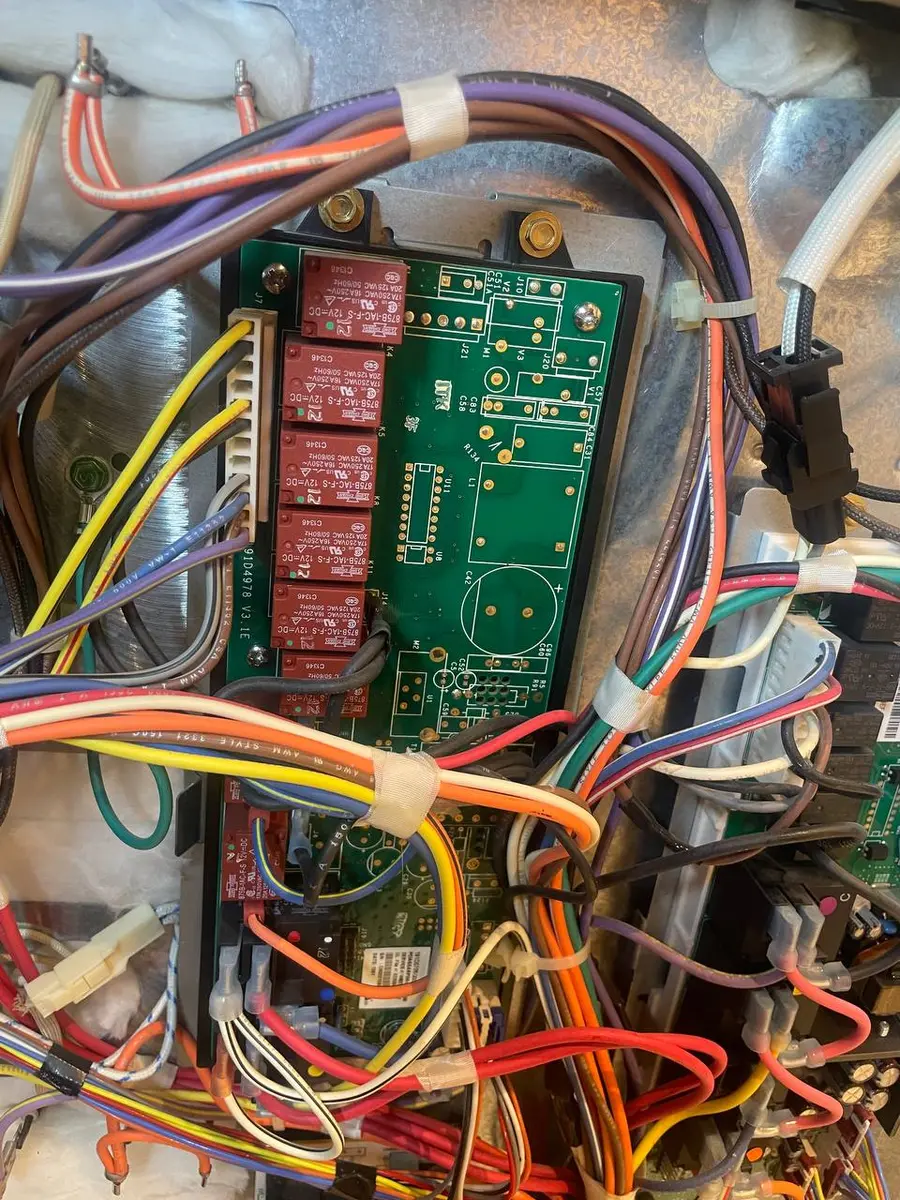
The main control board distributes power to ALL cooling components — both compressors on dual-system models, all fan motors, and damper controls. A catastrophic board failure (power surge damage, failed voltage regulator) disables the entire cooling system while potentially leaving display and lighting functional.
On KitchenAid models, power surges are the primary board failure cause. Homes in older [Sacramento](/sacramento/sacramento)-area neighborhoods with aging electrical infrastructure are more susceptible.
Diagnosis: If the display works (temperatures shown but rising), lights illuminate when doors open, but absolutely no cooling occurs in either compartment — and the compressor is silent — the board is not sending power to cooling components. Visual inspection may reveal burned components or swollen capacitors.
DIY Difficulty: Difficult Parts Professional
4. Compressor Mechanical Failure (15% of cases)#
A seized or failing compressor cannot pump refrigerant through the system. On single-compressor KitchenAid models, this affects both compartments. On Preserva dual-compressor models, if both compressors fail simultaneously, it strongly suggests a shared cause (power surge or board issue) rather than coincidental mechanical failure.
Signs of compressor failure: hot compressor body with no refrigerant circulation sounds (no gurgling in lines), or compressor that hums briefly and trips immediately.
Diagnosis: Place your hand near (not on) the compressor housing after it has been running. A working compressor is warm and produces slight vibration. A seized compressor is hot with no vibration, or cold if it hasn't started at all.
DIY Difficulty: Not DIY Parts -900+ Professional
5. Refrigerant Leak (10% of cases)#
A significant refrigerant leak leaves the system without enough working fluid to transfer heat. Both compartments lose cooling gradually over days to weeks as refrigerant escapes. The compressor runs but produces diminishing cold because there is insufficient refrigerant to absorb heat effectively.
Diagnosis: If both compartments warmed gradually (over days rather than suddenly), and the compressor runs continuously but coils feel barely cool, suspect a refrigerant leak. An oily residue near tubing connections can indicate leak points.
DIY Difficulty: Not DIY (requires EPA certification) Parts (leak repair + recharge) Professional
Safety First — Know the Risks
Refrigerant (R-134a/R-600a) requires EPA certification to handle. Improper discharge is a federal violation and health hazard. Our techs are licensed and insured — let them handle the risk.
Licensed & Insured · 90-Day Warranty · Same-Day Service
Preserva vs Single-System Diagnosis#
| Symptom | Single Evaporator | Preserva Dual System |
|---|---|---|
| Both warm simultaneously | Compressor, condenser, board, or refrigerant | Board (common to both), power, or extreme coincidence |
| Freezer OK, fridge warm | Damper, fridge fan | Fridge-side compressor/evap |
| Fridge OK, freezer warm | Defrost failure restricting airflow | Freezer-side compressor/evap |
On Preserva models, if BOTH sides fail simultaneously, focus on the control board and power supply — the only components shared between the two independent systems.
What Is the Diagnostic Sequence?#
- Is the compressor running? Listen at the bottom rear. Running = check efficiency (coils, refrigerant). Silent = check relay, board, power.
- Are lights and display working? Yes = power is reaching the unit, focus on cooling components. No = power issue or board.
- Clean condenser coils immediately if dusty — this resolves 30% of cases.
- Test the start relay — pull it off the compressor and shake.
- Check for error codes on the display.
- On Preserva models: Both sides failing together points to the shared control board.
The Real Cost of DIY
Average DIY attempt: $150-400 in tools you may use once, plus the risk of further damage. Our diagnostic visit costs $0 — we find the problem and give you an honest quote.
Licensed & Insured · 90-Day Warranty · Same-Day Service
Should You DIY or Call a Professional?#
| Issue | DIY? | Parts Cost | Professional Cost |
|---|---|---|---|
| Dirty condenser | Yes | ||
| Start relay | Yes | ||
| Control board | Difficult | ||
| Compressor | No | -900+ | |
| Refrigerant leak | No |
How Can You Prevent This?#
- Clean condenser coils every 6 months — the single most effective preventive measure.
- Install a surge protector to protect the control board from power events.
- Schedule professional inspection every 2-3 years for sealed system health check.
- Monitor temperature trends — gradual warming over weeks suggests a developing problem (refrigerant leak or progressive coil buildup).
Don't Void Your Warranty
Opening your appliance yourself may void the manufacturer warranty. Our repair comes with a 90-day guarantee, and we document everything for warranty compliance.
Licensed & Insured · 90-Day Warranty · Same-Day Service
FAQ#
Q: Both compartments are warm — how long do I have before food spoils?
FDA guidelines: perishable food in the fresh-food section becomes unsafe after 4 hours above 40F. A fully loaded freezer holds safe temperature for 48 hours (24 hours if half full) if the door stays closed.
Q: Is it worth repairing a KitchenAid with compressor failure?
For KBSD built-in models ( replacement cost), compressor replacement at is almost always worthwhile. For freestanding KRFF units over 12 years old, compare repair cost to replacement cost — the economics are closer.
Q: Can a power outage cause both compartments to stay warm permanently?
A power outage itself resolves when power returns. If the unit does not resume cooling after power restoration, the outage likely damaged the control board or start relay — components vulnerable to the power surge that often accompanies outage recovery.
Professional KitchenAid [refrigerator repair](/bay-area/services/refrigerator-repair) — diagnosis, parts, and fix in a single visit. Sacramento and Bay Area coverage. Schedule a visit
Appliance Repair Technician · 11 years experience
Experienced technician with 11 years specializing in Frigidaire and Electrolux refrigerator and dryer repair with a focus on safety.