KitchenAid Refrigerator Door Won't Close or Latch — Seal & Hinge Fixes
KitchenAid refrigerators use magnetic gasket seals rather than mechanical latches for the primary doors — the gasket's embedded magnets pull the door against the frame to create a seal. When owners report a "latch failure," the actual problem is typically a combination of gasket demagnetization, hinge wear causing misalignment, or cam closer mechanism failure that prevents the door from pulling itself shut for the final inch.
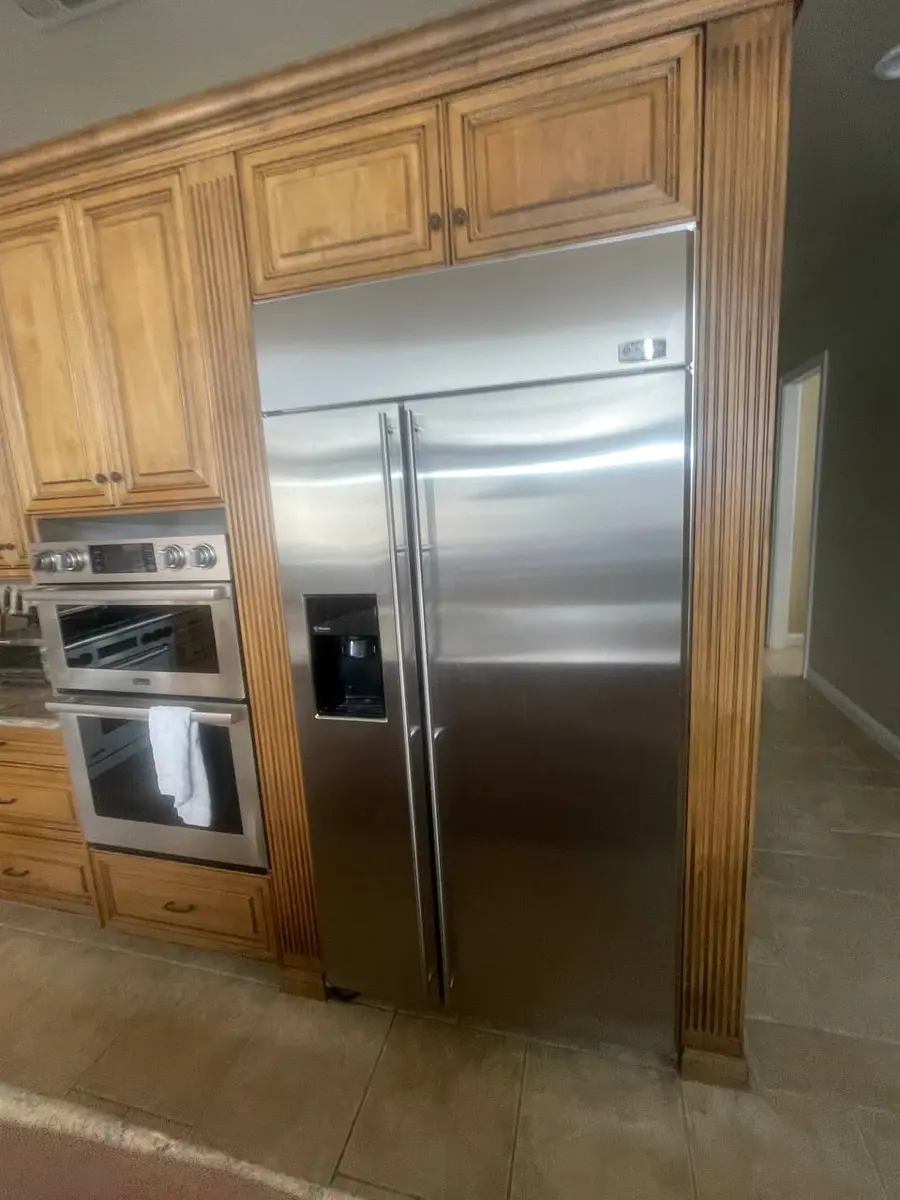
On KBSD built-in models with custom cabinet panels, door weight is a critical factor — hardwood panels add 10-20 pounds per door, placing significantly more stress on hinges and cam closers than the unit was designed for without proper counterbalancing.
Understanding KitchenAid Door Closure Systems
KitchenAid French door models use a multi-component closure system:
- Door hinges (top and bottom) — support the door weight and maintain alignment
- Cam closers — spring-loaded mechanisms in the lower hinge that pull the door closed for the last 2-3 inches of travel
- Magnetic gasket — embedded magnets in the gasket create the final seal pull
- Door alarm — beeps if the door remains open beyond a set time (typically 5 minutes)
When any component degrades, the door may not close fully, creating air gaps that trigger temperature problems and the door alarm.
Do You Have the Right Tools?
Refrigerant gauges ($200+), vacuum pump ($250), leak detector ($150), and EPA-certified recovery equipment. Our technician arrives with $15K+ in professional tools — your diagnostic is free.
Licensed & Insured · 90-Day Warranty · Same-Day Service
Safety Note
- A door that does not seal properly allows warm air into the compartments, potentially raising food temperatures to unsafe levels.
- Do not tape or prop the door closed as a workaround — this masks the underlying problem and can bend hinges further.
- On KBSD built-in models, a sagging door with a heavy panel can damage the cabinet surround. Support the door before attempting hinge work.
Most Common Causes (Ranked by Likelihood)
1. Worn or Demagnetized Door Gasket (30% of cases)
The door gasket contains small magnets along its length that pull the door tight against the refrigerator frame. Over 5-8 years, these magnets weaken, and the gasket material becomes less flexible — losing its ability to conform to the frame surface. KitchenAid's gaskets are slightly softer than basic brands (for better sealing against the Platinum Interior) and can deform more easily from repeated contact with food containers or shelving placed too close to the door edge.
The center seal between French doors is a separate magnetic strip that is often overlooked — when it weakens, the two doors do not pull against each other properly.
Diagnosis: Dollar-bill test along entire perimeter — close the door on a bill at 8-10 points. If it pulls out with no resistance anywhere, the gasket has weakened. Also check if the gasket has pulled out of its retention groove at any point (visible gap between gasket and door edge).
DIY Difficulty: Easy to Moderate Parts Cost: $55-135 (complete gasket set for French door) Professional Repair Cost: $145-295
Repair Steps:
- Order the correct gasket using your model number from the interior sidewall sticker.
- Starting at the top, pull the old gasket from its retention groove around the door perimeter.
- Press the new gasket lip into the groove, working in sections. Start at the top corners.
- For the center French door seal: pull the old magnetic strip from its channel and press the new one in.
- Close the doors and verify they pull tight against the frame.
- If new gasket sections are stiff, use a hair dryer on low to soften them for better conformity.
2. Cam Closer Mechanism Worn (25% of cases)
The cam closer is a spring-loaded device inside the bottom hinge that provides the self-closing action — when you push the door to within 2-3 inches of closed, the cam mechanism pulls it the rest of the way. When the spring weakens or the cam surfaces wear smooth, the door stops at that 2-3 inch gap without completing closure.
On KitchenAid French door models, each door has its own cam closer. On KBSD built-in models with heavy custom panels, cam closers wear significantly faster — often lasting only 4-6 years instead of the expected 10+.
Diagnosis: Push the door to near-closed position and release. A functioning cam closer will pull the door shut with an audible magnetic contact. If the door stops 1-3 inches from closed and stays there, the cam closer has lost its pulling force.
DIY Difficulty: Moderate Parts Cost: $25-65 per cam closer Professional Repair Cost: $145-275
Repair Steps:
- Open the door fully and support its weight (especially important on panel-ready built-ins).
- Remove the bottom hinge cover plate.
- Locate the cam closer assembly — it sits within or adjacent to the bottom hinge mechanism.
- Remove the mounting screws (typically 2-3).
- Extract the old cam closer — note the spring orientation.
- Install the new cam closer with the spring properly loaded.
- Reassemble the hinge cover and test the self-closing action.
3. Hinge Pin Wear or Loosening (20% of cases)
Door hinges support the entire door weight and allow smooth opening. On KitchenAid refrigerators, both top and bottom hinges can wear over time. The bottom hinge bears the majority of the weight and its pin can develop play (wobble), causing the door to sag and no longer align with the frame. Even 1-2mm of misalignment is enough to prevent proper gasket contact on one side.
French door models are particularly vulnerable because each door is narrower and taller — creating a lever arm that amplifies any hinge play into significant misalignment at the top or bottom edges.
Diagnosis: With the door closed, check the gap between the door edge and the refrigerator frame. The gap should be even along the entire height. If the gap is wider at the top and tighter at the bottom (or vice versa), the hinge has worn and the door has shifted.
DIY Difficulty: Moderate Parts Cost: $35-95 (hinge assembly) Professional Repair Cost: $145-295
Repair Steps:
- Empty the door shelves to reduce weight during work.
- Open the door and support from underneath.
- Remove the hinge cover (top or bottom as needed).
- Note: removing the bottom hinge requires supporting the door — it will be free-swinging once the bottom hinge is disconnected.
- Remove hinge bolts and extract the worn hinge.
- Install the new hinge, aligning mounting holes precisely.
- Tighten bolts evenly and check door alignment before fully tightening.
4. KBSD Panel Weight Imbalance (15% of cases)
KBSD built-in models are designed to accept custom cabinet panels that match surrounding cabinetry. When panels are too heavy (solid hardwood exceeding KitchenAid's weight specifications) or unevenly weighted, they stress the hinge and cam mechanisms beyond design limits. Bay Area custom kitchen installations sometimes use exotic hardwood panels that weigh 15-25 lbs — when KitchenAid specifies maximums of 10-12 lbs depending on door size.
After installation, the added weight gradually overwhelms the cam closers and stretches hinges over 1-3 years.
Diagnosis: If you have a KBSD built-in and the door closure has degraded gradually (worked fine for the first year, then progressively worsened), panel weight is likely exceeding specifications. Weigh the panel if possible — remove it temporarily and test if closure improves.
DIY Difficulty: Moderate (panel removal) to Difficult (panel replacement with lighter material) Parts Cost: $25-65 (stronger cam closer) or $200+ (lighter panel fabrication) Professional Repair Cost: $175-400
5. Door Alarm Sensor Fault (10% of cases)
Sometimes the reported "latch failure" is actually a false door alarm — the door IS closing properly, but the door switch sensor reports it as open. This triggers continuous beeping that owners interpret as a closure problem. KitchenAid uses a magnetic reed switch on the frame that detects a corresponding magnet on the door. If either the switch or door magnet shifts position, the sensor reports "open" despite a good seal.
Diagnosis: When the alarm beeps, physically check the door — is it actually ajar or is it sealed tight? If sealed tight but beeping, the sensor has drifted. Look for the small magnet on the door edge (near the top on most models) and the corresponding switch on the frame.
DIY Difficulty: Easy Parts Cost: $10-25 (reed switch or magnet) Professional Repair Cost: $95-150
Safety First — Know the Risks
Refrigerant (R-134a/R-600a) requires EPA certification to handle. Improper discharge is a federal violation and health hazard. Our techs are licensed and insured — let them handle the risk.
Licensed & Insured · 90-Day Warranty · Same-Day Service
Diagnostic Sequence
- Is the door actually open or just reporting open? Check if the seal is in contact all around.
- Dollar-bill test the gasket for magnetic strength.
- Test cam closer — does the door self-close from 3 inches?
- Check door alignment — even gap all around?
- On KBSD: Assess panel weight relative to specifications.
Same-Day Appliance Repair
Fixed or It's Free
$89 → $0 Service Call & Diagnosis — offer ends May 25
DIY vs Professional Repair
| Issue | DIY? | Parts Cost | Professional Cost |
|---|---|---|---|
| Door gasket | Yes | $55-135 | $145-295 |
| Cam closer | Moderate | $25-65 | $145-275 |
| Hinge replacement | Moderate | $35-95 | $145-295 |
| Panel weight issue (KBSD) | Difficult | varies | $175-400 |
| Door alarm sensor | Easy | $10-25 | $95-150 |
The Real Cost of DIY
Average DIY attempt: $150-400 in tools you may use once, plus the risk of further damage. Our diagnostic visit costs $0 — we find the problem and give you an honest quote.
Licensed & Insured · 90-Day Warranty · Same-Day Service
Prevention
- Do not hang heavy items on the door handles — this accelerates hinge wear.
- Check door alignment annually — catching slight sag early prevents gasket damage.
- Clean the gasket monthly with mild soap — sticky residue prevents proper magnetic contact.
- KBSD owners: Verify panel weight before installation. Consult KitchenAid's specifications for your exact model.
- Do not force the door open beyond its designed arc — stop hinges prevent damage, but repeated forcing weakens them.
FAQ
Q: My KitchenAid beeps that the door is open but it looks closed — what should I do?
First verify the door is actually sealed (no visible gap, dollar-bill holds). If sealed, the door switch sensor has likely shifted. Locate the reed switch on the frame and the door magnet — reposition if needed or replace the switch ($10-25 part).
Q: Can I adjust KitchenAid door hinges without replacing them?
Some models have adjustable hinge mounting slots — loosening the screws allows repositioning. However, if the hinge pin itself is worn (causing wobble), adjustment alone does not resolve the problem. The hinge must be replaced.
Q: My KBSD built-in door was fine for years and now won't stay closed — why the sudden change?
Gradual cam closer wear from heavy panels eventually reaches a threshold where self-closing force drops below what is needed. It appears sudden but is actually years of progressive wear. Replacing the cam closer and verifying panel weight are within specs should resolve the issue.
KitchenAid door not sealing? Our technicians carry gaskets, cam closers, and hinge kits for same-visit door closure repair. Schedule door repair →