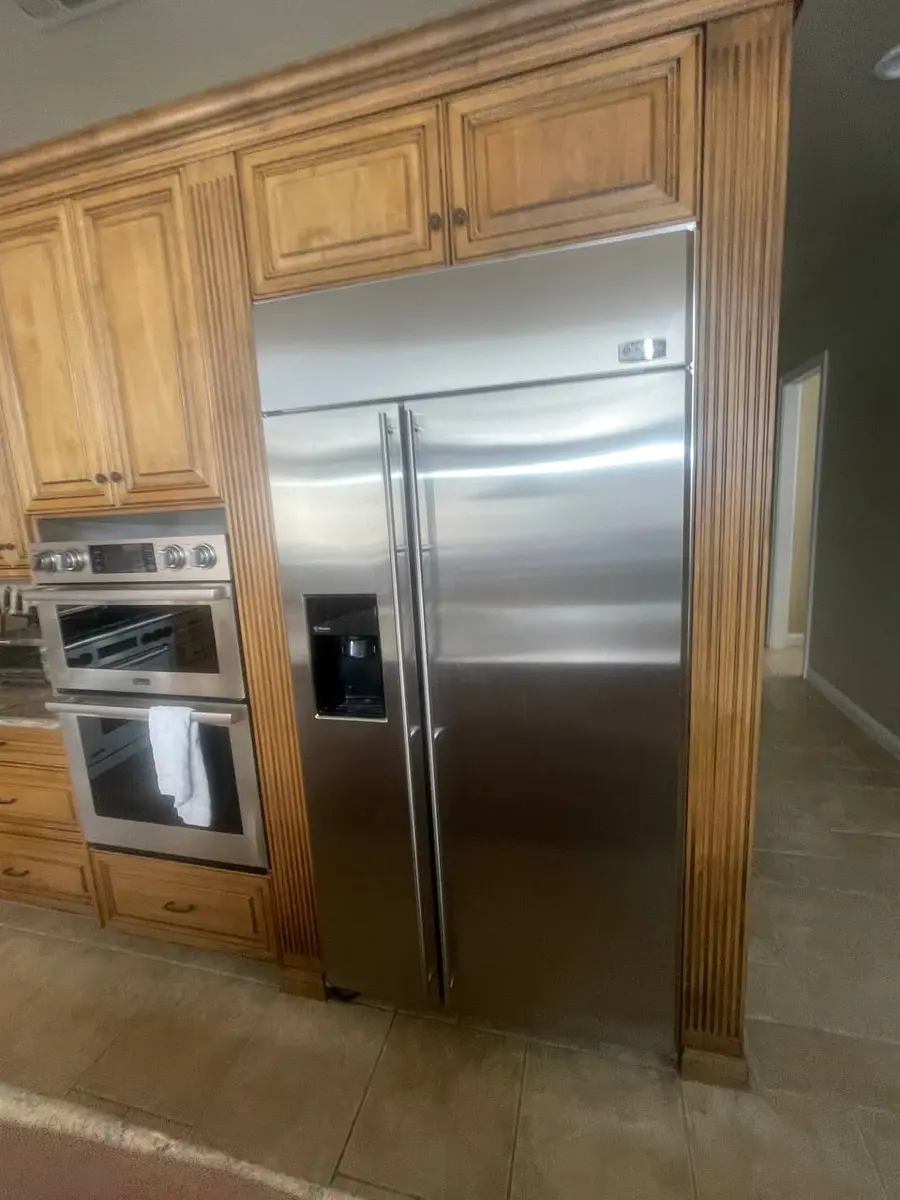
A Kenmore refrigerator that trips the circuit breaker is drawing more current than the circuit allows — almost always a surge during compressor startup or a short to ground. Refrigerators run on a standard 120V circuit (15A or 20A), so a fault that pushes past that rating trips the breaker. This guide ranks the causes.
The likely culprit#
Most likely: a failed compressor start relay. When the relay fails, the compressor tries to start, draws locked-rotor current — roughly 5-8 times normal running current — and that surge trips the house breaker before the compressor's own overload can react. If the relay and compressor test good, look for a short to ground in a heater, fan, or the wiring.
Do You Have the Right Tools?
Refrigerant gauges ($200+), vacuum pump ($250), leak detector ($150), and EPA-certified recovery equipment. Our technician arrives with $3,000+ in professional tools — your diagnostic is free.
Licensed & Insured · 90-Day Warranty · Same-Day Service
Safety first#
Unplug the refrigerator before inspecting the start relay, compressor terminals, or any wiring. Do not keep resetting the breaker on a repeated trip — a dead short can overheat the wiring.
Ranked causes at a glance#
| Likely cause | How common | What you'll notice / what to check |
|---|---|---|
| Compressor start relay failure | 30% of cases | Breaker trips on a startup attempt; relay drawing locked-rotor current (5-8x normal). |
| Compressor winding short or seizure | 25% of cases | Immediate trip; a shorted or seized compressor pulling excess current. |
| Grounded defrost heater | 20% of cases | Trips during the defrost cycle when a cracked heater shorts to ground. |
| Condenser fan motor short | 10% of cases | Trips as the fan runs; a shorted or seized fan motor drawing high current. |
| Damaged wiring or control board | 5% of cases | Intermittent trips from a chafed harness, damaged cord, or a shorted board. |
Safety First — Know the Risks
Refrigerant (R-134a/R-600a) requires EPA certification to handle. Improper discharge is a federal violation and health hazard. Our techs are licensed and insured — let them handle the risk.
Licensed & Insured · 90-Day Warranty · Same-Day Service
Working through each cause#
1. Compressor start relay failure (30% of cases)#
The start relay (on Whirlpool-platform units, part W10189190) gives the compressor its starting boost. When it fails, the compressor keeps attempting to start and pulls locked-rotor current — about 5-8 times its running draw — and that repeated surge trips the breaker. Unplug the fridge, pull the relay off the compressor, and inspect it; a burnt or rattling PTC relay is the common finding and an inexpensive replacement.
2. Compressor winding short or seizure (25% of cases)#
A compressor with a shorted winding or a mechanically seized rotor draws excess current the instant it's energized, tripping the breaker almost immediately. Test the compressor windings for a short to the shell with a meter. A shorted or seized compressor is a major repair — often the point where replacement of the unit is weighed against the cost.
3. Grounded defrost heater (20% of cases)#
If the fridge trips specifically during defrost, a cracked defrost heater shorting to ground is the likely cause, since the heater only energizes during that cycle. Isolate the heater and check it for continuity to ground. A heater shorting to the chassis draws fault current that trips the breaker only when it's powered.
4. Condenser fan motor short (10% of cases)#
A condenser fan motor with shorted windings or seized bearings draws high current when it runs, and that can trip the breaker as the fan cycles on. Unplug the fridge and spin the fan by hand — drag or a burnt smell points here — and test the motor for a short. Replace the motor if it reads shorted or won't turn freely.
5. Damaged wiring or control board (5% of cases)#
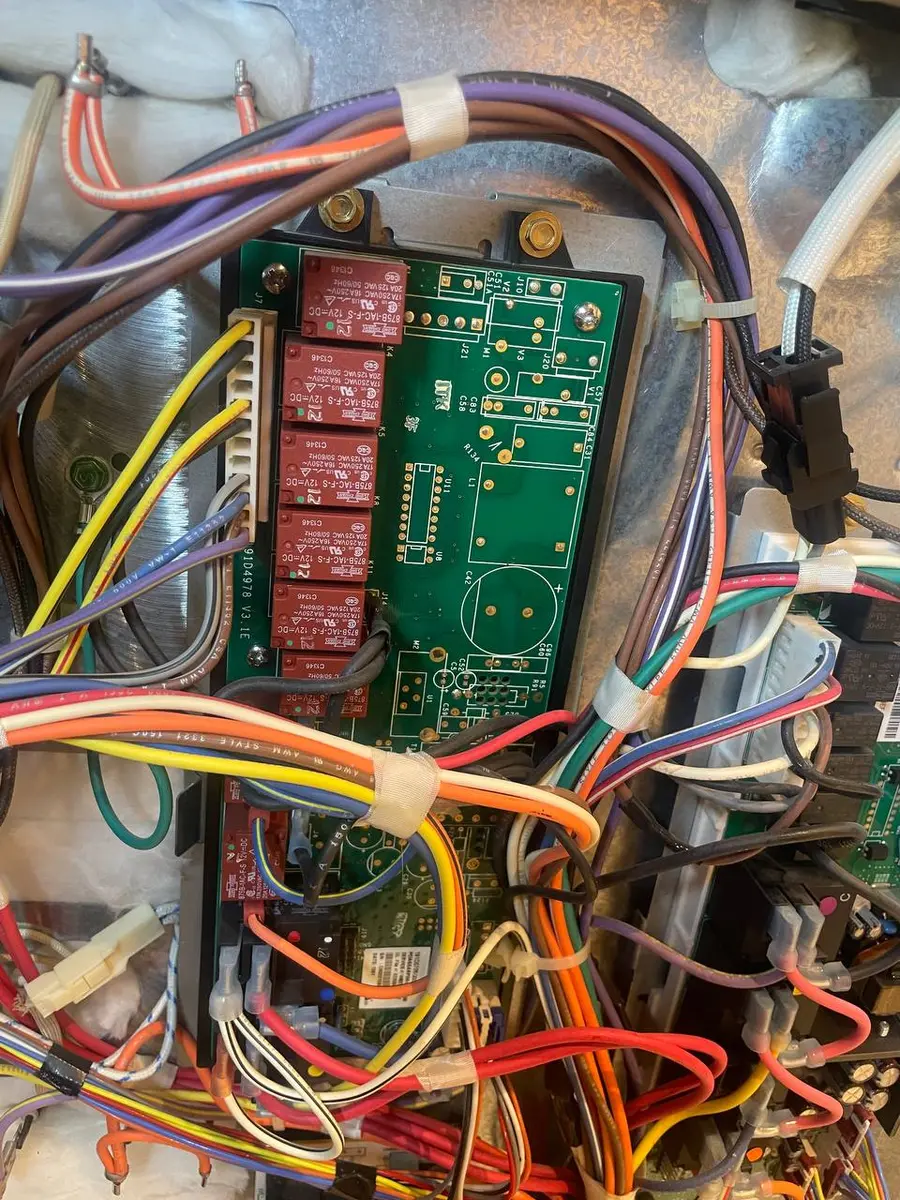
A chafed harness, a damaged power cord, or a shorted main control board (on LG-platform units, board EBG60663230) can cause intermittent trips that don't line up with a specific component. Inspect the cord and visible wiring for damage, especially where it flexes or passes an edge. A board that shows scorching or shorts on test is replaced.
The short version#
- Start relay — 30%; locked-rotor surge (5-8x), relay W10189190.
- Compressor short/seizure — 25%; immediate trip, winding shorted to shell.
- Grounded defrost heater — 20%; trips only during defrost.
- Condenser fan short — 10%; trips as the fan runs.
- Wiring / control board — 5%; intermittent, harness or board EBG60663230.
The Real Cost of DIY
Average DIY attempt: $150-400 in tools you may use once, plus the risk of further damage. Our diagnostic visit costs $0 — we find the problem and give you an honest quote.
Licensed & Insured · 90-Day Warranty · Same-Day Service
What the repair usually involves#
A breaker-trip repair isolates the fault by when it trips — at startup points at the relay or compressor, during defrost at the heater, as the fan runs at the condenser motor — then tests that component for a short with the fridge unplugged. Most are a relay, heater, or fan-motor replacement; a shorted compressor is the exception that drives a repair-or-replace decision.
When to call a professional#
Call a technician if the breaker trips repeatedly, if the compressor or a start relay is involved, or if you'd be testing for shorts at the compressor terminals — these are line-voltage, high-current faults. Don't keep resetting the breaker in the meantime. The cost depends on whether it's a relay, a heater, a fan, or the compressor plus labor, and a tech can confirm first.
Tripping the breaker? Book an EasyBear technician — we service Kenmore refrigerators on both the Whirlpool and LG platforms and diagnose electrical faults safely.
Appliance Repair Technician · 11 years experience
Experienced technician with 11 years specializing in Frigidaire and Electrolux refrigerator and dryer repair with a focus on safety.