Diagnosing a noisy Kenmore refrigerator starts with one question: who built it? A 106-series is a Whirlpool with a rotary compressor and simple AC fan motors, while a 795-series is an LG Elite with a linear compressor and DC brushless fans — and the two platforms fail with entirely different sounds. Once you know the platform and can describe the noise, most sounds point straight at one part.
First, Rule Out Normal Sounds#
Every refrigerator makes noise, so confirm the sound is actually abnormal before chasing a repair. On a 106-series, the rotary compressor gives a steady low hum during run cycles that should be barely audible a few feet away. On a 795-series, the linear compressor cycles more often and adds a slight click at each start and stop — that intermittent clicking is normal for the LG platform, not a fault. Both platforms produce a rushing or gurgling sound as refrigerant flows, especially after defrost, and both crack or pop as plastic panels expand and contract with temperature. A smooth fan whir is normal; grinding or scraping is not.
Do You Have the Right Tools?
Refrigerant gauges ($200+), vacuum pump ($250), leak detector ($150), and EPA-certified recovery equipment. Our technician arrives with $3,000+ in professional tools — your diagnostic is free.
Licensed & Insured · 90-Day Warranty · Same-Day Service
106-Series (Whirlpool) Abnormal Sounds#
Click-Buzz-Click, Repeating#
A rhythmic click, then a buzz of a few seconds, then a click, repeating every couple of minutes, is a failing compressor start relay. The relay tries to start the compressor (click), the motor fails to engage and trips its thermal overload (buzz), and the overload resets (click). The part is the start relay, Whirlpool W10613606 — a small device that plugs directly onto the compressor terminal pins at the lower rear. This is a plug-and-play fix with no tools beyond pulling the fridge from the wall: pull the old relay off, push the new one on. Treat it as moderately urgent, though, because the compressor is not running during this pattern, so cooling has stopped, and repeated failed starts can eventually damage the compressor windings if left for days.
Grinding or Scraping From the Freezer#
Grinding inside the freezer is a worn evaporator fan motor, or ice that has formed around the blades and is scraping. On a 106-series the evaporator fan stops when the freezer door opens, so there is a clean test: if the noise stops the instant you open the door, it is the evaporator fan. Press the door switch by hand with the door closed; if the grinding returns, the motor is the source. If ice is the cause, a manual defrost clears it temporarily, but the underlying defrost failure has to be fixed or it returns. A worn motor is Whirlpool part W10189703, reached by removing the rear freezer panel, unplugging one harness, and unbolting the motor.
Rattling or Buzzing From the Bottom Rear#
A rattle from the bottom rear is usually the condenser fan — worn bearings, or debris wrapped around the blade throwing it out of balance. On a 106-series the condenser fan runs whenever the compressor runs, and dust or pet hair on the shaft is a common cause. Pull the fridge out, remove the rear access panel, and watch the fan run: visible wobble, debris, or bearing noise confirms it. Clean the blade and shaft first; if you can feel play in the shaft when you wiggle the blade (unplugged), replace the motor, Whirlpool part W10124096.
A Loud Snap Every Several Hours#
A single loud snap or pop every several hours is the defrost heater expanding or contracting as its cycle starts and ends — the glass-tube element heats fast and the thermal expansion makes an audible snap. It is normal, and gets louder as the heater ages. No action is needed unless the snap comes with a burning smell, which can mean the heater's glass tube has cracked.
795-Series (LG) Abnormal Sounds#
Loud Knocking Every Few Seconds#
Rhythmic knocking that sounds like someone tapping the cabinet with a hammer is the signature of LG linear compressor failure. The linear compressor drives a piston that oscillates on springs; as the piston or springs wear, it strikes the ends of its travel and knocks. This is high urgency — the compressor is in active failure and, while it may limp along for days or weeks, the noise worsens and cooling degrades. Before paying for anything, check whether your unit falls under the LG linear compressor class-action settlement, which covers affected units made in the 2014-2020 window; the coverage follows the hardware maker, not the Kenmore badge, so a rebranded unit can still qualify.
High-Pitched Whine or Whistle#
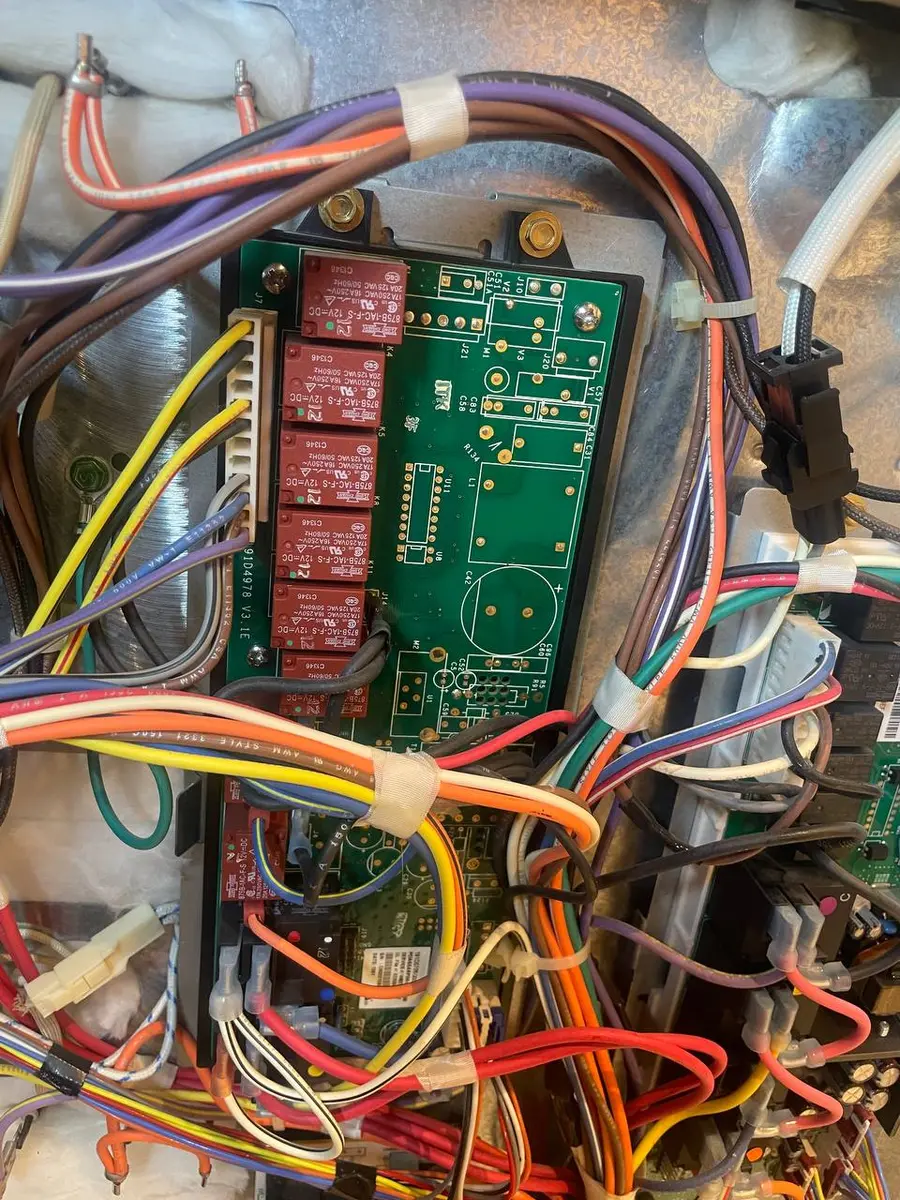
The 795-series uses DC brushless fans with electronic speed control, so a failing motor-driver circuit on the main board can emit a high-pitched whine from its speed-control switching, and a failing DC fan bearing whines rather than grinds the way an AC motor would. Locate the sound to sort it: from the top rear, where the main board lives, suspect a failing driver on the board; from inside the freezer, suspect the evaporator fan motor.
Buzzing When the Ice Maker Fills#
A brief buzz when the ice maker fills is the water inlet valve solenoid opening, and a low buzz lasting several seconds followed by silence is normal fill. A continuous loud buzz with no water flowing means the solenoid is energized but stuck closed, or the water pressure is too low to open the valve against its spring. Check the supply — the saddle valve or angle stop should be fully open and the line should carry at least 20 PSI. If pressure is fine and the valve still buzzes without filling, replace it, LG part AJU72992603.
Fans That Never Stop#
A 795-series that runs its evaporator and condenser fans continuously is usually not a fan problem at all — the board is holding the fans on because it senses temperature above threshold and is trying to reject more heat. The real cause is a cooling shortfall: an underperforming compressor, a sealed-system leak, or a dirty condenser. Fix the underlying cooling issue rather than the fan noise.
Safety First — Know the Risks
Refrigerant (R-134a/R-600a) requires EPA certification to handle. Improper discharge is a federal violation and health hazard. Our techs are licensed and insured — let them handle the risk.
Licensed & Insured · 90-Day Warranty · Same-Day Service
Locate the Sound, Name the Part#
| Sound Location | Likely Source (106-series) | Likely Source (795-series) |
|---|---|---|
| Top-rear of unit | N/A (no components) | Main board driver, fan motor |
| Inside freezer | Evaporator fan motor | Evaporator fan motor |
| Bottom-rear | Condenser fan, compressor, start relay | Condenser fan, linear compressor |
| Behind fresh food | Damper motor (periodic clicks when adjusting) | Damper motor |
| Ice maker area | Harvest motor, fill valve | Twist-tray motor, fill valve |
How to Keep a Kenmore Quiet#
- Vacuum the condenser coils and the fan area at the bottom rear a few times a year — dust and pet hair on the condenser fan shaft is a top cause of rattling on 106-series units.
- Keep the unit level; a fridge that rocks transmits normal compressor vibration into the floor as a hum or buzz that is easily mistaken for a fault.
- Leave a few inches of clearance behind and above the unit so the fans move air freely and are not forced to run louder or longer.
- Address any defrost problem promptly — ice forming around the evaporator fan is what turns a quiet fan into a scraper.
- On a 795-series, notice when the linear compressor's normal start-stop click first changes character, since a shift toward knocking is the early warning of compressor wear.
None of these will silence a part that has already failed, but they slow the wear that makes an otherwise healthy refrigerator get louder as it ages, and they make a genuinely new noise easier to notice against a quiet baseline.
The Real Cost of DIY
Average DIY attempt: $150-400 in tools you may use once, plus the risk of further damage. Our diagnostic visit costs $0 — we find the problem and give you an honest quote.
Licensed & Insured · 90-Day Warranty · Same-Day Service
When a Noise Means Act Now#
- Continuous click-buzz-click (106): cooling has stopped — food is at risk within hours.
- Loud knocking (795): the compressor is failing — plan repair within days, not weeks.
- Grinding plus warming temperatures: a fan failure is now affecting cooling — same-day attention.
- Buzzing plus a burning smell: an electrical component is overheating — unplug immediately.
- A loud single pop then silence: the compressor may have seized — confirm whether it is still cooling.
Your Kenmore refrigerator issue is likely a straightforward repair. Our [Sacramento](/sacramento/sacramento) and Bay Area technicians can diagnose it today. Schedule your repair
Appliance Repair Technician · 11 years experience
Experienced technician with 11 years specializing in Frigidaire and Electrolux refrigerator and dryer repair with a focus on safety.