Condensation on a Kenmore refrigerator door is usually a heater or humidity issue, not a broken compressor — and which heater depends on whether you have a 106-series (Whirlpool platform) or a French-door 795-series (LG platform). This guide splits the diagnosis by platform.
The likely culprit#
Most likely: an anti-sweat heater circuit has failed. Kenmore doors carry low-wattage heaters in the frame that keep the exterior surface above the dew point; when a circuit opens, condensation appears in the area that heater used to warm. If the heaters are fine, high indoor humidity is the next thing to rule out — sometimes it's physics, not a fault.
Do You Have the Right Tools?
Refrigerant gauges ($200+), vacuum pump ($250), leak detector ($150), and EPA-certified recovery equipment. Our technician arrives with $3,000+ in professional tools — your diagnostic is free.
Licensed & Insured · 90-Day Warranty · Same-Day Service
Why refrigerator doors sweat#
The door surface is chilled from inside by the cold compartment, and without help its exterior can drop below the dew point and collect condensation in any humid room. Manufacturers embed low-wattage heaters around the frame and gasket to keep that surface just warm enough to stay dry. When a heater circuit fails — or the room is very humid — the surface drops below dew point and sweats.
Kenmore 106-series (Whirlpool platform)#
| Likely cause | How common | What you'll notice / what to check |
|---|---|---|
| Anti-sweat heater failure | 40% of cases | Condensation in one area of the door where a frame-heater circuit has opened. |
| High-humidity environment | 30% of cases | Sweating across the whole door when indoor humidity runs high (often 60-70%). |
| Gasket leaking cold air | 20% of cases | Localized condensation at points along the gasket where cold air escapes. |
| Energy Saver switch off | 10% of cases | Heaters disabled by the Energy Saver setting, so condensation returns. |
Anti-sweat heater failure (40% of cases)#
The 106-series has thin resistance-wire heaters in the door-frame perimeter alongside the gasket channel. When one circuit opens, condensation shows up in the area that circuit used to keep warm. Run your hand across the door — areas over working heaters feel slightly warm — or map it with an infrared thermometer. On many 106-series models the heaters are integral to the door, but a loose lead at the hinge can often be reconnected to restore function.
High-humidity environment (30% of cases)#
When indoor humidity climbs — 60-70% in homes without air conditioning or with evaporative coolers — even healthy heaters can't keep the whole door dry, and you get uniform condensation. This is a wattage limitation, not a failure. Reducing room humidity with a dehumidifier and running the kitchen exhaust fan usually clears it.
Gasket leaking cold air (20% of cases)#
A failed or misaligned gasket lets cold compartment air escape along the door edge, chilling the exterior directly and causing condensation right at the leak. Condensation concentrated at specific gasket points — rather than across the door — points here. The dollar-bill test confirms a weak seal at those spots.
Energy Saver switch off (10% of cases)#
Some 106-series models have an Energy Saver switch that disables the anti-sweat heaters, and with it on the heaters stay off and condensation appears. Look inside the fresh-food section near the temperature controls for a switch labeled Energy Saver or marked with a moisture-droplet icon. Switching it back re-enables the heaters.
Safety First — Know the Risks
Refrigerant (R-134a/R-600a) requires EPA certification to handle. Improper discharge is a federal violation and health hazard. Our techs are licensed and insured — let them handle the risk.
Licensed & Insured · 90-Day Warranty · Same-Day Service
Kenmore 795-series (LG platform, French door)#
| Likely cause | How common | What you'll notice / what to check |
|---|---|---|
| Mullion heater failure | 35% of cases | Condensation or frost between the two French doors, dripping down the center. |
| Door-in-door condensation | 25% of cases | Sweating on the door-in-door panel when its separate heater circuit fails. |
| High humidity / gasket issues | 25% of cases | Localized sweat at the extra gasket perimeter of the French-door layout. |
| Defrost-drain internal condensation | 15% of cases | Water at the bottom of the door that's actually internal condensation from a clogged drain. |
Mullion heater failure (35% of cases)#
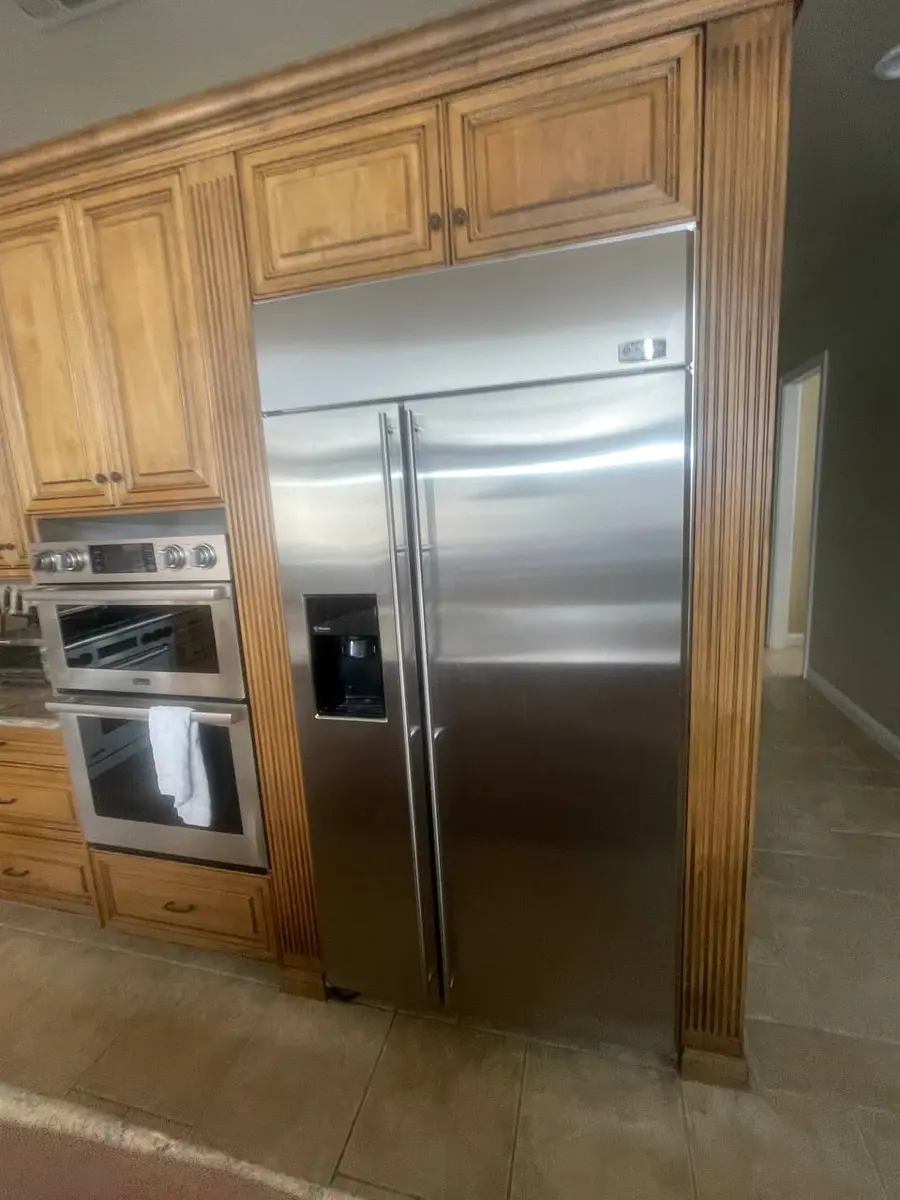
French-door 795-series models use a mullion heater between the two upper doors to keep the center strip above dew point. When it fails, condensation or frost forms right where the doors meet and can drip down the center onto the floor. Condensation limited to that meeting point — rather than the door faces — is the signature.
Door-in-door condensation (25% of cases)#
On 795-series Elite models with a door-in-door compartment, the anti-sweat heater there is on its own circuit, so when it fails condensation appears specifically on the door-in-door panel. Diagnose it the same way — a cold, wet panel where the rest of the door is dry points at that circuit.
High humidity or gasket issues (25% of cases)#
The French-door layout has more gasket perimeter — two doors plus a drawer — so it has more potential leak points, and the center seal between the doors is a common weak spot for air infiltration and localized sweat. Reduce room humidity and check the seals, especially at the center.
Defrost-drain internal condensation (15% of cases)#
Sometimes what looks like door sweating is internal condensation from a clogged defrost drain: meltwater can't exit, evaporates inside, and re-condenses on cooler surfaces, dripping to the bottom of the door. If the water shows only at the bottom and drips from under the gasket, suspect the drain rather than dew-point sweating on the exterior.
The short version#
- 106-series — anti-sweat heater (40%), high humidity (30%), gasket leak (20%), Energy Saver off (10%).
- 795-series — mullion heater (35%), door-in-door (25%), humidity/gasket (25%), defrost drain (15%).
The Real Cost of DIY
Average DIY attempt: $150-400 in tools you may use once, plus the risk of further damage. Our diagnostic visit costs $0 — we find the problem and give you an honest quote.
Licensed & Insured · 90-Day Warranty · Same-Day Service
When to call a professional#
Call a technician if condensation persists after ruling out room humidity and the Energy Saver setting, if a frame, mullion, or door-in-door heater circuit has failed, or if the "sweat" is really internal condensation from a defrost drain. Heavy, continuous condensation can damage cabinetry and flooring, so address it before it does. A tech can confirm which circuit or seal is at fault and quote the repair.
Doors sweating? Book an EasyBear technician — we service Kenmore refrigerators on both the 106 Whirlpool and 795 LG platforms.
Appliance Repair Technician · 11 years experience
Experienced technician with 11 years specializing in Frigidaire and Electrolux refrigerator and dryer repair with a focus on safety.