Kenmore Refrigerator Burning Smell — Locating the Source by Platform
A burning smell from any refrigerator demands immediate attention. While rarely representing a fire hazard in modern units (thermal overload protection shuts down faulting components before ignition), the smell indicates an electrical component is overheating and will fail completely if not addressed. In Kenmore refrigerators, the source of the burning smell and the urgency of response depend on which manufacturer built your unit and which component is overheating.
Immediate Safety Steps
Before diagnosing, take these precautions:
- Identify the smell type. Electrical burning (hot plastic/rubber) indicates motor or relay overheating. Chemical/refrigerant smell (sharp, slightly sweet) could indicate a sealed system leak near a hot surface. Rotten egg or sulfur smell is not a refrigerator issue — check your gas lines.
- If you see smoke or sparks: Unplug the refrigerator immediately. Do not use the outlet until an electrician inspects it.
- If smell is present but no visible smoke: You can leave the unit plugged in briefly to aid diagnosis (locating the heat source), but plan to unplug within 15-20 minutes of investigation.
Do You Have the Right Tools?
Refrigerant gauges ($200+), vacuum pump ($250), leak detector ($150), and EPA-certified recovery equipment. Our technician arrives with $15K+ in professional tools — your diagnostic is free.
Licensed & Insured · 90-Day Warranty · Same-Day Service
Burning Smell Sources in Kenmore 106-Series (Whirlpool Platform)
1. Compressor Start Relay Overheating (30% of Cases)
The most common source of burning smell in 106-series Kenmore fridges is the compressor start relay (Whirlpool part W10613606). This relay provides the initial power surge to start the compressor motor each cycle. When the relay's internal contacts degrade, they arc during each start attempt, generating heat that eventually melts the relay housing and produces a distinct hot-plastic smell.
You may also hear the click-buzz-click pattern (failed start attempts) accompanying the smell. The relay is located directly on the compressor terminals at the bottom-rear of the unit.
Diagnostic: Unplug the fridge. Pull it away from the wall. Remove the rear lower access panel. Locate the relay plugged onto the side of the compressor. If it is discolored, melted, or has visible burn marks, it has failed. You can also shake it gently — a rattling sound (broken internal parts) confirms failure.
Risk level: Low fire risk (thermal overload prevents sustained overheating), but the component will not function and the compressor cannot start. Cooling has stopped.
Parts Cost: $15-30 Professional Repair Cost: $90-150
2. Condenser Fan Motor Seizure (25% of Cases)
The condenser fan motor on 106-series units sits next to the compressor at the bottom-rear. This shaded-pole motor runs whenever the compressor runs. When its sleeve bearings seize, the motor stalls but continues to receive power, causing the motor windings to overheat. The overheating produces a hot-wire smell (burning enamel from the copper wire insulation in the motor windings).
Diagnostic: With the unit plugged in and running, pull it from the wall and remove the rear access panel. If the condenser fan blade is stationary while the compressor hums, the motor has seized. You may see the motor housing discolored from heat or smell concentrated in this area. The motor may also be hot to the touch (unplug before touching).
Risk level: Moderate. A stalled motor drawing locked-rotor current for extended periods can overheat wiring. The thermal protector on the motor should eventually trip, but older units may have degraded protection.
Parts Cost: $20-50 (Whirlpool W10124096) Professional Repair Cost: $120-200
3. Defrost Heater Malfunction (15% of Cases)
While the defrost heater is designed to get hot (it melts evaporator frost), a heater with a cracked glass tube can arc where moisture contacts the exposed element. This produces a brief burning smell during defrost cycles (every 8-12 hours of compressor run time). The smell is intermittent, occurring only when defrost activates and lasting 15-25 minutes.
Diagnostic clue: If the burning smell appears only once or twice per day and lasts less than 30 minutes each time, the defrost heater is the likely source. The smell originates from inside the freezer section.
Parts Cost: $20-45 (WR51X10055) Professional Repair Cost: $140-240
4. Wiring Harness or Connector Overheating (15% of Cases)
On Kenmore 106-series units older than 15 years, wire connectors at high-current points (compressor terminals, defrost heater connections, ADC board output) can develop high-resistance connections due to oxidation. A high-resistance connection carrying normal current generates heat at the connection point, potentially melting the connector housing and producing burning smell.
Diagnostic: This requires inspecting each major connector for discoloration, melting, or charring. Most common locations: compressor terminal block, defrost heater wire nuts inside the freezer panel, and the power cord connection at the rear terminal block.
Parts Cost: $5-20 (connectors/wire repair) Professional Repair Cost: $120-200
5. Control Board Component Failure (15% of Cases)
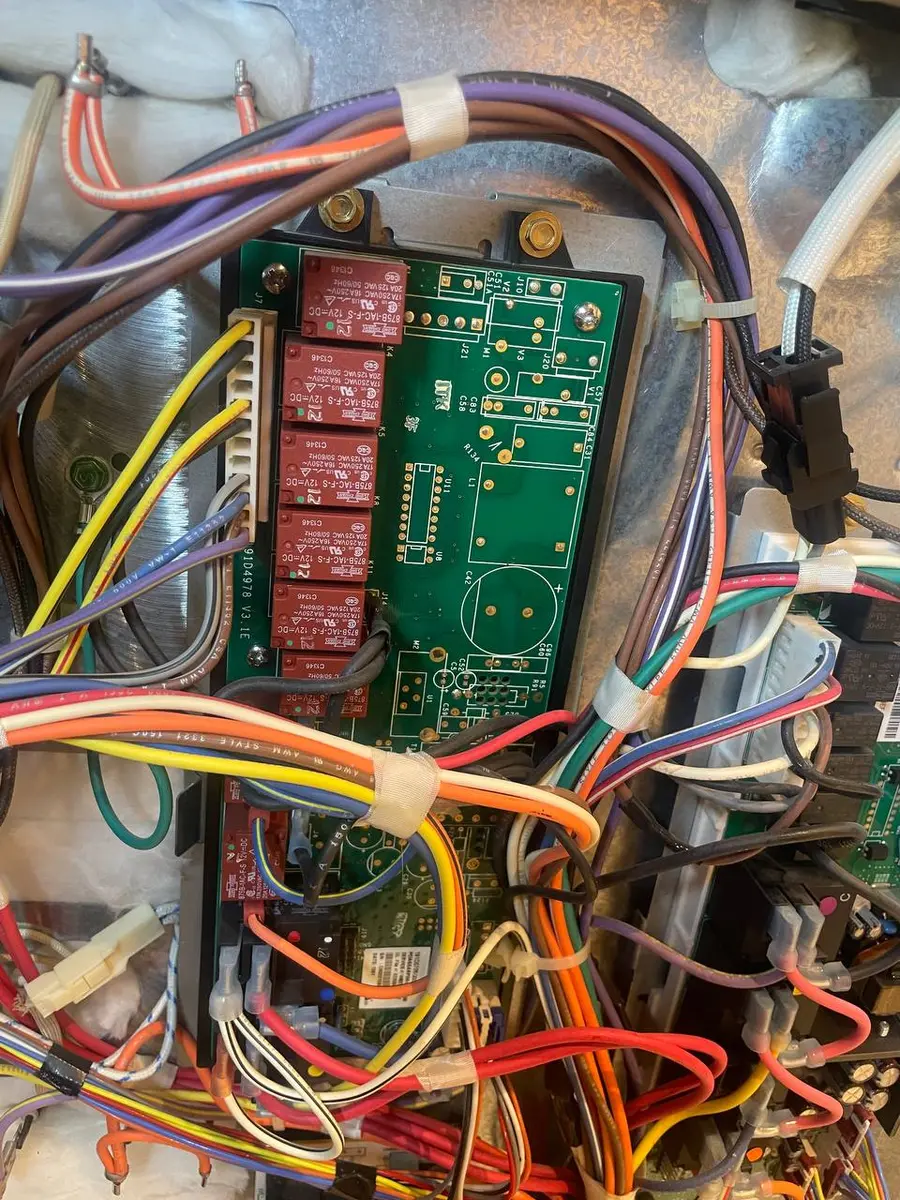
On 106-series models with electronic control boards (rather than mechanical thermostats), a failing board relay or capacitor can produce burning smell. The board is typically located behind the fresh food temperature control panel. A failed component may produce visible burn marks on the circuit board.
Diagnostic: Remove the control panel cover inside the fresh food section. Inspect the board visually for darkened areas, burnt components, or melted solder. A distinctive acrid smell concentrated at the board location confirms this source.
Parts Cost: $35-80 Professional Repair Cost: $140-250
Burning Smell Sources in Kenmore 795-Series (LG Platform)
1. Linear Compressor Overload (35% of Cases)
The LG linear compressor in 795-series units can produce a burning smell when its internal overload protector repeatedly trips and resets. Unlike the external start relay on Whirlpool platforms, the LG linear compressor has an integrated protection circuit. When the compressor is failing (documented class action issue), it draws excessive current, trips protection, cools, restarts, and repeats. The thermal cycling of the protection components generates a hot-electrical smell.
Diagnostic: The smell originates from the top-rear area of the unit (where the compressor is housed on most 795-series models — note this is different from the bottom-rear location on 106-series). Accompanied by the characteristic knocking sound of a failing linear compressor.
Action: Check class action warranty coverage. Units manufactured 2014-2020 may qualify for free repair.
Parts Cost: $0 under warranty / $400-700 out of warranty Professional Repair Cost: $0 under warranty / $600-1,100 out of warranty
2. Main Control Board Relay Failure (30% of Cases)
The 795-series main PCB (located in the upper-rear housing) contains multiple relays that switch compressor, fan motors, and defrost heater power. A failing relay produces arcing at its contacts during each switching event. The arcing carbonizes the contact surfaces, generating progressively worse heat and burning smell until the relay fails completely.
Diagnostic: The smell is strongest at the top-rear of the unit near the control board housing. The unit may display Er CO error code if the board damage affects communication circuits.
Parts Cost: $120-250 (main PCB EBR78940602) Professional Repair Cost: $250-400
3. Evaporator Fan Motor Stall (20% of Cases)
The DC brushless fan motors in 795-series units can stall if ice buildup blocks the blade. Unlike the 106-series shaded-pole motors which overheat quickly when stalled, the DC brushless motor controller on the LG platform may attempt repeated start pulses, each producing brief heat at the motor. The accumulated effect over hours produces a smoldering smell from inside the freezer compartment.
Parts Cost: $25-55 Professional Repair Cost: $140-240
4. Wiring at Door Hinge Pass-Through (15% of Cases)
The 795-series (like all French-door and side-by-side models) routes wires through the door hinge area to power door-mounted lights, dispensers, and controls. The repeated opening/closing of the door flexes these wires at the hinge point. Over years of use, insulation wears and conductors can touch, creating a short that arcs and smells. This is more common on French-door models than top-freezer configurations.
Diagnostic: Smell concentrated at the top hinge area. May be accompanied by intermittent door light flicker or dispenser malfunction.
Parts Cost: $30-80 (harness replacement) Professional Repair Cost: $150-250
Same-Day Appliance Repair
Fixed or It's Free
$89 → $0 Service Call & Diagnosis — offer ends May 25
Safety First — Know the Risks
Refrigerant (R-134a/R-600a) requires EPA certification to handle. Improper discharge is a federal violation and health hazard. Our techs are licensed and insured — let them handle the risk.
Licensed & Insured · 90-Day Warranty · Same-Day Service
When Burning Smell Is NOT the Refrigerator
Before blaming the Kenmore, verify the smell is actually from the unit:
- New refrigerator smell: Fresh plastic and adhesive off-gassing in new or recently purchased units is normal for the first 1-2 weeks. Not a burning smell but often described as one.
- Dust burning on condenser coils: After cleaning or when the unit first runs in fall after a hot summer with open windows, dust on hot surfaces can produce a brief burning smell. Not harmful and resolves within hours.
- Outlet or wall wiring issue: A burning smell concentrated at the electrical outlet rather than the refrigerator itself indicates a wall wiring problem. Check if the outlet faceplate is warm to the touch.
FAQ
Q: Should I unplug my Kenmore immediately if I smell burning?
If you see smoke, sparks, or the smell is very strong and getting worse: yes, unplug immediately. If the smell is faint and you want to diagnose the source location, you can leave it plugged in briefly (15-20 minutes) while you locate the heat source. Always unplug before opening any panels or touching components.
Q: Can a burning smell from a Kenmore refrigerator start a house fire?
Modern Kenmore refrigerators (any unit with UL listing manufactured after 2000) have multiple thermal protection devices that prevent sustained overheating. House fires from refrigerator electrical faults are extremely rare. However, units older than 20 years with degraded protection should be treated with more caution.
Q: The burning smell comes and goes. Is that still a problem?
Yes. An intermittent burning smell typically indicates a component that is failing progressively. The smell appears when the component operates (compressor start relay during startup, defrost heater during defrost cycle, fan motor during compressor run time) and dissipates when it stops. The component will eventually fail completely.
Q: My Kenmore 795-series has a burning smell and is making knocking sounds. What is the priority?
This combination strongly suggests linear compressor failure. Check your warranty status immediately under the LG class action settlement. If covered, you can get a free compressor replacement that resolves both the smell and the noise. If out of warranty, this is a cost-effectiveness decision point — compressor replacement on a 795-series is $600-1,100.
Burning smell from your Kenmore refrigerator? Do not ignore it. Our technicians can identify the overheating component and determine if your unit qualifies for warranty coverage. Schedule urgent diagnosis →