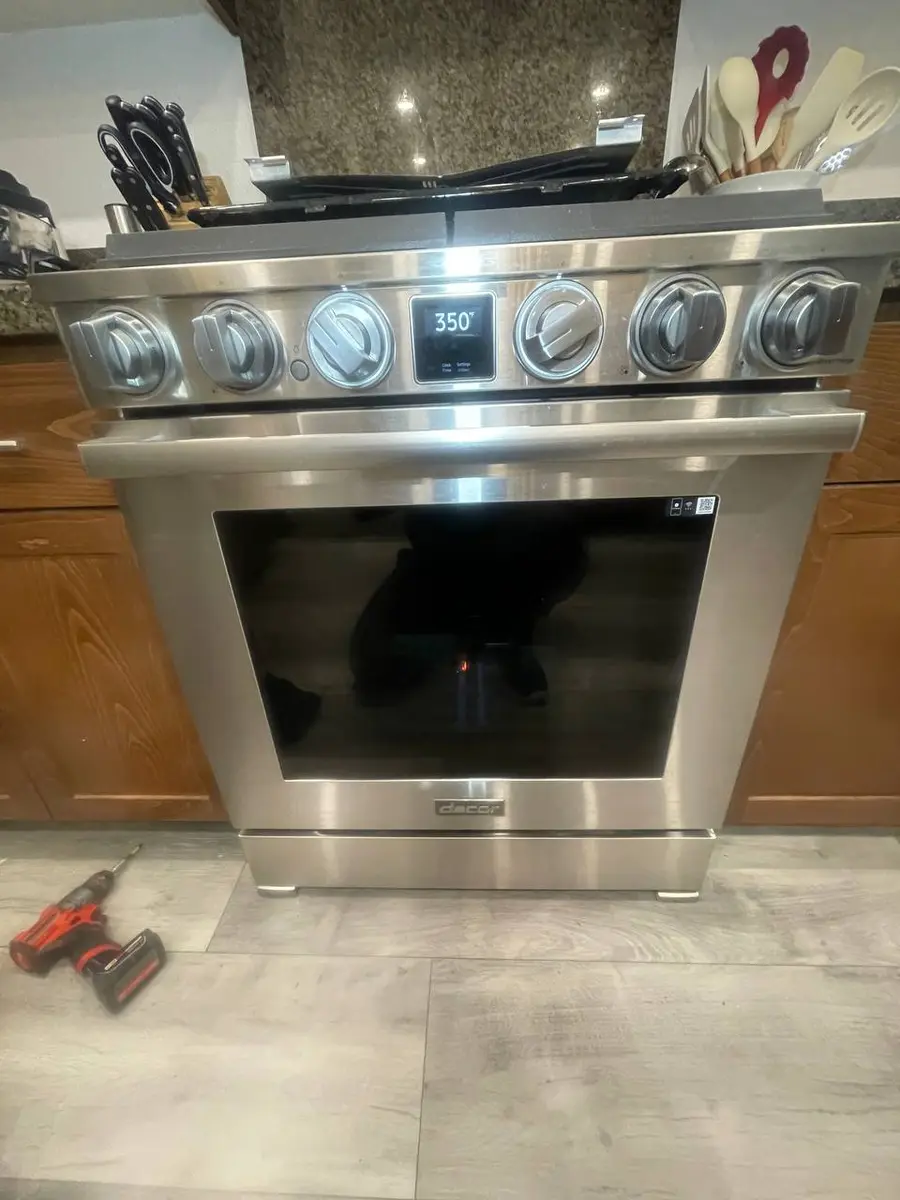
Replace Samsung Stove Oven Temperature Sensor
Swapping the oven temperature sensor on a Samsung range is a beginner, 15-25 minute job. You meter the sensor (a good one reads about 1,080 ohms cold), unscrew the probe from the oven's rear wall, feed in the replacement, and confirm the oven holds temperature.
A Samsung oven sensor changes resistance predictably with heat: at room temperature — about 77 degrees F — it reads roughly 1,080 ohms, and that rises steadily as the cavity warms. When the reading drifts out of range the control board flags it, usually as an SE code.
Before you start#
| Item | Use |
|---|---|
| Phillips #2 screwdriver | Mounting screw |
| Multimeter | Resistance test |
| 1/4-inch nut driver | Some models |
| Samsung oven sensor | DG32-series, model-specific |
Safety warning: Turn off the circuit breaker for the range. Allow the oven to cool completely if recently used.
Do You Have the Right Tools?
Combustion analyzer ($300), igniter tester ($120), temperature calibrator ($150), and gas pressure manometer. Our technician arrives with $3,000+ in professional tools — your diagnostic is free.
Licensed & Insured · 90-Day Warranty · Same-Day Service
Step-by-step#
1. Confirm the sensor has failed#
Set the meter to ohms. The sensor sits at the oven's rear wall and its connector is reached from behind (drop the rear lower panel on freestanding models). Unplug the connector and read the probe cold: about 1,080 ohms is healthy. Below 900 or above 1,200 at room temperature — or an infinite or zero reading — confirms failure.
2. Reach the probe inside the oven#
The probe passes through the rear wall, usually upper-left, and juts three to four inches into the cavity. It is held by a single Phillips or 1/4-inch hex screw.
3. Remove the old sensor#
Back out the mounting screw and draw the probe straight out of its hole, taking care not to enlarge it. Reach behind the range (or through the removed rear panel) and unplug the harness from the sensor leads.
4. Fit the new sensor#
Feed the new probe through the rear-wall hole from inside the oven and secure it with the screw. Reconnect the keyed harness behind the range — it only seats one way.
5. Restore power and calibrate#
Switch the breaker on. Many Samsung models allow oven calibration in the settings menu (often by holding Bake for three seconds); start at zero offset and test before adjusting.
6. Check accuracy#
Set the oven to 350 degrees F with a separate oven thermometer on the middle rack. After twenty minutes it should read within plus or minus 15 degrees; if not, dial in the calibration offset.
Troubleshooting#
- The error returns after the swap: a break in the harness between sensor and board mimics a dead sensor — meter its continuity from the board end.
- Temperature still off: a self-clean cycle can permanently shift calibration; correct it with the offset function, but if you need more than 35 degrees of correction the board relay may be sticking the element on.
- Probe will not fit the hole: some generations use different probe diameters, so confirm the part matches your exact model.
- An SE code flashing is specifically the oven sensor error — the board is seeing an out-of-range resistance.
Safety First — Know the Risks
Gas ovens involve live gas lines — a loose connection creates explosion and carbon monoxide risk. Electric ovens run on 240V circuits. Our techs are licensed and insured — let them handle the risk.
Licensed & Insured · 90-Day Warranty · Same-Day Service
When this fix will not work#
EasyBear technicians serving Sacramento and the Bay Area carry Samsung-specific diagnostic tools and replacement parts on every service call. Call a professional if the board drives the elements to full heat regardless of the sensor, if several codes appear together, if the door locks unexpectedly into a self-clean protection state, or if the job means working on the 240V wiring behind the range and you are not comfortable with high voltage.
Need Professional Help?#
Same-day Samsung stove repair available across Sacramento, the Bay Area, and surrounding California communities. Get started
Appliance Repair Technician & Diagnostics Specialist · 10 years experience
Electronics and diagnostics specialist with 10 years of experience in modern smart appliance repair, specializing in LG and Samsung.