How to Repair Whirlpool Fridge Ice Maker Wiring
Intermittent ice making or an F7E1 code on a Whirlpool refrigerator usually traces to a broken wire in the ice-maker harness, most often where it flexes at the freezer-door hinge. The fix is to find the break with a continuity test and repair it with heat-shrink solder-seal connectors — a 35-60 minute intermediate…
Before you start#
- Tools: Torx T20 screwdriver, Phillips #2 screwdriver, 1/4-inch nut driver, a multimeter, wire strippers, heat-shrink solder-seal connectors, a heat gun or lighter, needle-nose pliers.
- Parts: heat-shrink solder-seal connectors and, if needed, replacement 18 AWG wire or a new ice-maker harness.
- Safety: Unplug the refrigerator before touching any wiring. The circuit is only 12V DC, but a bad connection can short and damage the main board.
Step by step#
- Confirm the ice maker is being told to run. Enter diagnostic mode (the tech-sheet button sequence — typically press the door switch three times and hold on the fourth) and run the ice-maker test. On forced harvest you should hear the motor; silence points to wiring, the module, or the board output. An F7E1 code specifically means the board cannot talk to the module, which strongly implies a broken wire between them.
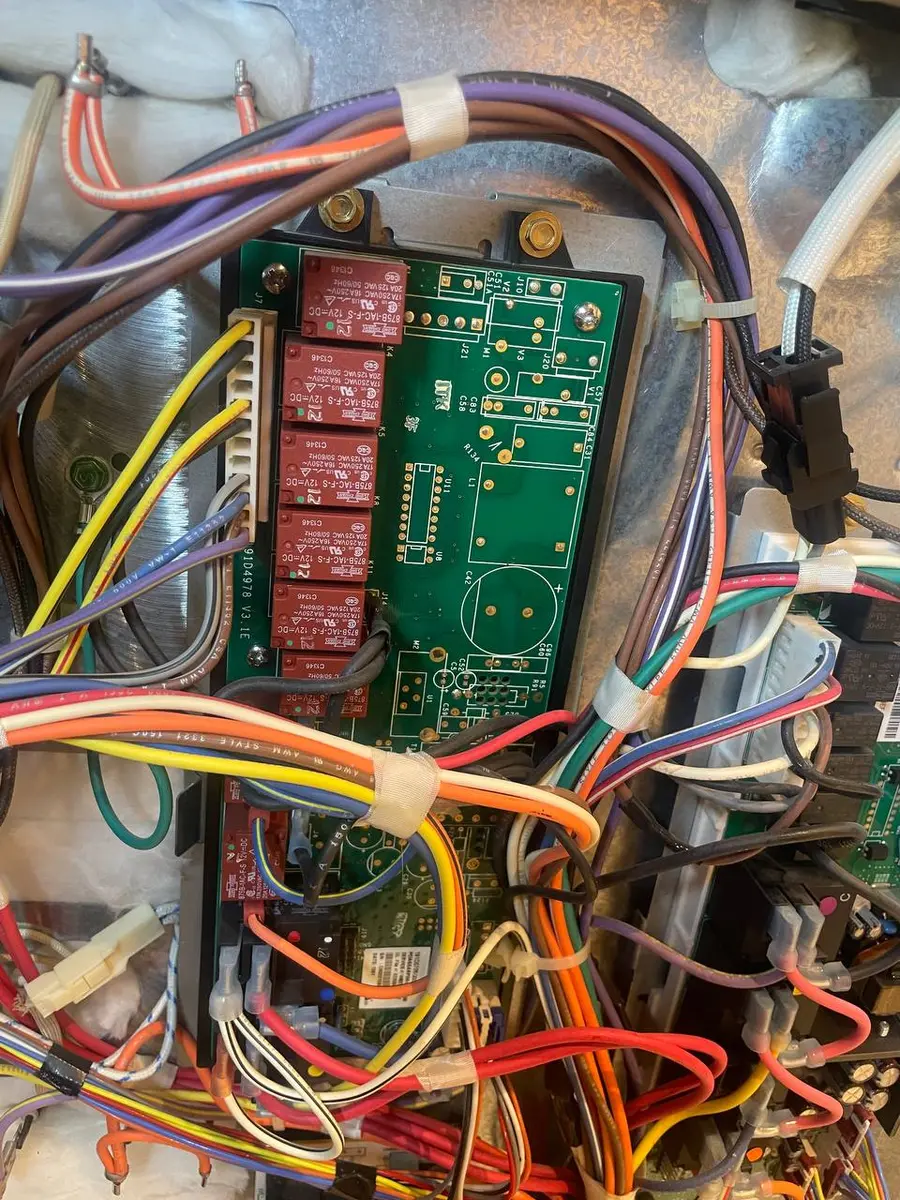
- Get to the harness. Unplug the fridge, loosen the module's single mounting screw, and unplug the harness at the module. On In-Door-Ice models, pull the bin and bracket to expose the wiring into the door — the critical failure point on French-door units is where the harness crosses the hinge and flexes thousands of times a year.
- Inspect the hinge run. Pull back the protective loom at the top hinge and examine each wire for broken strands under cracked insulation, green corrosion from moisture, insulation rubbed through on a metal edge, or a hidden break under intact-looking insulation (tug each wire gently). This is the number-one ice-maker wiring fault on Whirlpool French-door fridges more than a few years old.
- Test continuity through the harness. On continuity mode, probe each connector pin at the module end against its matching pin at the board end (you may need to pull the rear fresh-food panel to reach the board connector). Any wire that reads open is broken along its run — most likely at the hinge.
- Repair the broken wires. Cut out the damaged section, strip a quarter inch on each end, slide a heat-shrink solder-seal connector over the joint, and heat it until the solder flows and the adhesive-lined tubing shrinks tight — a waterproof, strong joint that survives freezer cycling. If several wires are damaged, run a new 18 AWG section inside split-loom tubing and zip-tie it clear of the hinge bend.
- Re-test and reassemble. Re-check continuity end to end (all pins should beep), reconnect the harness at the module and board, refit the module and its screw, and route the wiring with no pinch points where panels close.
- Test the ice maker. Plug in, run the forced-harvest test again, and listen for the motor cycling; then allow 2-4 hours for the first batch, since a Whirlpool ice maker takes about 90 minutes per batch at a normal 0 degrees F freezer temperature.
- Clear the code. Clear a stored F7E1 in diagnostic mode. If it returns within 24 hours, the module may have been damaged by the earlier fault and need replacing.
Do You Have the Right Tools?
Refrigerant gauges ($200+), vacuum pump ($250), leak detector ($150), and EPA-certified recovery equipment. Our technician arrives with $3,000+ in professional tools — your diagnostic is free.
Licensed & Insured · 90-Day Warranty · Same-Day Service
Whirlpool In-Door-Ice note#
The In-Door-Ice system carries the fill tube and ice maker in the door, so it needs a flexible connection at the hinge — a white multi-pin Molex-style plug behind a cover panel. Ice-crystal buildup can raise its contact resistance and cause intermittent ice; clean the contacts with electronic contact cleaner and add dielectric grease to keep moisture out.
If it still misbehaves#
- Motor runs but no ice drops: the mold-heater wire may read high resistance (it should be about 60-80 ohms) and not warm the mold enough to release cubes.
- Water overflows the ice maker: a fill-valve signal wire shorted to ground holds the valve open — disconnect the harness to confirm, then find the short.
- Only half the tray fills: a high-resistance valve wire cuts the Measured Fill flow — repair the connection or replace the harness section.
- F7E1 persists on known-good wiring, or a power pin has no voltage: the board's ice-maker output may be damaged and need replacement.
Appliance Repair Technician & Diagnostics Specialist · 10 years experience
Electronics and diagnostics specialist with 10 years of experience in modern smart appliance repair, specializing in LG and Samsung.