GE Refrigerator Won't Start? Causes & Fix
Most likely a failed start relay or overload protector is stopping the compressor — if the interior lights work but the compressor never runs, the fault is in the compressor circuit — though the main control board, the compressor itself, a cold-control thermostat, the power cord, or the thermal overload can each keep…
First: is it the refrigerator or the power?#
Before you suspect the refrigerator, prove power is reaching it. Plug a lamp or phone charger into the same outlet — if that is dead, the outlet or breaker is your problem, not the fridge. Many kitchens run on GFCI-protected outlets, so check for a tripped GFCI at the outlet or upstream in the circuit; GE actually advises against GFCI circuits for refrigerators because compressor inrush current causes nuisance trips. And after any power interruption, wait five minutes before reconnecting — the compressor needs that time to equalize pressure or it can lock up on restart.
Stay safe#
- Never bypass the grounding prong — GE refrigerators have metal frames that must be grounded.
- Do not use an extension cord; GE prohibits them because the voltage drop damages the compressor start circuit.
- Wait five minutes after a power loss before plugging back in, to avoid a locked-rotor start.
- If you smell burning, do NOT plug the unit back in — a burnt start relay or compressor can start a fire if forced.
Do You Have the Right Tools?
Refrigerant gauges ($200+), vacuum pump ($250), leak detector ($150), and EPA-certified recovery equipment. Our technician arrives with $3,000+ in professional tools — your diagnostic is free.
Licensed & Insured · 90-Day Warranty · Same-Day Service
Causes at a glance#
| Likely cause | What you'll notice | Share of cases | First move |
|---|---|---|---|
| Start relay / overload | Click-buzz-click, warm compressor | 30% | Shake-test and inspect the relay |
| Main control board | No response, erratic behavior | 25% | Inspect the board for damage |
| Compressor | Hums then shuts on overload | 20% | Test compressor windings |
| Cold-control thermostat | No call for cooling at all | 10% | Test the thermostat continuity |
| Power cord | Intermittent or no power | 8% | Inspect the cord and plug |
| Thermal overload | Cuts out, resets minutes later | 7% | Test the overload device |
Working through the causes#
Start relay or overload (30%). The start relay gives the compressor the extra current it needs to spin up from a standstill; on GE units it is a PTC device or coil relay in a plastic housing on the side of the compressor, alongside the overload protector (part WR07X10097 on many models). A failing relay produces the classic click-buzz-click as the compressor tries and gives up. Unplug, pull the relay off the compressor pins, and shake it — a rattle or a burnt smell condemns it. It is one of the easiest refrigerator parts to replace, pushing straight onto the pins.
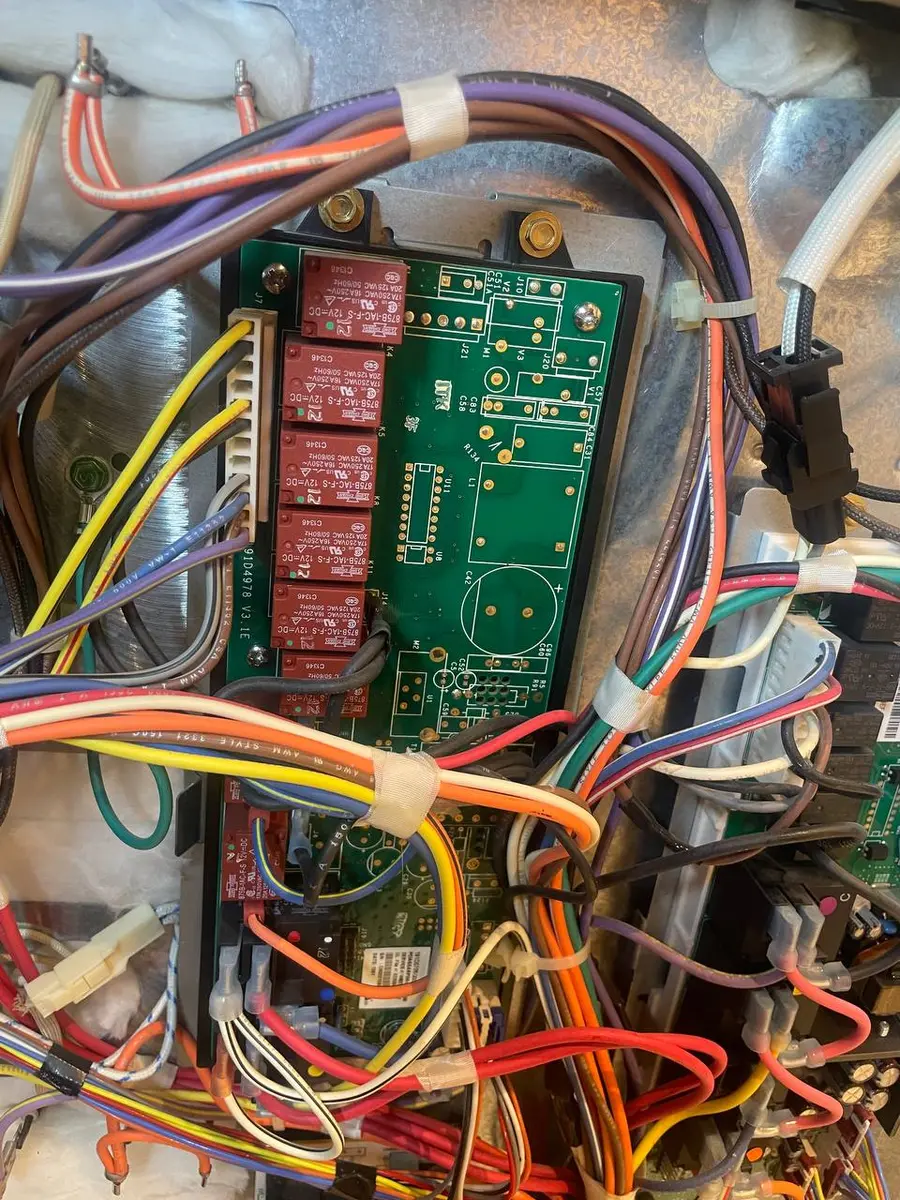
Main control board (25%). The board sequences the compressor, fans, and defrost. Power surges are the leading cause of board failure, and a dead or erratic board can leave the compressor circuit unpowered even when everything downstream is fine. Inspect the board (part WR55X10942 on many models) for scorched traces, swollen components, or relay damage before replacing it.
Compressor (20%). If the relay and board check out but the compressor only hums and then trips the overload, the compressor windings may be shorted or the motor seized. Test the windings for correct resistance across the pins; an open or shorted winding means the compressor itself has failed — the most involved repair on this list, and a sealed-system job.
Cold-control thermostat (10%). On models that use one, the cold-control thermostat is what calls for cooling. If it never closes its contacts, the compressor never gets the signal to start even though everything else is healthy. Test it for continuity when turned to its coldest setting; no continuity means it is not commanding the compressor.
Power cord (8%). A cord damaged by being pinched behind the cabinet, or a worn plug, can deliver intermittent or no power. Inspect the full length of the cord and the plug for cracks, heat damage, or loose blades before assuming an internal fault.
Thermal overload (7%). The overload protector cuts the compressor when it senses excess heat or current and resets on its own after 15 to 30 minutes. One that trips early, or fails open, stops the compressor. Test the device; if it will not pass current when cool, replace it — and find why it was overheating.
Safety First — Know the Risks
Refrigerant (R-134a/R-600a) requires EPA certification to handle. Improper discharge is a federal violation and health hazard. Our techs are licensed and insured — let them handle the risk.
Licensed & Insured · 90-Day Warranty · Same-Day Service
Listen to what it's telling you#
Sound narrows the cause fast. A repeating click-buzz-click is the start relay struggling to spin the compressor. Complete silence with the lights on points to the board, thermostat, or a wiring break in the compressor circuit. No lights at all sends you back upstream to the power supply or board. Give the compressor its five-minute equalization wait before drawing conclusions after any power event.
Repair or replace?#
A start relay, overload, or cord is inexpensive and quick, so a fridge that won't start is usually worth fixing — the exception is a failed compressor, where the sealed-system labor can approach the value of the unit and replacement deserves a look.
The Real Cost of DIY
Average DIY attempt: $150-400 in tools you may use once, plus the risk of further damage. Our diagnostic visit costs $0 — we find the problem and give you an honest quote.
Licensed & Insured · 90-Day Warranty · Same-Day Service
Preventing a repeat#
- Use a surge protector rated for refrigerators, with an adequate joule rating and no voltage drop — worth it on older Sacramento wiring.
- Give the refrigerator a dedicated circuit rather than sharing with other high-draw appliances.
- Keep about four inches of clearance behind the unit so the cord is not crushed.
Refrigerator dead but the lights are on? Our technicians diagnose GE refrigerators same-day across Sacramento and the Bay Area. Book your repair.## What the lights actually prove, and what they do not
The interior lights are the most misread signal on a fridge that will not start, so it is worth being precise about what they establish.
Lights on prove that mains power is reaching the appliance and that the low-voltage side of the board is alive. That is genuinely useful — it retires the outlet, the cord and the protected-circuit question in one observation, which is a large part of the list above.
What they do not prove is anything at all about the compressor circuit, because it is fed and switched separately. A start relay that has failed, an overload that is cycling, or a compressor that will not run all leave the lighting completely untouched, which is why a brightly lit fridge that is slowly warming up is such a common and confusing presentation.
And the reverse case is worth naming too: dark lights do not automatically mean dead power, because the same board that switches the compressor also drives the lighting. A fridge with no lights and no cooling is a power question first; a fridge with lights and no cooling has already answered that question.
Senior Gas Appliance Specialist · 18 years experience
AGA-certified gas appliance specialist with 18 years of experience in residential and commercial oven, range, and cooktop repairs.