Most Likely Cause#
When a GE refrigerator light goes dark, the most common culprit isn't a burned bulb — it's the door switch, behind about 30% of cases. The switch tells the board the door is open so it can light the lights and stop the evaporator fan; when it sticks in the pressed "closed" position, the board thinks the door is always shut and never turns the lights on. Reassuringly, the lighting circuit is completely separate from cooling, so a dark fridge that still runs isn't a food-safety problem — just an annoyance to fix. The one exception: if every light dies at once, look at the switch, wiring, or board rather than the bulbs, since LED modules rarely fail simultaneously.
Fault Map: Cause by What You See#
| What you observe | Most likely cause | How often | Part |
|---|---|---|---|
| All lights dead, fridge still cools | Door switch stuck closed | ~30% | WR23X10530 |
| One strip dark, others fine | Failed LED module | ~25% | WR55X26486 |
| Single bulb out (older model) | Incandescent bulb burnout | ~20% | WR02X12208 (40W A15) |
| Bulb loose or flickers; socket discolored | Heat-damaged light socket | ~15% | WR02X10637 |
| All lights dead, cooling normal, switch good | Board light-circuit fault | ~10% | WR55X10942 |
Read the "How often" column as a ranking of these five causes against one another, not as an incidence rate: it orders them from most to least likely on a dark GE fridge, and this guide names no sample or period it was drawn from. Nothing on this page turns on the exact figures — what the ordering is for is deciding which row to test first.
Do You Have the Right Tools?
Refrigerant gauges ($200+), vacuum pump ($250), leak detector ($150), and EPA-certified recovery equipment. Our technician arrives with $3,000+ in professional tools — your diagnostic is free.
Licensed & Insured · 90-Day Warranty · Same-Day Service
Start With All-vs-One#
The fastest split is whether everything is dark or just one section. All dark points at the door switch or the board; one dark strip or bulb points at that module. To test the door switch, open the door, find the small plunger button in the upper frame, and press and release it by hand — the lights should go off when you press it (simulating a closed door) and come on when you release it. No response means the switch failed; confirm with a meter that it toggles between open and closed. The common GE French-door part is WR23X10530.
Confirm the door switch without a meter: listen to the fan#
The door switch does two jobs, not one. It turns the interior lights on, and it stops the evaporator fan so the fridge is not blowing cold air into your kitchen while the door stands open. That second job is what makes the switch testable by ear, with the fridge running and nothing taken apart.
Stand in a quiet kitchen, open the fresh-food door, and listen for the fan behind the rear wall as you do it.
- The fan keeps running with the door open, and the lights stay dark. The switch is telling the board the door is still shut — it is stuck in the pressed position, and it is failing both of its jobs in the same direction. This is the top row of the fault map, and no bulb or module will change it.
- The fan stops when you open the door, but the lights stay dark. The switch is reporting correctly, so it has done its half of the job. What is left is the lighting circuit downstream of it: an LED module if only one section is dark, the board's light output if every one is.
- The fan stops and the lights come on, but they flicker or die when the door is nudged. The switch is working intermittently rather than being stuck, or a connector behind it has corroded. Press and release the plunger by hand a few times and watch whether the lights follow every press.
- The fan behaves correctly and one strip alone is dark. Nothing about the switch is in question. Go to that module and check its connector for green corrosion on the pins before ordering anything.
If the fan is inaudible in your kitchen, the second test is the fridge's own reaction: with the door held open for a minute, a fridge whose switch is stuck will keep pushing cold air out at the shelf edges, while one reporting correctly goes still.
Where this comes from: the door switch's second function is already stated at the top of this page — it tells the board the door is open so the board can light the lights and stop the evaporator fan. This section only turns that stated behaviour into a test, since a switch that controls two outputs can be judged by the one you can hear. It replaces no part of the plunger test above; it is what to do when you want an answer before taking a meter to it. No frequency is attached to any branch here, and none is implied.
Safety First — Know the Risks
Refrigerant (R-134a/R-600a) requires EPA certification to handle. Improper discharge is a federal violation and health hazard. Our techs are licensed and insured — let them handle the risk.
Licensed & Insured · 90-Day Warranty · Same-Day Service
LED Modules, Bulbs, and Sockets#
LED module. GE LED panels are solid-state strips with built-in drivers, and they fail by individual-LED burnout (one section dark), driver failure (the whole strip dead), or connector corrosion from condensation — freezer modules go first from defrost thermal stress. If some strips work and one doesn't, replace that module (WR55X26486 on many GFE/GNE units) and check its connector for green corrosion on the pins before you do.
Incandescent bulb. Older GE fridges use a 40W appliance bulb — not a household bulb, which isn't rated for the vibration and cold. The classic mistake is fitting a 60W household bulb, which burns out fast and can melt the socket, sometimes with a burning smell. Replace with a 40W A15 appliance bulb such as WR02X12208, and never exceed GE's 40W maximum.
Socket. On older models the plastic socket melts or cracks from the wrong wattage or from moisture, giving intermittent or no contact. Pull the bulb and inspect the socket for melting, discoloration, or broken contacts; heat damage means replacing both socket (WR02X10637) and bulb.
The Control Board#
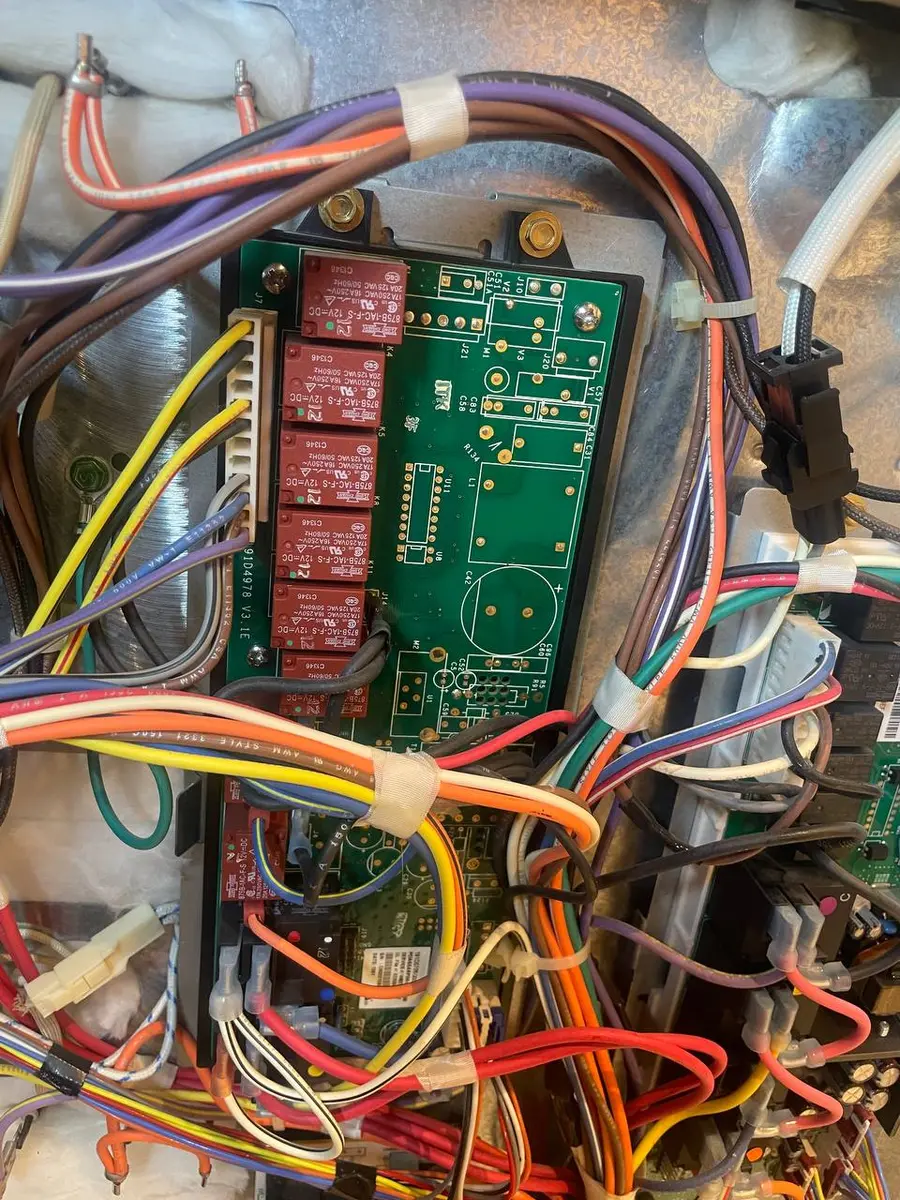
Least often, the board's low-voltage light circuit fails — usually from a surge — while cooling carries on normally. The signature is every light dead with a door switch that tests good and cooling that still works. Confirm it by metering for voltage at the LED module connector with the door open and the switch known-good: no voltage there means the board output has failed, and the fix is the main board (WR55X10942 on GFE/GNE).
The Real Cost of DIY
Average DIY attempt: $150-400 in tools you may use once, plus the risk of further damage. Our diagnostic visit costs $0 — we find the problem and give you an honest quote.
Licensed & Insured · 90-Day Warranty · Same-Day Service
Replacing the Door Switch#
Since a stuck door switch is both the most common cause and the cheapest fix, it's the first part to swap when every light is dead:
- Unplug the refrigerator.
- Find the plunger switch in the upper door frame and gently pry its bezel out — most GE switches unclip rather than unscrew.
- Ease the switch forward, unplug its wire connector, and note the orientation.
- Fit the new switch (WR23X10530 on French-door models), reconnect, and clip it back into the frame.
- Restore power and test: the lights should come on when the door opens and go off when you press the plunger by hand.
Diagnostic Steps#
- All lights dead or just one section? All dead is the switch or board; one section is that module or bulb.
- Test the door switch by hand and with a meter.
- On older models, try a known-good 40W A15 bulb; on LED models, reseat the module connector.
- Inspect sockets and LED modules for melting or corrosion.
- Check whether cooling still works — if it also failed, the fault is power or the main board, not just the lights.
Don't Void Your Warranty
Opening your appliance yourself may void the manufacturer warranty. Our repair comes with a 90-day guarantee, and we document everything for warranty compliance.
Licensed & Insured · 90-Day Warranty · Same-Day Service
Cost and Repair-or-Replace#
Almost every cause here is cheap and DIY: a door switch, an LED module, an appliance bulb, or a socket is a low-cost part and an easy swap, and a stuck switch or reseated connector can be free. Only the main-board light circuit pushes cost up, and even then it beats replacing a fridge that still cools perfectly. Because the lights are independent of cooling, there's no urgency to it — but if all the lights are dead and the switch tests good, the board is the likely culprit, so request a technician to confirm the light-circuit fault before you buy an expensive main board on a guess.
Senior Gas Appliance Specialist · 18 years experience
AGA-certified gas appliance specialist with 18 years of experience in residential and commercial oven, range, and cooktop repairs.