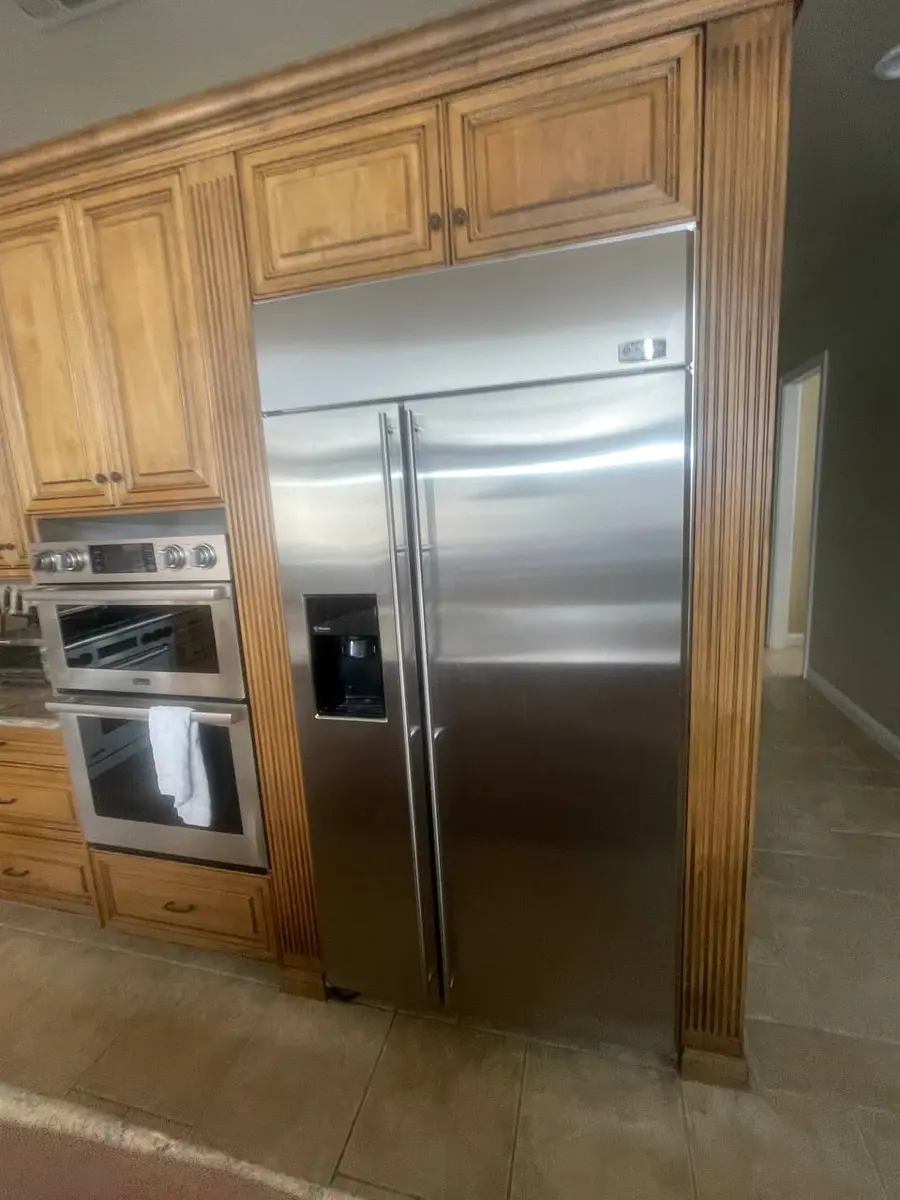
A GE refrigerator that is not making ice comes down to two questions, and answering them in order solves the large majority of cases: is water actually reaching the ice maker, and is the freezer cold enough to freeze it? Water problems — a closed supply, a clogged filter, a frozen line, or a failed inlet valve — are the most common. A freezer that is not cold enough is the frequently-overlooked second cause. Only after both are ruled out do you look at the ice-maker module itself. Here is the full diagnostic in the right order.
Quick answer#
Confirm two things. First, water: is the supply valve open, the filter recent, and the fill line unfrozen? Second, cold: is the freezer around 0°F? If the freezer is warmer than about 10°F, ice production drops off or stops. Fix water and temperature first — they account for most no-ice cases and are largely free. Only if both are good does the ice-maker module or the inlet valve become the suspect.
Do You Have the Right Tools?
Refrigerant gauges ($200+), vacuum pump ($250), leak detector ($150), and EPA-certified recovery equipment. Our technician arrives with $3,000+ in professional tools — your diagnostic is free.
Licensed & Insured · 90-Day Warranty · Same-Day Service
Question 1: Is water reaching the ice maker?#
Water supply and filter#
- Confirm the water supply valve behind or under the fridge is fully open.
- Check the water filter — an overdue or clogged filter restricts flow enough to starve the ice maker. Replace it if it is old, or bypass it to test.
- Test the dispenser: if water dispenses slowly or not at all, the same restriction is starving the ice maker, and the fault is upstream of the ice maker itself.
Frozen fill line#
The small tube that fills the ice mold can freeze, especially if the freezer runs very cold or the fill is slow. A frozen line blocks water entirely. Thawing it (unplug, let it warm, or warm the line gently) restores fill. If it refreezes, the fill-tube heater or the freezer temperature needs attention.
Water inlet valve#
The inlet valve (a 120VAC solenoid valve behind the fridge) opens to admit water on demand. If it fails, no water reaches the ice maker even with the supply open and the filter fresh. A valve getting its signal but not opening has failed internally — parts such as WR57X10032 and WR57X10051 across models — and is replaced with the water off.
Question 2: Is the freezer cold enough?#
Ice makers need the freezer at about 0°F to freeze a full harvest. A freezer running warm — from a door left ajar, a failing seal, blocked vents, or a cooling problem — makes thin, hollow, or no cubes. Check the freezer temperature; if it is above roughly 10°F, solve the cooling first, because no ice maker works in a warm freezer. This is the single most overlooked cause of a "broken" ice maker.
Safety First — Know the Risks
Refrigerant (R-134a/R-600a) requires EPA certification to handle. Improper discharge is a federal violation and health hazard. Our techs are licensed and insured — let them handle the risk.
Licensed & Insured · 90-Day Warranty · Same-Day Service
Causes by likelihood#
| Cause | Notes |
|---|---|
| Water supply / clogged filter | Restricted flow — DIY |
| Freezer too warm (not near 0°F) | Fix cooling first — DIY check |
| Frozen fill line | Thaw — DIY |
| Failed water inlet valve | Technician / part (about 25% of true failures) |
| Ice-maker module / motor | Technician / part |
Question 3: The ice-maker module itself#
If water reaches the mold and the freezer is at 0°F but you still get no ice, the ice-maker module — the motor, the mold heater that releases cubes, and the control — is the suspect. GE ice-maker assemblies (part families such as WR17X11267, WR30X10093, and WR30X10131 across models, with WR02X12380-class components) are replaced as a unit. A module that fills but never harvests, or harvests but never refills, has an internal fault confirmed by a technician.
The Real Cost of DIY
Average DIY attempt: $150-400 in tools you may use once, plus the risk of further damage. Our diagnostic visit costs $0 — we find the problem and give you an honest quote.
Licensed & Insured · 90-Day Warranty · Same-Day Service
Read the ice you are getting#
The kind of ice — or lack of it — is a fast diagnostic. No ice at all and a dry mold means no water is arriving: supply, filter, frozen line, or valve. Thin, small, or hollow cubes mean water is arriving but either the freezer is not cold enough to freeze a full harvest, or water pressure is low from a partly-clogged filter or a pinched line. Cubes that form but never release, so the mold stays full of solid ice, point at the harvest mechanism or a mold-heater fault in the module. Matching what you see to these three patterns tells you whether to chase water, temperature, or the module.
Run the ice maker's test cycle#
Most GE ice makers have a test or harvest feature that forces a full cycle so you do not have to wait hours to see whether it works. On many modules there is a test button or a fill-and-harvest sequence; triggering it makes the module cycle the motor and call for water. Watch what happens: if the motor turns but no water enters, the fault is on the water side (valve, filter, line); if water enters but the mold never empties, the module or its heater is the problem. This one test separates a water problem from a module problem in a few minutes instead of overnight.
Don't Void Your Warranty
Opening your appliance yourself may void the manufacturer warranty. Our repair comes with a 90-day guarantee, and we document everything for warranty compliance.
Licensed & Insured · 90-Day Warranty · Same-Day Service
After a filter change: air in the line#
A very common "ice maker stopped" call comes right after a water-filter change. Changing the filter introduces air into the line, and the first few fills can sputter or come up short, so the ice maker makes little or thin ice for a day. Run several glasses of water through the dispenser to purge the air, then give the ice maker 24 hours. If ice returns to normal, it was just air; if it stays poor, confirm the new filter is fully seated and is a genuine GE filter, since some aftermarket filters restrict flow enough to starve the ice maker.
Water pressure and the line#
The ice maker needs adequate water pressure to fill the mold fully. Low household pressure, a saddle valve barely cracked open, a kinked line behind the fridge, or a clogged filter all reduce the fill so cubes come out small or hollow. Confirm the supply valve is fully open (not a quarter-turn), the line is not crimped where the fridge sits close to the wall, and the filter is current. The inlet valve itself is a 120VAC solenoid; it needs both the signal and adequate pressure to deliver a full fill.
Is It Worth Your Time?
Diagnosing a cooling issue requires testing the compressor, start relay, thermostat, condenser fan, and defrost system — 4-6 hours of DIY research and testing. Our technician diagnoses the issue in about 30 minutes — same-day appointments available.
Licensed & Insured · 90-Day Warranty · Same-Day Service
How long to wait for ice#
After any fix — new filter, thawed line, opened supply — a GE ice maker typically takes several hours to produce the first harvest and up to 24 hours to fill the bin at a normal rate. Do not judge a repair in the first hour. If there is no ice at all after 24 hours with water confirmed reaching the mold and the freezer at temperature, then the module is the suspect and it is time for the technician step.
Which causes need a technician#
Which causes need a technician#
- Water inlet valve: tested for signal and flow, replaced with the water off.
- Ice-maker module: replaced as an assembly when fill and freezer temperature are confirmed good.
- Underlying cooling fault keeping the freezer warm — its own diagnosis.
The supply, filter, and thawing checks are yours; the valve and module are technician parts, though modest ones.
The Risk of Getting It Wrong
A wrong diagnosis often turns a simple fix into a costly replacement. Without proper diagnostic tools, you might replace the wrong part — or cause additional damage. Our free diagnostic eliminates the guesswork.
Licensed & Insured · 90-Day Warranty · Same-Day Service
Check the obvious: the ice-maker arm or switch#
Before diagnosing anything mechanical, confirm the ice maker is actually turned on. Many GE ice makers have a wire feeler arm or an on/off switch: if the arm is lifted (or the switch is off), the ice maker stops on purpose, and it is easy to bump the arm up while unloading the freezer or to leave it off after cleaning. Lower the arm or switch it on and confirm it is in the run position. This costs nothing and resolves a surprising share of "not making ice" calls that were never a fault at all.
Seasonal and after-install issues#
Two situations cause temporary ice problems that are not failures. After a new install or a move, the line needs time to fill and the freezer needs to reach temperature, so it can be 24 hours before the first ice. And a freezer that was recently overfilled or had its vents blocked can warm just enough to slow ice production seasonally, especially in a hot kitchen or a garage fridge in summer. Rule these out before assuming a part failed — the fix may simply be time or airflow.
Free Diagnostic Visit — Zero Risk
Our certified technician comes to your home, diagnoses the problem with professional tools, and gives you an honest quote — all at zero cost. No parts markup, no hidden fees. If you decide not to proceed, you pay nothing.
Licensed & Insured · 90-Day Warranty · Same-Day Service
Preventing ice-maker problems#
- Change the water filter on schedule so flow never drops.
- Keep the freezer near 0°F and the door sealing fully.
- If ice stops after a filter change, confirm the new filter is seated and the supply is fully open.
- Do not force the ice maker with the arm or a reset if the freezer is warm — fix the cold first.
Frequently Asked Questions#
Why is my GE refrigerator not making ice?#
Almost always one of two things: water is not reaching the ice maker (a closed supply, a clogged filter, or a failed inlet valve), or the freezer is not cold enough to freeze it (needs to be around 0°F). Check the water supply and the freezer temperature first.
How cold does a GE freezer need to be to make ice?#
About 0°F. If the freezer is warmer than roughly 10°F, the ice maker will produce little or no ice, or thin hollow cubes. Fix the freezer temperature first — a too-warm freezer is a common and overlooked ice-maker cause.
Why is water not reaching my GE ice maker?#
Common causes are the water supply valve behind the fridge not fully open, a clogged or overdue water filter restricting flow, a frozen water line in the door or freezer, or a failed water inlet valve that is not letting water through.
Is a GE [ice maker not making ice](/bay-area/services/ice-maker-not-making-ice) worth repairing?#
Yes — most fixes (filter, supply, thawing a line) are cheap or free, and even an inlet valve or ice-maker module is a modest part on a fridge under about ten years old, well worth it versus replacement.
Senior Gas Appliance Specialist · 18 years experience
AGA-certified gas appliance specialist with 18 years of experience in residential and commercial oven, range, and cooktop repairs.