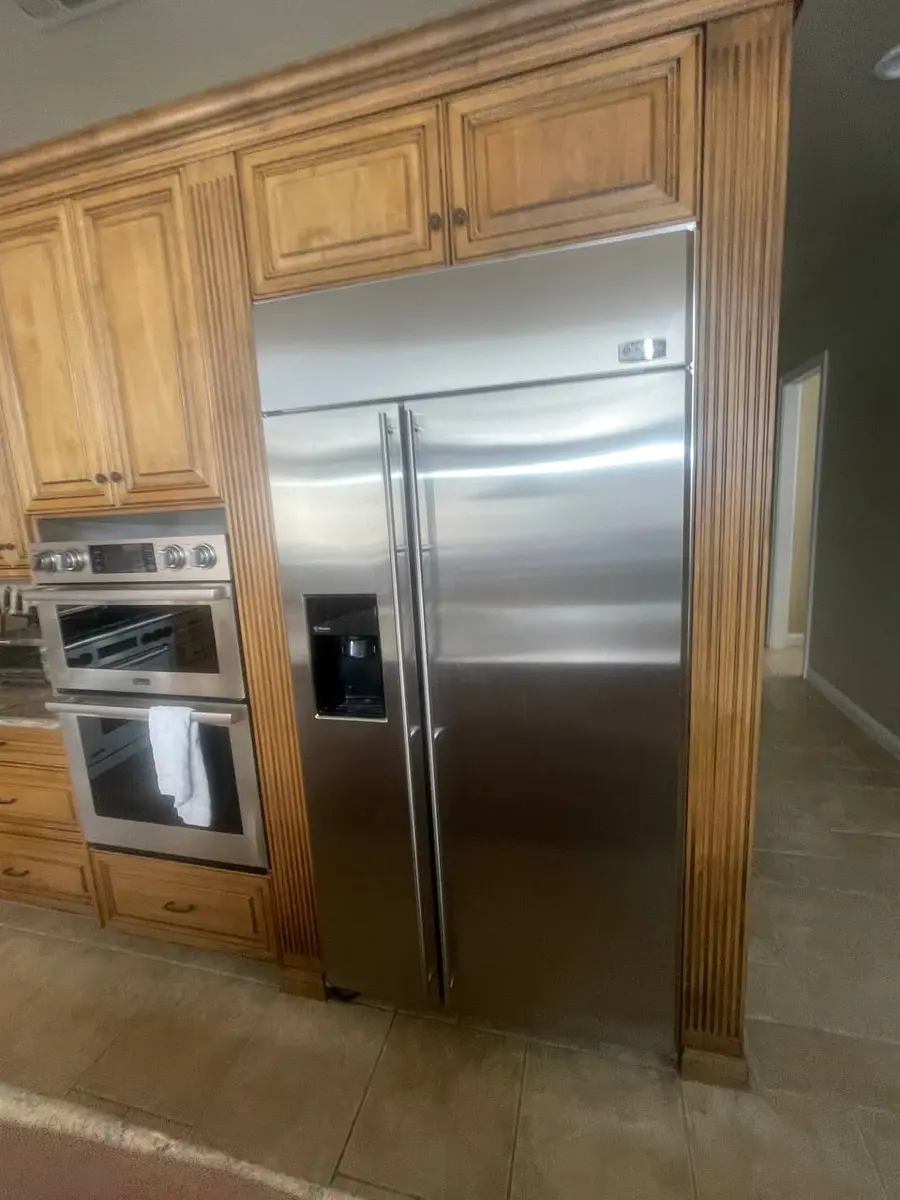
Why are both my GE fridge and freezer too warm?#
When both compartments of a GE refrigerator warm up together, the fault is almost always in a shared system — dirty condenser coils, a dead condenser fan, or a compressor that isn't running. On GE TwinChill models (GNE27, GYE22) each side has its own evaporator, so only a shared failure can warm both at once. Treat it as a food-safety issue while you diagnose.
GE fridge and freezer too warm: ranked causes#
Start by confirming the compressor is even trying to run, then work through the shared cooling path.
| Likely cause | Share | What you'll find |
|---|---|---|
| Dirty condenser coils | 25% | Compressor runs nonstop, both sides slowly warm; coils matted with dust |
| Condenser fan motor failure | 22% | Compressor housing painfully hot, fan not spinning while the compressor runs |
| Compressor not running | 20% | No steady hum at the back, or a click-buzz-click every few minutes |
| Sealed-system refrigerant leak | 15% | Gradual warming over days, a room-temperature suction line, gurgling |
| Brownout / low voltage | 10% | Warming during peak-demand hours when outlet voltage sags |
| Demo mode switched on | 3% | Display shows a demo code while lights and controls still work |
Food safety: the USDA says food held above 40°F for more than two hours may be unsafe. Put a thermometer in each compartment, keep the doors shut, and check the GE SmartHQ app for a high-temperature alert.
Do You Have the Right Tools?
Refrigerant gauges ($200+), vacuum pump ($250), leak detector ($150), and EPA-certified recovery equipment. Our technician arrives with $3,000+ in professional tools — your diagnostic is free.
Licensed & Insured · 90-Day Warranty · Same-Day Service
How to troubleshoot a warm GE refrigerator#
Move from the free checks toward the sealed system.
- Confirm power and rule out demo mode — a display showing a demo code disables the compressor while everything else looks normal. Exit it with the temperature-button combination for your model.
- Listen at the back. A steady low hum means the compressor runs, so the problem is airflow or coils; silence points at the compressor or its start relay (GE parts WR07X10097 and WR87X29409).
- Pull the fridge out and watch the condenser fan while the compressor runs. If it's not spinning, it's failed — GE uses WR60X10350 on side-by-sides and WR60X26866 on French-door models.
- Vacuum the condenser coils with a brush attachment; badly matted coils lose a big share of cooling capacity. Give it four to six hours to recover.
- Trigger Turbo Cool and Turbo Freeze. If the fridge responds, the compressor works and you're chasing coils, fan, or a stuck setting rather than a dead compressor.
- Measure outlet voltage during peak hours — below about 110 volts (down to 108 volts on long circuits) can stall the compressor, and that's an electrical job, not a fridge fault.
Coil cleaning, demo-mode exit, and a start-relay swap are DIY. A dead compressor or a refrigerant leak is sealed-system work that needs a certified tech.
Is a warm GE refrigerator worth fixing?#
Often yes — dirty coils and a failed condenser fan are cheap, common fixes that restore full cooling. A refrigerant leak or a failed compressor is the expensive end and, on an older fridge, is where you weigh repair against replacement. For an upfront quote after diagnosis, book a repair.
Safety First — Know the Risks
Refrigerant (R-134a/R-600a) requires EPA certification to handle. Improper discharge is a federal violation and health hazard. Our techs are licensed and insured — let them handle the risk.
Licensed & Insured · 90-Day Warranty · Same-Day Service
GE fridge and freezer too warm: frequently asked questions#
Both sections of my GE fridge are warming slowly — is it low refrigerant?#
It might be — gradual warming with a compressor that runs constantly can mean low refrigerant. But check the condenser coils and fan first; they're far more common and much easier to fix.
My GE SmartHQ app shows a high-temperature alert. Is my food safe?#
The alert means the temperature stayed above safe levels for hours. The USDA recommends discarding perishables held above 40°F for more than two hours; verify with an independent thermometer.
Why would both compartments warm at the same time?#
Because they share a compressor, condenser, and condenser fan. A problem in any of those — or in the power feeding them — warms both sides together, unlike a single-compartment fault.
Senior Gas Appliance Specialist · 18 years experience
AGA-certified gas appliance specialist with 18 years of experience in residential and commercial oven, range, and cooktop repairs.