Most Likely Cause#
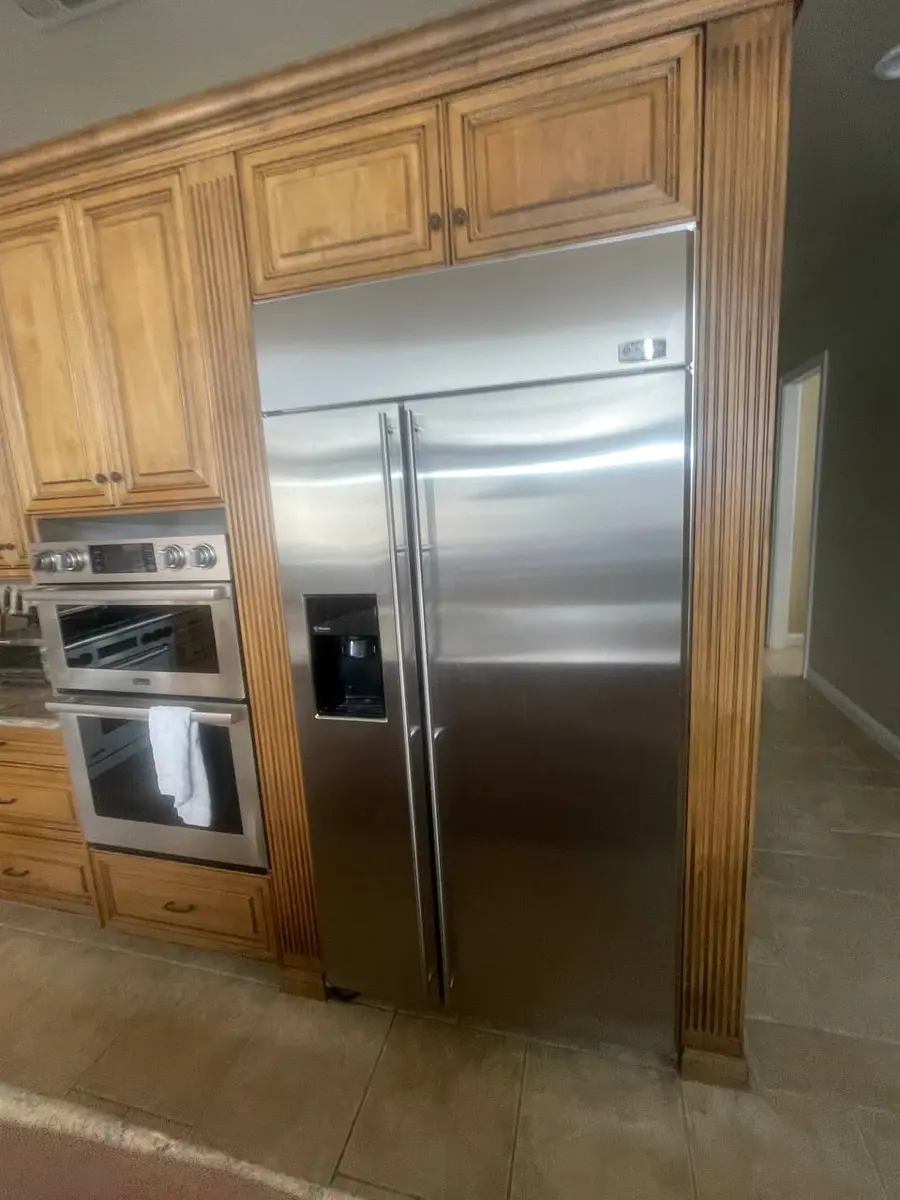
Where a GE refrigerator sweats tells you why. Heavy condensation on the metal strip between the two French doors is a failed mullion heater — the hidden anti-sweat element that keeps that surface just above the dew point — or, just as often, Energy Saver mode left on, which deliberately switches that heater off. Sweating concentrated along a door edge is warm air leaking past a worn gasket. Sweating over the whole surface usually is not a fault at all but high kitchen humidity, or a temperature set colder than it needs to be.
GE's stainless and Profile models are especially prone to this because stainless conducts heat readily and forms cold spots. So before ordering parts, map exactly where the moisture forms.
Normal vs a Real Problem#
Light, brief condensation while cooking or during very humid weather is normal. What signals a fault is persistent, dripping condensation, moisture that tracks the gasket line, or — on a French-door model — sweat between the two doors, which points straight at the mullion heater.
Do You Have the Right Tools?
Refrigerant gauges ($200+), vacuum pump ($250), leak detector ($150), and EPA-certified recovery equipment. Our technician arrives with $3,000+ in professional tools — your diagnostic is free.
Licensed & Insured · 90-Day Warranty · Same-Day Service
What Usually Causes It#
| Where it sweats | Likely cause | First move |
|---|---|---|
| Between the French doors | Failed mullion heater, or Energy Saver on | Feel the center strip; turn Energy Saver off |
| Along a door edge | Worn door gasket leaking warm air | Dollar-bill test at the wet spot |
| Whole door surface | High kitchen humidity | Vent cooking moisture; add a dehumidifier |
| Everywhere, even when dry | Temperature set too cold | Return to 0°F freezer, 37°F fresh food |
The mullion heater and Energy Saver#
On a French-door GE, a low-wattage heater runs through the center pillar and door edges to hold those surfaces above the dew point. Feel the strip between the doors with the back of your hand — it should be faintly warm, and if it is as cold as the door, the heater is off or failed. First rule out the easy one: Energy Saver mode turns the anti-sweat heater off to save power, and if it was switched on by accident, sweating is the expected result, so turn it off. If Energy Saver is already off and the strip is cold, the mullion heater itself has failed — the part on the common GFE and GNE French-door models is WR49X10244, and it reads roughly 100 to 300 ohms when good.
Gasket, humidity, and temperature#
A worn door gasket lets humid room air reach the cold surface near the seal, so the sweat follows the gasket line, usually along the bottom or a corner. Map whether the moisture is uniform (a heater issue) or localized (a gasket issue), then dollar-bill test at the wet spots and inspect the gasket for tears or hardened sections; the French-door gaskets are WR24X10231 on the left and WR24X10232 on the right. If the whole surface sweats, the room is simply too humid — run the range hood during and after cooking, avoid running the dishwasher right beside the fridge, and consider a dehumidifier. And setting the freezer or fresh-food section colder than GE recommends, or leaving Turbo Cool running, drops the surface enough to sweat even in dry air, so return to 0°F and 37°F.
Diagnostic Sequence#
- Map the sweating pattern — between the doors, along an edge, or the whole surface.
- If it is between the doors, feel the center strip and turn Energy Saver off first.
- If the strip stays cold with Energy Saver off, test the mullion heater's resistance.
- Dollar-bill test the gasket wherever the sweat is localized to an edge.
- Check the temperature settings and switch off Turbo Cool or Turbo Freeze.
- Gauge the kitchen humidity and improve ventilation if the whole door sweats.
Safety First — Know the Risks
Refrigerant (R-134a/R-600a) requires EPA certification to handle. Improper discharge is a federal violation and health hazard. Our techs are licensed and insured — let them handle the risk.
Licensed & Insured · 90-Day Warranty · Same-Day Service
Repair or Replace#
Turning off Energy Saver, adjusting temperatures, and venting the kitchen cost nothing. A door gasket is an easy, inexpensive swap, while the mullion heater is a moderate job behind the center cover. There is rarely a big-ticket outcome here — door sweating is a heater, seal, or environment issue, not a failing compressor. If Energy Saver is off, the gasket is sound, and the room is not especially humid but it still sweats, you can book a visit to have the mullion heater tested and replaced in one trip.
Senior Gas Appliance Specialist · 18 years experience
AGA-certified gas appliance specialist with 18 years of experience in residential and commercial oven, range, and cooktop repairs.