GE Refrigerator Cycle Not Completing — Diagnosis & Repair Guide
When a GE refrigerator fails to complete its cooling or defrost cycle, the compressor either shuts off prematurely, the defrost heater cuts out before fully clearing frost, or the fan motors stop cycling between modes. This problem manifests differently across GE's lineup: French door models (GFE26, GFE28, GNE25, GNE27) tend toward thermistor-driven premature shutoffs, while older GE Profile side-by-sides (GSS25, GSH25) more commonly suffer from compressor start relay failures that prevent the compressor from running long enough to complete a full cooling cycle.
GE refrigerators since approximately 2014 use an Adaptive Defrost Control (ADC) algorithm integrated into the main control board rather than a separate mechanical defrost timer. The ADC calculates when to initiate defrost based on compressor run hours and door-opening frequency. When this algorithm malfunctions, it can either defrost too frequently (causing warm temperatures as the heater runs excessively) or too infrequently (causing frost buildup that eventually blocks airflow and makes the cooling cycle appear incomplete).
Recognizing the Problem
A GE refrigerator with incomplete cycles shows specific symptoms:
- Compressor runs for 10-15 minutes then shuts off instead of running the typical 30-60 minute cycle — temperatures rise between cycles
- Fresh food section warms to 45-50°F while the freezer maintains near-normal temperature — indicates the damper or fresh-food fan cycle is cutting short
- Frost accumulates unevenly on the evaporator — one section frosted, another clear — the defrost cycle is interrupting before completing a full pass
- The compressor clicks repeatedly at startup then goes silent — the start relay is failing to hold the compressor running past initial startup current draw
- SmartHQ app shows frequent short compressor runs with gaps between them (connected models GFE28, GNE27, GYE22)
Do You Have the Right Tools?
Refrigerant gauges ($200+), vacuum pump ($250), leak detector ($150), and EPA-certified recovery equipment. Our technician arrives with $15K+ in professional tools — your diagnostic is free.
Licensed & Insured · 90-Day Warranty · Same-Day Service
Safety Before You Start
- Unplug the refrigerator at the wall outlet. GE refrigerators are typically plugged in (not hardwired), making disconnection straightforward.
- Wait 5 minutes before accessing the compressor area — the start relay capacitor can hold a charge.
- Do not attempt sealed system work (compressor replacement, refrigerant recharge) without EPA 608 certification. GE uses R-134a refrigerant in most residential models.
- Protect your flooring when accessing the rear panel — condensation from the defrost drain pan may spill when the unit is moved.
GE Diagnostic Mode for Cycle Issues
GE's built-in service diagnostics are essential for cycle-not-completing problems because they force individual components to run independently:
- Press and hold Freezer Temp + Fridge Temp buttons simultaneously for 8 seconds.
- The display enters test mode showing "0" — press Fridge Temp to advance through test programs.
- Test 1: Compressor forced on — listen for startup and continuous run. If it clicks and stops within 10 seconds, the start relay is failed.
- Test 3: Evaporator fan forced on — verify airflow through the freezer vents.
- Test 4: Condenser fan forced on — verify the rear fan spins freely.
- Test 6: Defrost heater forced on — remove rear freezer panel to visually confirm the heater glows orange within 30 seconds.
- Test 8: Damper motor test — listen for the motorized damper between freezer and fresh-food sections cycling open and closed.
On SmartHQ-connected models, the app provides compressor run history and will flag "Short Cycle Detected" if the compressor consistently runs less than 20 minutes per cycle.
Safety First — Know the Risks
Refrigerant (R-134a/R-600a) requires EPA certification to handle. Improper discharge is a federal violation and health hazard. Our techs are licensed and insured — let them handle the risk.
Licensed & Insured · 90-Day Warranty · Same-Day Service
Most Common Causes (Ranked by Likelihood)
1. Compressor Start Relay Failure (28% of cases)
The compressor start relay (also called the start device or relay-overload kit) provides the extra current surge needed to start the compressor motor. Once the compressor reaches operating speed, the relay disengages. When this relay fails, the compressor attempts to start, draws locked-rotor current for 2-5 seconds, then the overload protector trips and shuts it down. After cooling for a few minutes, it tries again — creating the characteristic click-run-click pattern.
This is GE's most common refrigerator failure across all model lines because the relay contacts gradually pit and corrode from repeated electrical arcing during normal startup/shutdown cycles.
Diagnosis:
- Pull the refrigerator away from the wall. Remove the rear lower access panel (2-4 Phillips screws).
- Locate the start relay — it plugs directly onto the compressor terminals (two or three pins).
- Unplug the relay. Shake it gently — a rattling sound indicates the internal contact has broken free, confirming failure.
- Use a multimeter between the relay terminals: expected resistance 3-12 ohms. Open circuit (OL) = failed relay.
- Smell the relay — a burnt electrical odor confirms the contacts have arced.
GE Part Numbers: WR07X10131 (most French door/bottom freezer models), WR07X10097 (older side-by-sides).
DIY Difficulty: Easy — plug-on replacement, no tools beyond a Phillips screwdriver for the access panel. Parts Cost: $15-$45 Professional Repair Cost: $100-$200
2. Thermistor (Temperature Sensor) Fault (22% of cases)
GE refrigerators use multiple thermistors (NTC thermistors) to monitor temperatures throughout the unit: fresh-food section, freezer section, evaporator coil, and ambient/condenser. The main control board reads these sensors to decide when to run the compressor, when to cycle the fans, and when to initiate defrost. A drifted or failed thermistor sends incorrect temperature data, causing the board to prematurely terminate cycles because it believes the target temperature has been reached.
On GE French door models (GFE/GNE series), the fresh-food thermistor is the most common failure point. It is located on the rear wall of the fresh-food section, clipped to the air duct.
Diagnosis:
- Enter diagnostic mode (Freezer + Fridge buttons, 8 seconds). Navigate to the sensor readout — the display cycles through each thermistor reading.
- Compare displayed temperatures to an independent thermometer placed in the same location.
- A thermistor reading that is off by more than 5°F from the actual temperature indicates drift.
- Remove the thermistor and test with a multimeter: at 37°F (fresh food normal) expect approximately 16,600 ohms. At 0°F (freezer) expect approximately 33,000 ohms. Readings significantly outside these ranges confirm failure.
GE Part Numbers: WR55X10025 (fresh food thermistor, most models), WR55X24064 (freezer thermistor, GFE/GNE series).
DIY Difficulty: Easy — clip-on sensor with a single wire connector. Parts Cost: $10-$30 Professional Repair Cost: $120-$220
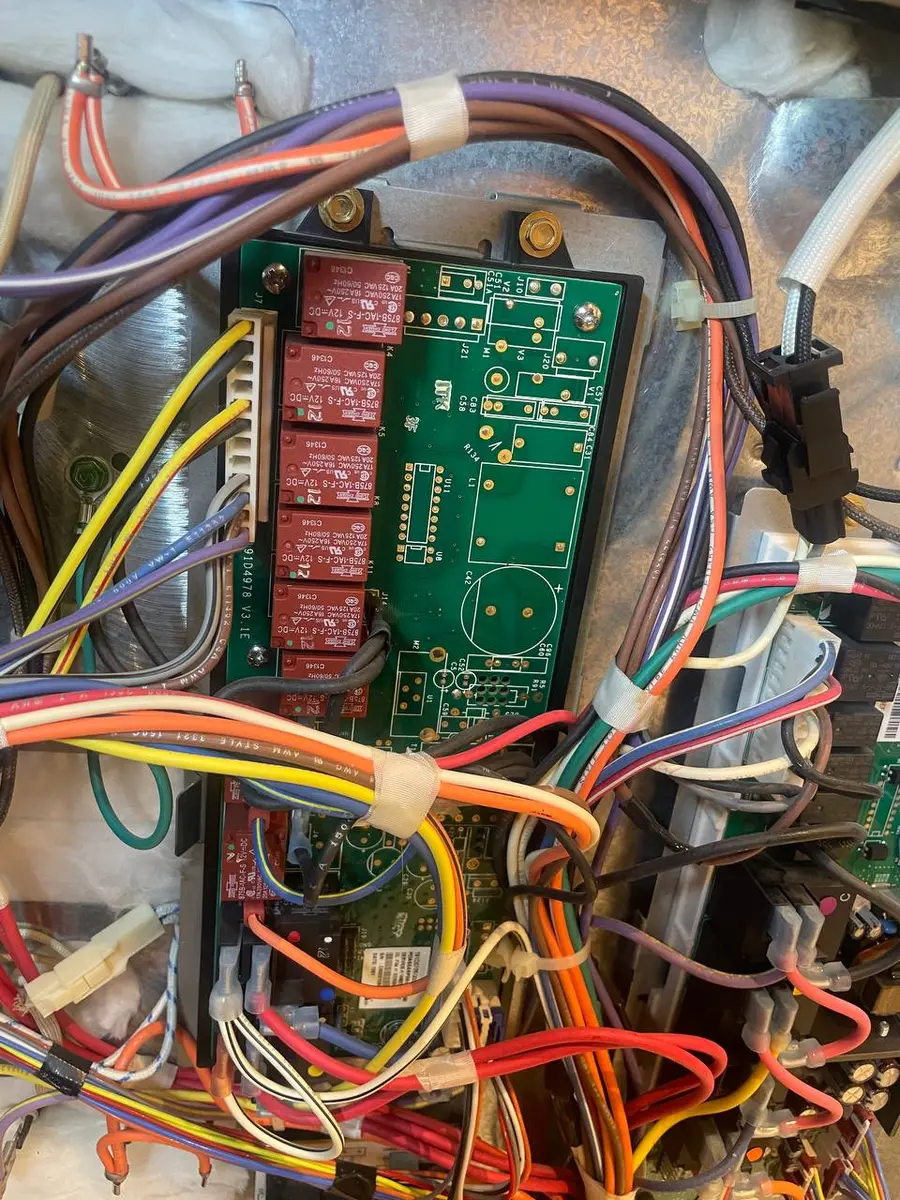
3. Adaptive Defrost Control Board Malfunction (18% of cases)
The ADC logic on the main control board calculates defrost timing based on accumulated compressor runtime and door-opening events. When the board's ADC circuit develops a fault, it can either initiate defrost too frequently (every 4-6 hours instead of the normal 8-16 hours) or fail to initiate defrost at all. Both scenarios cause cycle completion issues — too-frequent defrost interrupts cooling cycles prematurely, while no-defrost causes progressive frost buildup that eventually blocks evaporator airflow and reduces cooling capacity.
Diagnosis:
- Force defrost using diagnostic Test 6. If the heater activates normally, the defrost components are functional — the issue is the board's timing algorithm.
- Monitor defrost frequency over 48 hours (SmartHQ app on connected models, or manually by listening for the defrost heater activating).
- If defrost occurs every 4-6 hours, the board ADC has failed toward over-defrosting.
- If no defrost occurs in 24+ hours and frost is accumulating, the ADC has failed toward under-defrosting.
GE Part Numbers: WR55X10942 (GFE/GNE main board), WR55X11072 (GYE Profile main board), WR55X26038 (newer GFE28 revision).
DIY Difficulty: Moderate — multiple wire harness connections, specific connector orientation matters. Parts Cost: $120-$280 Professional Repair Cost: $250-$450
4. Condenser Fan Motor Failure (12% of cases)
The condenser fan (located at the rear bottom near the compressor) cools the condenser coils and the compressor itself. When this fan fails, the compressor overheats and the thermal overload protector trips, shutting down the compressor mid-cycle. The compressor restarts once it cools down, creating a pattern of short cooling cycles that never reach target temperature.
In Sacramento and Bay Area garages where ambient temperatures reach 90-100°F in summer, condenser fan failure causes especially rapid compressor overheating because the condenser cannot dissipate heat into already-warm ambient air.
Diagnosis:
- With the rear access panel removed and the fridge plugged in, observe the condenser fan during compressor operation. It should spin whenever the compressor runs.
- If the fan is not spinning: check for debris (pet hair, dust) blocking the blade. GE condenser fans are particularly susceptible to pet hair wrapping around the motor shaft.
- Spin the blade by hand — it should rotate freely with minimal resistance. Grinding or stiffness indicates bearing failure.
- Test the motor with a multimeter: expected resistance 10-30 ohms across the motor leads.
GE Part Number: WR60X10307 (most common, fits GFE/GNE/GSS series).
DIY Difficulty: Easy — 2-3 mounting screws, single wire connector. Parts Cost: $25-$65 Professional Repair Cost: $130-$240
5. Evaporator Fan Motor Failure (10% of cases)
The evaporator fan circulates cold air from the freezer evaporator through the fresh-food section via a motorized damper. When this fan fails, the evaporator continues to cool but the cold air is not distributed. The freezer may stay cold (since the evaporator is physically inside it), but the fresh-food section warms because it depends on forced air circulation through the damper.
On GE TwinChill models with dual evaporators, each section has its own fan. A single fan failure affects only that compartment while the other continues normally.
Diagnosis:
- Open the freezer door. Press and hold the door switch (light switch) to simulate a closed door. Listen for the evaporator fan — you should hear it within 5 seconds.
- If silent, the fan motor is failed or the board is not sending power.
- Access the fan by removing the rear panel inside the freezer (6-10 Phillips screws). Inspect the blade for ice contact (icing from a separate drain issue can lock the fan).
- Test the motor: 40-60 ohms expected across motor leads.
GE Part Numbers: WR60X10185 (most French door models), WR60X10074 (side-by-side GSS models).
DIY Difficulty: Moderate — requires removing freezer contents and rear panel. Parts Cost: $30-$80 Professional Repair Cost: $150-$280
6. Dirty Condenser Coils (5% of cases)
GE French door refrigerators (GFE/GNE series) have condenser coils located underneath the unit, accessed from the front by removing the base grille. When coated with dust, pet hair, or kitchen grease, the condenser cannot reject heat efficiently. The compressor runs longer and hotter, eventually triggering the thermal overload protector and cutting the cycle short.
This is the most common cause of short cycling in homes with pets, especially in the Sacramento area where dry conditions create more airborne dust.
Diagnosis:
- Remove the base grille (pull straight forward at the bottom front of the fridge).
- Shine a flashlight on the condenser coils. If you see a visible mat of dust or hair, this is likely contributing to short cycling.
- Vacuum the coils with a brush attachment or use a condenser coil cleaning brush.
DIY Difficulty: Very easy — no tools required beyond a vacuum. Parts Cost: $0 Professional Repair Cost: $89-$130 (service call + cleaning)
7. Compressor Overload Protector Weak (3% of cases)
The overload protector is a bimetallic disc or PTC device that cuts power to the compressor if current draw exceeds safe limits (indicating an overheating condition). As this component ages, it can trip at progressively lower temperatures, shutting down the compressor during normal operation before the cooling cycle completes.
Diagnosis:
- If the compressor runs normally during diagnostic Test 1 (forced compressor) for 10+ minutes but shuts down during regular operation, the overload may be marginal.
- The overload is typically integrated into the start relay assembly on newer GE models — replacing the start relay replaces the overload as well.
GE Part Numbers: Usually included in the start relay kit (WR07X10131).
DIY Difficulty: Easy (same as start relay replacement). Parts Cost: $15-$45 (included in relay kit) Professional Repair Cost: $100-$200
8. Door Gasket Air Leak Causing Overcycling (2% of cases)
A worn door gasket allows warm, humid air into the cabinet continuously. The control board detects temperatures above setpoint and runs the compressor more frequently in shorter bursts. While the compressor technically completes each mini-cycle, the result is frequent short runs that never fully bring temperatures down — mimicking incomplete cycling.
Diagnosis:
- Dollar-bill test: close the door on a dollar bill at multiple points around the perimeter. If it slides out easily at any point, the gasket seal is compromised.
- Look for frost patterns near the gasket edges — warm air meeting cold interior creates localized frost.
GE Part Numbers: WR24X10231 (French door left), WR24X10232 (French door right), model-specific for side-by-side.
DIY Difficulty: Easy — gasket pushes into a retaining channel, no screws on most GE models. Parts Cost: $40-$110 Professional Repair Cost: $120-$260
Step-by-Step Diagnostic Sequence
- Listen to the compressor — is it clicking repeatedly (start relay), running briefly then stopping (overload/overheating), or not running at all (board)?
- Check condenser coils — pull the base grille and inspect for dust/hair accumulation.
- Run diagnostic mode — force each component individually using Tests 1-8 to isolate which component fails.
- Check thermistor readings — compare diagnostic sensor values against an independent thermometer.
- Monitor defrost frequency — count how often you hear the defrost heater activate over 24 hours.
- Inspect the condenser fan — with the rear panel removed, verify it spins whenever the compressor runs.
Same-Day Appliance Repair
Fixed or It's Free
$89 → $0 Service Call & Diagnosis — offer ends May 25
The Real Cost of DIY
Average DIY attempt: $150-400 in tools you may use once, plus the risk of further damage. Our diagnostic visit costs $0 — we find the problem and give you an honest quote.
Licensed & Insured · 90-Day Warranty · Same-Day Service
DIY Fix vs Professional Repair
| Cause | DIY? | Parts | Professional |
|---|---|---|---|
| Start Relay | Yes (easy) | $15-$45 | $100-$200 |
| Thermistor | Yes (easy) | $10-$30 | $120-$220 |
| Control Board (ADC) | Maybe | $120-$280 | $250-$450 |
| Condenser Fan | Yes (easy) | $25-$65 | $130-$240 |
| Evaporator Fan | Yes (moderate) | $30-$80 | $150-$280 |
| Dirty Condenser | Yes (very easy) | $0 | $89-$130 |
| Overload Protector | Yes (easy) | $15-$45 | $100-$200 |
| Door Gasket | Yes (easy) | $40-$110 | $120-$260 |
Prevention Tips for GE Refrigerators
- Clean condenser coils every 6 months — pull the base grille and vacuum with a brush attachment. This is the single most effective maintenance step for preventing short cycling.
- Replace the RPWFE or MWF water filter every 6 months — a clogged filter does not directly cause cycle issues but restricts water flow to the ice maker, which can trigger error codes that affect the control board's cycle management.
- Keep 2-3 inches of clearance behind and above the refrigerator for adequate condenser airflow — especially critical in Sacramento summer heat.
- Avoid placing the refrigerator in a garage without a garage-ready kit — ambient temperatures above 100°F or below 60°F cause abnormal cycling patterns.
- Use the SmartHQ app on connected models to monitor compressor behavior remotely and catch short-cycling patterns before they become critical.
Don't Void Your Warranty
Opening your appliance yourself may void the manufacturer warranty. Our repair comes with a 90-day guarantee, and we document everything for warranty compliance.
Licensed & Insured · 90-Day Warranty · Same-Day Service
FAQ
Q: Why does my GE refrigerator compressor run for 10 minutes then shut off? A: The most common cause is a failing compressor start relay (WR07X10131). The relay cannot maintain the electrical connection needed for continuous compressor operation. This is a simple plug-on replacement that takes under 15 minutes.
Q: My GE refrigerator works fine in winter but short-cycles in summer. Why? A: Dirty condenser coils combined with high ambient temperatures. When coils are partially blocked with dust, the system manages in cooler weather but cannot dissipate enough heat when room temperature rises above 85°F. Clean the condenser coils and verify the condenser fan operates.
Q: How do I know if my GE refrigerator ADC (Adaptive Defrost Control) has failed? A: If the defrost heater works when forced in diagnostic Test 6 but the refrigerator either defrosts too often (every 4-6 hours) or never defrosts automatically, the ADC circuit on the main board has failed. Board replacement is the fix — the ADC is not a separate component on modern GE models.
Q: Can Sacramento hard water cause cycle problems in GE refrigerators? A: Not directly for cooling cycles, but mineral buildup in the water inlet valve can cause error codes related to the ice maker and water dispenser. These errors can sometimes trigger the control board to enter a reduced-operation mode that affects normal cycling patterns.
GE refrigerator cycling on and off? Our technicians carry start relays, thermistors, and GE-specific diagnostic tools on every service call. We test every component in your home — no guessing. Schedule your GE refrigerator repair →