GE Refrigerator Compressor Replacement
Replacing a GE refrigerator compressor is EPA 608 professional-only work, but the diagnosis is worth doing yourself — a failed start relay (WR07X10131) or overload protector (WR07X10097) mimics a dead compressor (WR87X29409) and costs a fraction as much. On premium models a separate inverter board (WR55X30490) can…
How GE Compressors Fail#
| Failure mode | What you see |
|---|---|
| Mechanical seizure | Buzzing or clicking, then the overload trips every few minutes |
| Winding burnout | Start relay clicks but nothing runs — no current draw |
| Worn valves (inefficient) | Runs nonstop yet the box slowly warms over days |
Test the Cheap Parts First#
Several parts imitate a dead compressor, so rule them out before condemning it. The start relay plugs onto the compressor terminals — shake it, and a rattle means the internal contacts have broken. The overload protector, a thermal switch on the compressor, may be tripping because of the compressor or because it has failed itself. A stalled condenser fan or dust-caked coils make a healthy compressor overheat and trip the overload, so confirm the fan spins and the coils are clean. Finally, meter the three compressor terminals: on a typical GE unit you should read about 3 to 8 ohms between start and run, 6 to 15 ohms between start and common, and 3 to 8 ohms between run and common, with an open reading on any pair meaning a burned winding.
Do You Have the Right Tools?
Refrigerant gauges ($200+), vacuum pump ($250), leak detector ($150), and EPA-certified recovery equipment. Our technician arrives with $3,000+ in professional tools — your diagnostic is free.
Licensed & Insured · 90-Day Warranty · Same-Day Service
Single-Speed or Inverter#
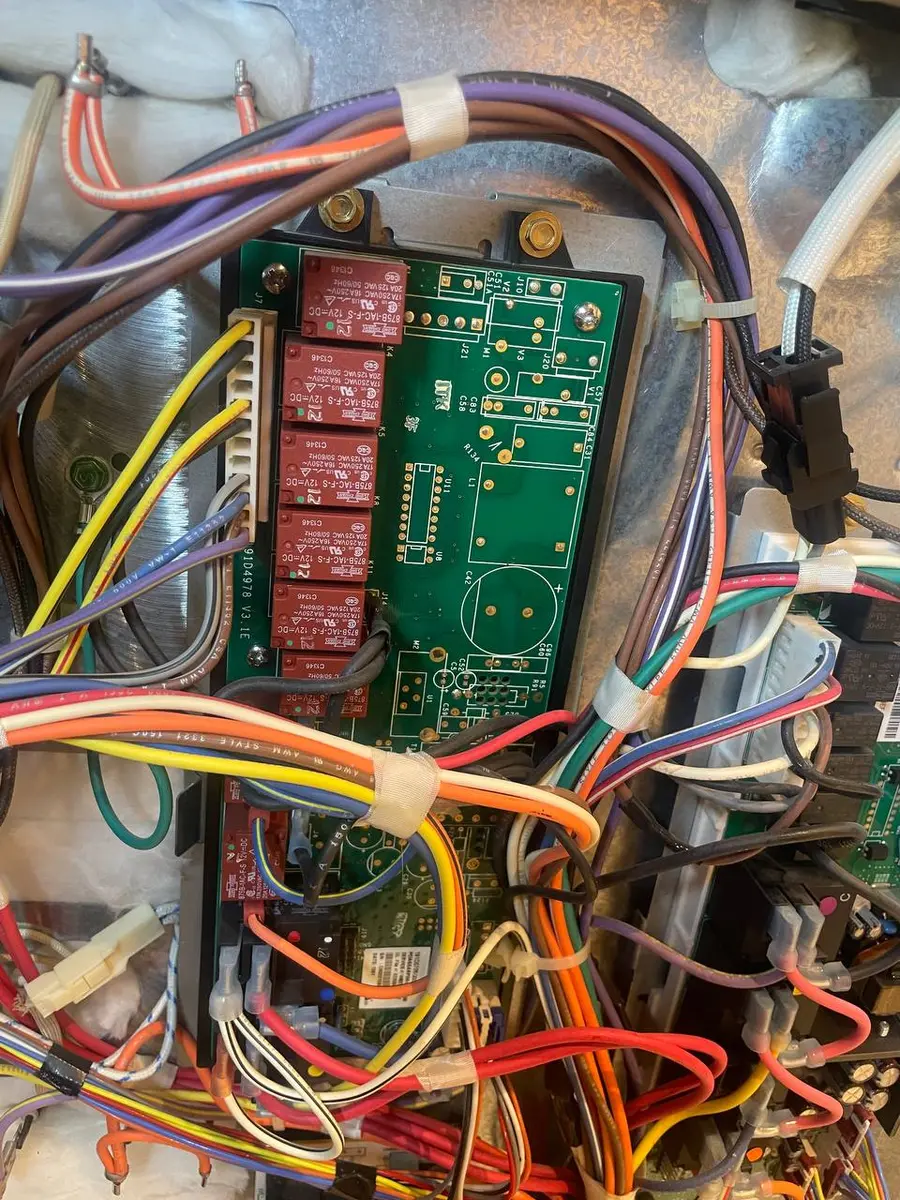
GE fits two very different compressors. Standard GE and most Hotpoint models use a single-speed compressor that cycles on and off from the thermostat — simpler and cheaper. Profile, Cafe, and Monogram models use a variable-speed inverter compressor that runs continuously at adjusting speeds, quieter and more efficient but far costlier to replace. The inverter compressor is driven by a separate control board that can fail independently, so on those models confirm whether the fault is the compressor or its inverter board before ordering the expensive part.
The Refrigerant Matters#
Refrigerators built before 2021 use R-134a, while GE moved to R-600a (isobutane) from 2021 to meet updated regulations. The two are not interchangeable — the compressor, charge weight, and lubricating oil are matched to one refrigerant — and R-600a is flammable in quantity, which demands specific handling. That is one more reason the actual swap belongs to a certified technician rather than a homeowner.
Safety First — Know the Risks
Refrigerant (R-134a/R-600a) requires EPA certification to handle. Improper discharge is a federal violation and health hazard. Our techs are licensed and insured — let them handle the risk.
Licensed & Insured · 90-Day Warranty · Same-Day Service
Why It Is Professional-Only#
Federal law (EPA Section 608) requires certification to recover and handle refrigerant, and the job needs a recovery machine, a vacuum pump, refrigerant gauges, and a brazing torch. A technician recovers the old charge into a certified tank, unsolders the failed compressor, brazes in the replacement with silver solder, pulls a vacuum to remove moisture and air, charges with the correct refrigerant and weight, verifies the operating pressures, and lets the system run to confirm stable performance — typically a few hours of work with specialized equipment.
Repair or Replace#
Age drives the decision: under five years, replace the compressor and check the warranty; five to ten, replace it if the unit is otherwise sound; ten to fifteen, lean toward a new refrigerator since other parts are aging; past fifteen, buy new. Check coverage first — standard GE models often carry a one-year full and five-year sealed-system warranty, and Profile and Cafe models may have longer sealed-system coverage listed on the rating plate.
The Real Cost of DIY
Average DIY attempt: $150-400 in tools you may use once, plus the risk of further damage. Our diagnostic visit costs $0 — we find the problem and give you an honest quote.
Licensed & Insured · 90-Day Warranty · Same-Day Service
Prevent the Next One#
As with any refrigerator, dirty condenser coils and a failing condenser fan are what cook a compressor early, so keep the coils clean and make sure the fan runs. Giving the cabinet room to shed heat and clearing the coils on a schedule is the cheapest way to keep either the single-speed or the inverter compressor alive to its full service life.
Senior Appliance Repair Technician · 15 years experience
EPA-certified technician with 15 years of experience specializing in refrigerator and cooling system repairs.