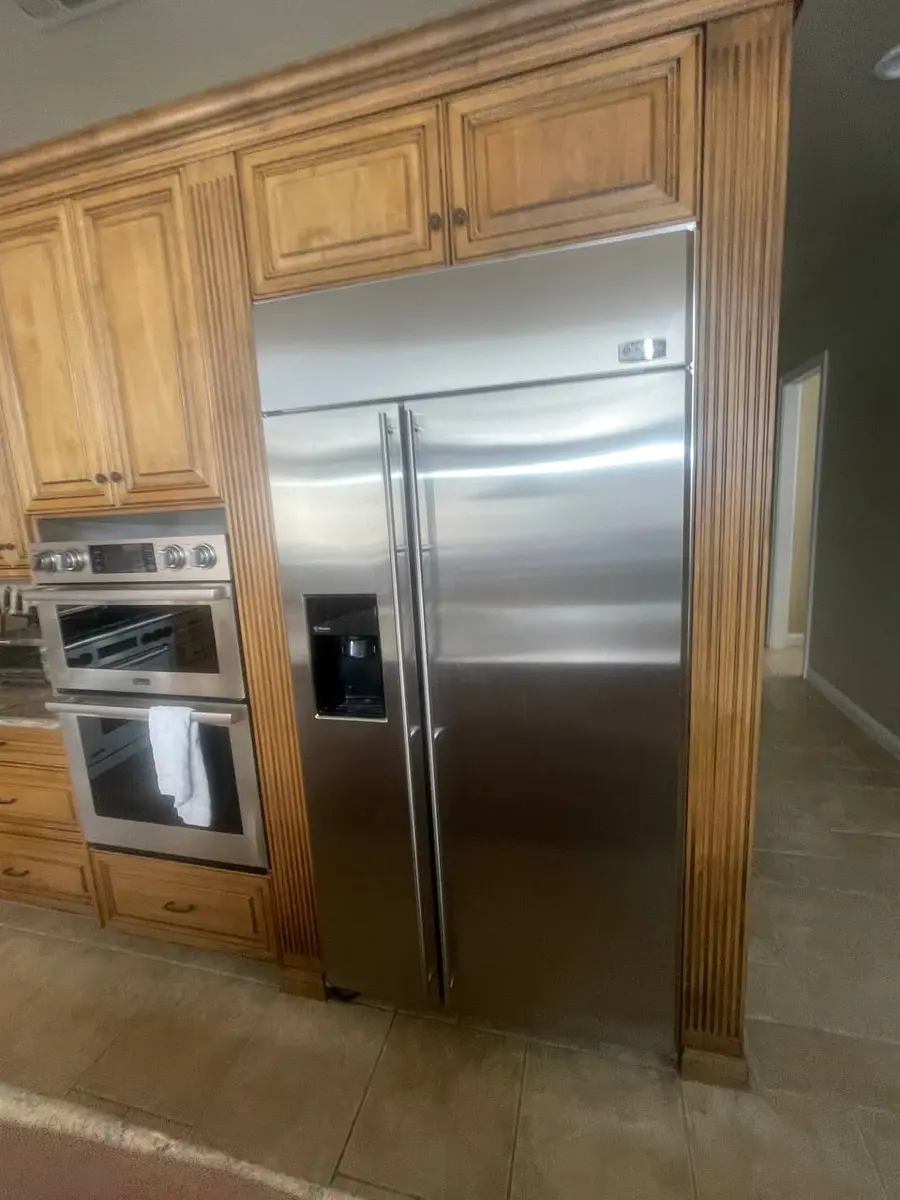
GE Profile refrigerators are the mid-premium tier of the GE lineup — offering advanced features like hands-free autofill, Turbo Cool/Freeze, fingerprint-resistant finishes, and SmartHQ Wi-Fi connectivity at a price point (varies by model and region) between standard GE and the design-focused Cafe line. Profile models like the PVD28BYNFS, PFE28KYNFS, and PSE25KYHFS are among the most popular premium refrigerators in California homes.
GE Profile refrigerators use the standard GE error code platform (FF, PF, CI, dE, CC) but include Profile-specific considerations around their variable-speed inverter compressors, adaptive defrost algorithms, and SmartHQ connected diagnostics. This guide covers every code with the detail needed to make informed repair decisions.
How GE Profile Refrigerator Error Codes Work#
Profile refrigerators display error codes on the front-panel digital display or the dispenser LCD screen. Connected models push error notifications to the SmartHQ app — often before you notice the code on the unit itself. The two-character alphanumeric code system is consistent across the GE platform.
To reset most error codes: Unplug the refrigerator for 60 seconds, then restore power. On models with the dispenser display, press and hold any temperature button for 3 seconds to acknowledge and clear. If the code returns after reset, the underlying condition persists.
SmartHQ connected models: Error history and real-time sensor data are accessible through the SmartHQ app, providing diagnostic depth beyond what the physical display shows.
Do You Have the Right Tools?
Refrigerant gauges ($200+), vacuum pump ($250), leak detector ($150), and EPA-certified recovery equipment. Our technician arrives with $3,000+ in professional tools — your diagnostic is free.
Licensed & Insured · 90-Day Warranty · Same-Day Service
FF — Freezer Fan Error#
FF means the evaporator fan motor in the freezer is not running when the control board expects it to operate.
Common causes:
- Evaporator fan motor failure (part WR60X10346) — the most common FF cause after 5+ years
- Ice buildup around the fan assembly from a failed defrost cycle (secondary failure — check dE history)
- Fan blade obstructed by frost, food packaging, or ice fragments from the ice maker
- Wiring harness damage between the fan motor and the main control board
How to fix:
- Open the freezer and listen for the fan. The fan stops when the freezer door opens on most Profile models — press and hold the door switch to simulate a closed door and listen for fan operation.
- If the fan is silent, unplug the refrigerator. Remove the rear freezer panel (4–6 Phillips screws on Profile French-door models) to access the evaporator fan.
- Check for ice buildup around the fan blades and evaporator coils. Heavy frost on the coils indicates defrost failure — clear ice with a hair dryer and investigate the defrost system (see dE below).
- Spin the fan blade by hand — it should rotate freely. If stiff or grinding, the motor bearings have failed.
- Test motor continuity: disconnect the motor leads and measure resistance (expect 5–20 ohms). Open reading confirms motor failure.
Profile-specific note: GE Profile French-door refrigerators (PVD28, PFE28, PWE23 series) use a variable-speed evaporator fan that adjusts RPM based on cooling demand. This variable-speed motor is more expensive than the single-speed motor used in standard GE units (varies by model and region vs varies by model and region) but offers better energy efficiency and quieter operation. Ensure you order the correct variable-speed version when replacing.
Part cost: Variable-speed fan motor varies by part. Professional repair: varies by part.
PF — Power Failure#
PF indicates the refrigerator experienced a power interruption during normal operation.
Common causes:
- Actual power outage or breaker trip
- Loose plug connection at the wall outlet
- GFCI outlet nuisance trip from compressor inrush current
- Main control board capacitor failure (documented on Profile boards manufactured 2019–2021)
How to fix:
- Press any button on the dispenser to acknowledge and clear PF.
- Check food safety per USDA guidelines — if the freezer was above 40 degrees F for more than 2 hours, discard affected perishables.
- Move the refrigerator off GFCI-protected circuits — compressor startup inrush current commonly causes nuisance GFCI trips. Use a standard dedicated 20A outlet.
- If PF recurs without actual outages, the main board power supply capacitors are likely failing. Profile boards from the 2019–2021 production window have a documented higher failure rate for this component.
Profile-specific note: GE Profile refrigerators with SmartHQ send push notifications when PF occurs. Review the SmartHQ temperature history after an outage to determine if food safety was compromised — the app shows exactly how high the temperature rose and for how long during the outage.
Part cost: $0 for simple power restoration. Main board: $200–$400 + labor.
Safety First — Know the Risks
Refrigerant (R-134a/R-600a) requires EPA certification to handle. Improper discharge is a federal violation and health hazard. Our techs are licensed and insured — let them handle the risk.
Licensed & Insured · 90-Day Warranty · Same-Day Service
CI — Ice Maker Communication Error#
CI means the main board cannot communicate with the ice maker control module.
Common causes:
- Wiring harness disconnected or pinched (part WR55X35511) — often caused by door hinge movement during installation or moves
- Ice maker module failure (part WR30X30972)
- Main board communication bus driver fault
- Water supply issue causing secondary protective shutdown (the ice maker stops communication after repeated failed fill attempts)
How to fix:
- Power cycle for 60 seconds to clear transient communication faults.
- Inspect the ice maker wiring harness — on Profile French-door models, it routes through the left hinge channel. Check for pinched, abraded, or disconnected wires.
- Enter diagnostic mode: press and hold Freezer Temp Down + Turbo Cool for 5 seconds. Run the ice maker test. If the test completes successfully, CI was transient.
- Verify water supply: if the water inlet valve is clogged or the water line is kinked, the ice maker may enter a protective shutdown that manifests as CI. Turn off the ice maker, clear any supply line issues, then turn it back on.
- If CI persists with good supply and intact wiring, test the communication bus voltage at the ice maker connector (expect 5V DC data signal). Zero volts indicates a main board bus driver failure.
Profile-specific note: Profile refrigerators with the internal water dispenser and ice maker share a water inlet valve assembly. A partially clogged inlet valve screen can reduce flow enough to trigger ice maker fill failures, leading to the protective CI shutdown — while the water dispenser continues to work (but slower than normal). If you notice reduced dispenser flow alongside CI, clean the inlet valve screens with vinegar.
Part cost: Ice maker varies by part. Harness varies by part. Main board varies by part. Professional repair: varies by part.
dE — Defrost Error#
dE indicates the automatic defrost system has failed to complete a defrost cycle successfully. Frost accumulates on the evaporator coils, eventually blocking airflow and reducing cooling performance.
Common causes:
- Defrost heater burned out (part WR51X10101)
- Defrost thermostat failed open (part WR50X10068)
- Defrost thermistor drifted out of calibration (part WR55X10942)
- Main board defrost algorithm/timer circuit fault
How to fix:
- Unplug the unit. Remove the rear freezer panel to inspect the evaporator coils.
- Heavy frost on the entire coil surface confirms total defrost failure. Light frost only at the bottom of the coils may indicate the thermostat is terminating the defrost cycle too early.
- Test defrost heater continuity: disconnect heater leads, measure resistance (expect 20–40 ohms). Open = heater burned out.
- Test defrost thermostat: should be closed (conducting) below 40 degrees F, open above 40 degrees F. If open when cold, it has failed.
- Test thermistor: approximately 5,000 ohms at 77 degrees F.
Profile-specific note: GE Profile refrigerators use an adaptive defrost algorithm that adjusts defrost frequency based on compressor run time, door openings, and ambient conditions. If your Profile runs in a hot Sacramento garage or a location with frequent door openings (commercial or family environment), the adaptive algorithm may not defrost frequently enough during peak summer heat. The board interprets high compressor duty as a need for more cooling (not more defrost), creating a feedback loop. If dE occurs during summer months specifically, the defrost frequency programming may need technician adjustment through the diagnostic mode.
Part cost: Heater varies by part. Thermostat varies by part. Thermistor varies by part. Board varies by part. Professional repair: varies by part.
The Real Cost of DIY
Average DIY attempt: $150-400 in tools you may use once, plus the risk of further damage. Our diagnostic visit costs $0 — we find the problem and give you an honest quote.
Licensed & Insured · 90-Day Warranty · Same-Day Service
CC — Compressor Control Error#
CC is a critical code indicating the compressor drive electronics or motor have failed. The refrigerator will not cool.
Common causes:
- Inverter board failure (part WR87X29409) — the power electronics that drive the variable-speed compressor
- Compressor start relay/overload protector failure (part WR07X10097)
- Compressor motor winding failure (sealed system fault)
- Loose or corroded connections between the inverter and compressor
How to fix:
- Unplug for 5 minutes (allows start capacitor discharge). Restore power and listen.
- Click-buzz-off pattern every 2–4 minutes = compressor attempting to start but failing. Either locked rotor or start circuit fault.
- No sound at all from compressor area = inverter board not sending power. Check for visible damage on the inverter board (burn marks, swollen caps).
- Test compressor windings if accessible: compare run-to-start and run-to-common resistance with nameplate spec. Open or shorted windings = compressor replacement (sealed system work).
Profile-specific note: GE Profile variable-speed compressors rely on the inverter board to modulate speed based on cooling demand. This inverter board fails approximately 3 times more often than the compressor motor itself. The click-buzz-off pattern that sounds like a failing compressor is frequently an inverter board issue, not a compressor issue. Always test and consider replacing the inverter board first (varies by model and region) before diagnosing sealed system failure ($400–significant cost with refrigerant handling). Sacramento technicians unfamiliar with Profile variable-speed systems sometimes misdiagnose this — insist on inverter testing before sealed system quotes.
Part cost: Inverter board varies by part. Relay kit varies by part. Sealed system: varies by part parts + varies by part labor. Professional total: varies by part.
Warning: Compressor sealed system work requires EPA 608 certification. Never attempt DIY.
Additional Profile Refrigerator Codes#
- dS — Door switch error. A door is not registering open/close properly. Check door alignment, switch contacts, and wiring.
- EC — Evaporator coil sensor out of range. Test sensor (5,000 ohms at 77 degrees F). Replace if readings are fixed or erratic.
- SH — Sabbath mode active. Deactivate via settings menu or SmartHQ app.
- OP — Dispenser door stuck open. Check the dispenser flap mechanism — ice chunks or moisture can freeze it in the open position.
Don't Void Your Warranty
Opening your appliance yourself may void the manufacturer warranty. Our repair comes with a 90-day guarantee, and we document everything for warranty compliance.
Licensed & Insured · 90-Day Warranty · Same-Day Service
GE Profile SmartHQ Diagnostics#
Profile models with SmartHQ offer:
- Real-time temperature monitoring — view fridge and freezer temps over time to catch trends before codes trigger.
- Error history with timestamps — last 20 codes preserved even after clearing.
- Remote firmware updates — some PF and CI conditions resolved via OTA patches on 2019–2021 boards.
- Component test mode — initiate tests through the app for hands-free diagnosis.
Profile Refrigerator Diagnostic Mode#
Enter diagnostic mode: press and hold Freezer Temp Down + Turbo Cool for 5 seconds. Cycle through component tests: compressor, evaporator fan, condenser fan, defrost heater, ice maker, dispenser solenoids. Each test runs 30–60 seconds with pass/fail on display.
Is It Worth Your Time?
Diagnosing a cooling issue requires testing the compressor, start relay, thermostat, condenser fan, and defrost system — 4-6 hours of DIY research and testing. Our technician diagnoses the issue in about 30 minutes — same-day appointments available.
Licensed & Insured · 90-Day Warranty · Same-Day Service
Frequently Asked Questions#
Q: Are GE Profile refrigerator codes different from standard GE codes? A: The codes (FF, PF, CI, dE, CC) mean the same thing across the GE platform. However, Profile uses variable-speed compressors and fans, adaptive defrost algorithms, and SmartHQ connectivity that affect diagnosis. Parts are different — a Profile variable-speed fan motor is not the same as a standard GE single-speed motor. Control boards are not interchangeable between lines.
Q: My Profile refrigerator's compressor clicks on and off repeatedly. Is that CC? A: The click-buzz-off pattern (compressor attempts to start, runs for 1–2 seconds, then shuts off, repeating every 2–4 minutes) often precedes a formal CC code. On Profile units, this is most commonly the inverter board failing to properly drive the compressor — not the compressor itself. The inverter board (varies by model and region) should be tested before quoting sealed system work (varies by model and region).
Q: How do I know if my Profile's adaptive defrost is working correctly? A: In SmartHQ, check the temperature history graph. If you see gradual freezer temperature rise over days followed by a sudden drop (defrost firing then recovering), the system is working. If the freezer temp trends steadily upward without recovery drops, defrost may be failing before a dE code formally triggers.
Q: Why does my Profile get PF errors during Sacramento summers? A: Sacramento summer afternoon brownouts (voltage drops during peak AC demand) can briefly interrupt power to sensitive appliance electronics. The Profile control board registers these millisecond drops as power failures. A dedicated 20A circuit with tight connections and proper wire gauge (12 AWG) minimizes this. SmartHQ logging confirms whether PF events correlate with citywide demand peaks.
Q: How long do GE Profile refrigerator repairs take in Sacramento/Bay Area? A: Common parts (sensors, fan motors, thermistors) arrive within 2–3 business days. Control boards and inverter boards take 3–5 business days. Sealed system components (compressor, line set) take 5–7 business days. EasyBear stocks common Profile parts locally for same-day or next-day repair on the most frequent failure modes.
Professional GE Profile Refrigerator Service#
GE Profile refrigerators feature variable-speed compressor technology, adaptive defrost algorithms, and SmartHQ connectivity that require informed diagnosis. EasyBear technicians are trained on the full Profile product line and understand the critical distinction between inverter board failures and compressor failures — a distinction that saves Profile owners hundreds of dollars in unnecessary sealed system quotes. We provide free diagnostic visits with common Profile parts in stock for same-visit repair. Every repair is backed by our 90-day parts and labor warranty. Schedule your free diagnosis today.
Appliance Repair Technician · 11 years experience
Experienced technician with 11 years specializing in Frigidaire and Electrolux refrigerator and dryer repair with a focus on safety.