Bosch Refrigerator and Freezer Both Too Warm — Complete System Failure
When both the refrigerator and freezer sections of your Bosch unit fail to maintain temperature simultaneously, it indicates a core cooling system failure rather than a compartment-specific issue. Unlike scenarios where one section is cold and the other warm (typically damper or fan problems), both sections warming together points to the compressor, inverter, refrigerant system, or main control board — components that serve both compartments equally.
Bosch B36 and B21 counter-depth models use a single inverter compressor feeding a dual-circuit evaporator. When this shared compressor stops working, all cooling ceases within hours. Food safety becomes an immediate concern — FDA guidelines require action when temperatures exceed 40°F (refrigerator) for more than 2 hours.
Immediate Actions
Before troubleshooting, protect your food:
- Minimize door openings — every opening accelerates warming.
- Move critical items to a cooler, neighbor's refrigerator, or insulated bags if temperature is already above 40°F.
- Place ice packs or bags of ice in the refrigerator to slow warming.
- Note the current temperature — if you can enter diagnostic mode (SuperCool + Alarm, 5 seconds), record readings. Place a standalone thermometer if the display is not functioning.
- Check Home Connect for the time when temperature began rising — this tells you how long food has been above safe temperatures.
Do You Have the Right Tools?
Refrigerant gauges ($200+), vacuum pump ($250), leak detector ($150), and EPA-certified recovery equipment. Our technician arrives with $15K+ in professional tools — your diagnostic is free.
Licensed & Insured · 90-Day Warranty · Same-Day Service
Distinguishing Total Failure from Partial
| Symptom | Likely System Affected |
|---|---|
| Both sections warm, compressor silent | Power, main board, or compressor failure |
| Both sections warm, compressor running | Refrigerant leak, sealed system restriction |
| Both sections warm, clicking every few min | Compressor start failure (relay/inverter) |
| Both warm with error code on display | Specific component per error code |
| Both warm after power event | Main board surge damage |
Most Common Causes (Ranked by Likelihood)
1. Compressor Not Running — Inverter or Start Failure (30% of cases)
The inverter board converts DC power to variable-frequency AC for the compressor motor. If the inverter fails, the compressor receives no power. The rest of the system (display, fans, lights) continues operating normally because they are powered by the main board independently.
The overload protector monitors compressor current. If the inverter sends abnormal signals, the overload trips and the compressor stops. It attempts restart every 4-5 minutes (audible as clicking), but trips again each time if the inverter fault persists.
Diagnosis: No compressor hum audible. Display and lights work normally. Clicking every 4-5 minutes from the compressor area. Error code E7 in diagnostic mode.
DIY Difficulty: Advanced Parts Cost: $100-300 (inverter board) Professional Repair Cost: $250-500
2. Refrigerant Leak — R600a Loss (25% of cases)
Bosch refrigerators use R600a isobutane refrigerant. A sealed system leak allows refrigerant to escape gradually. As the charge decreases, cooling capacity drops for both sections simultaneously. The compressor runs at maximum speed continuously but cannot absorb enough heat with reduced refrigerant volume.
Bosch internal line routing — with its European-design multiple connection points between dissimilar metals (copper evaporator to aluminum tubing) — provides more potential leak sites than simpler American designs. Vibration over years causes micro-fractures at solder joints, particularly where lines pass through the cabinet insulation.
Diagnosis: Compressor runs constantly at high speed (maximum hum, never modulating). Temperature drops slightly after manual defrost but warms again within hours. Partial frost pattern on evaporator — frost on upper coils, bare metal on lower (insufficient refrigerant reaches lower section).
DIY Difficulty: Not recommended — EPA-certified technician required Parts Cost: $50-100 (refrigerant and solder) Professional Repair Cost: $400-900
3. Main Control Board Failure (20% of cases)
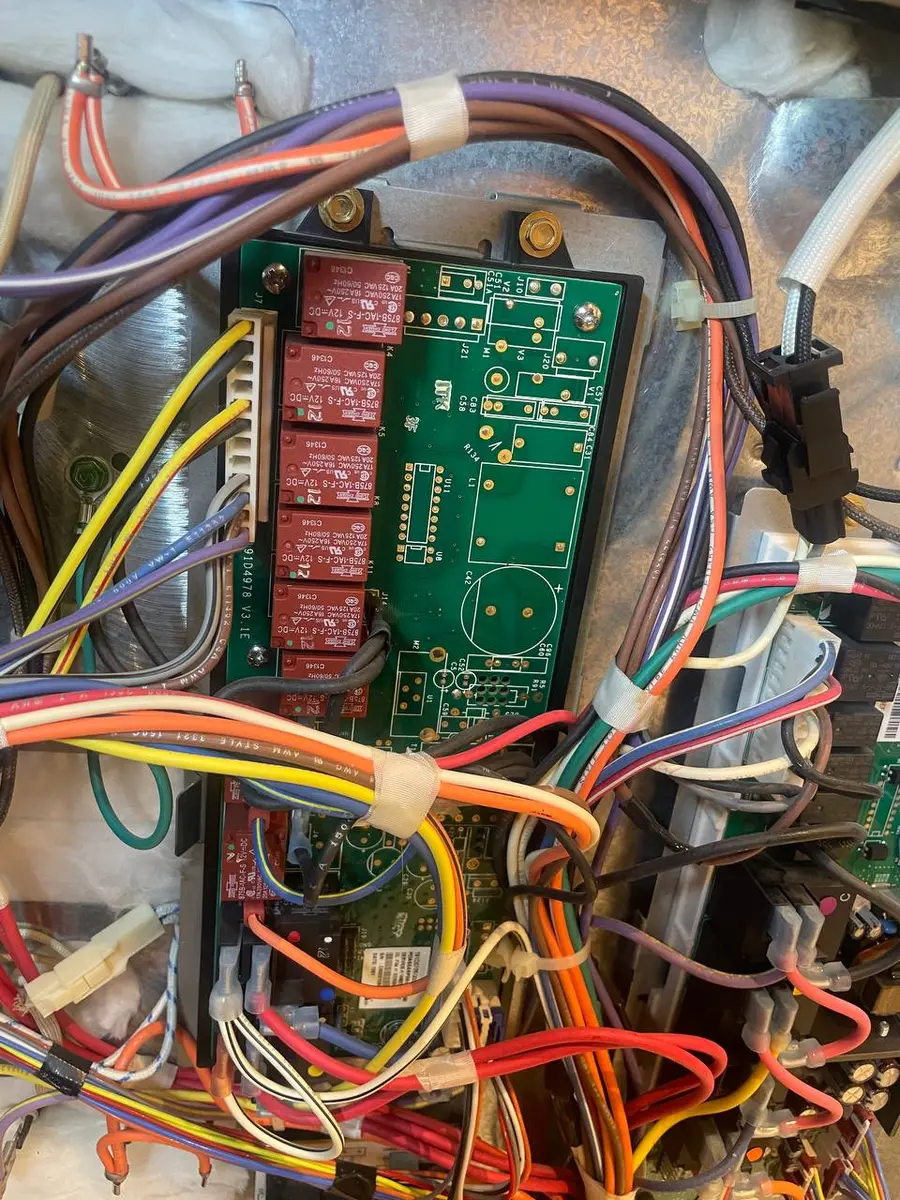
A complete main board failure stops all cooling functions. If the power supply section fails, both the display and cooling stop simultaneously (total unit death). If the compressor output section fails while the rest of the board functions, the display shows normal readings but the compressor never receives a start command.
Power surges during Sacramento summer brownouts are the primary trigger for board failure. The board's fuse may blow as a protective measure, or component-level damage (capacitors, MOSFETs) can cause partial or total board failure.
Diagnosis: If completely dead (no display, no lights): main board power section failed. If display works but no compressor and no error codes: main board compressor control section failed. Visual inspection of the board may reveal blown fuse, blackened components, or swollen capacitors.
DIY Difficulty: Moderate to Advanced Parts Cost: $150-350 Professional Repair Cost: $250-500
4. Compressor Mechanical Failure (15% of cases)
Internal compressor failure — seized bearings, broken valve plate, worn piston rings — prevents the compressor from running or prevents it from compressing refrigerant even if it runs. A seized compressor draws excessive current and trips the overload protector immediately. A compressor with broken internal components may run (you hear humming) but produce no refrigerant pressure differential.
Bosch inverter compressors are rated for approximately 60,000-80,000 hours. Units running 7+ years continuously are approaching potential end of life.
Diagnosis: Compressor either completely silent (seized) or running but with no temperature reduction at evaporator (internal valve failure). Multimeter test of compressor windings: all three pairs should read 5-15 ohms. Open or shorted winding confirms failure.
DIY Difficulty: Not recommended Parts Cost: $300-600 Professional Repair Cost: $600-1,000
5. Dirty Condenser Coils in Extreme Heat (10% of cases)
In extreme Sacramento heat waves (105°F+), severely dirty condenser coils on a Bosch counter-depth model can push the system beyond its cooling capacity entirely. At maximum compressor speed with fouled coils, the condenser cannot reject enough heat to maintain any meaningful temperature difference. Both compartments warm gradually over hours.
This scenario is extreme — it typically requires the combination of very dirty coils, high ambient temperature, and a partially degraded system (aging compressor, slightly low refrigerant).
Diagnosis: Both sections warmed gradually (over 12-24 hours) during a heat wave. Condenser coils visibly dirty. Temperature improves slightly overnight when ambient drops.
DIY Difficulty: Easy (coil cleaning) Parts Cost: $0 Professional Repair Cost: $89-150
Same-Day Appliance Repair
Fixed or It's Free
$89 → $0 Service Call & Diagnosis — offer ends May 25
Safety First — Know the Risks
Refrigerant (R-134a/R-600a) requires EPA certification to handle. Improper discharge is a federal violation and health hazard. Our techs are licensed and insured — let them handle the risk.
Licensed & Insured · 90-Day Warranty · Same-Day Service
Step-by-Step Troubleshooting
- Check if the compressor is running — listen at the bottom rear. Running compressor + no cooling suggests refrigerant or internal failure. Silent compressor suggests electrical failure.
- Check display and lights — dead display + dead compressor = power issue or main board failure.
- Verify outlet power with another device.
- Perform hard reset: unplug 5 minutes, reconnect.
- Enter diagnostic mode if display works — check for error codes.
- If compressor runs but no cooling: check condenser coils, check if evaporator is frosted (defrost issue blocking airflow).
- If condenser clean and compressor running: suspect refrigerant leak or compressor internal failure — call professional.
FAQ
Q: Is both sections warming an emergency?
Yes. Food safety requires action within 2-4 hours of the refrigerator exceeding 40°F. Move perishable food to alternative cold storage.
Q: Can I save my food while waiting for repair?
A full freezer holds safe temperature for 48 hours (24 hours if half full) without power. The refrigerator section is safe for approximately 4 hours. Use coolers with ice for bridge storage.
Q: How much does it cost when both sections fail?
Inverter board: $250-500. Refrigerant repair: $400-900. Main board: $250-500. Compressor: $600-1,000. Most cases are board or refrigerant issues ($250-600 range).
Q: Is it worth repairing or should I replace the Bosch refrigerator?
Bosch B36 models cost $2,200-$3,800 new. Repairs under $600 (80% of cases) are economically justified for units under 10 years old.
Both sections of your Bosch refrigerator warming? Our technicians carry diagnostic tools for BSH inverter and sealed systems. Schedule an urgent repair →