Bosch Refrigerator Burning Smell — Causes and Solutions
A burning smell emanating from your Bosch refrigerator requires immediate attention. Unlike older single-speed compressor models, Bosch B36 and B21 series refrigerators use variable-speed inverter compressors and multiple electronic control boards that generate distinct odors when overheating or failing. Understanding what you are smelling — electrical burning, hot plastic, or chemical — narrows the diagnosis significantly before you even open a panel.
Identifying the Type of Burning Smell
Bosch refrigerators contain several components that produce different odor signatures when malfunctioning:
- Electrical/ozone smell — indicates arcing at a relay, loose wire connection, or failing capacitor on the main control board. This is the most urgent type and warrants immediate power disconnection.
- Hot plastic smell — typically the condenser fan motor housing overheating due to a seized bearing, or the defrost heater contacting a plastic duct component.
- Chemical/sweet smell — could indicate a refrigerant leak (R600a isobutane has a faint petroleum-like odor) or degrading compressor oil. R600a is flammable in concentrations above 1.8%, so ventilate the area immediately.
- Rubber burning smell — usually the door gasket contacting the defrost heater during the defrost cycle, or a deteriorating vibration dampener on the compressor mounts.
Do You Have the Right Tools?
Refrigerant gauges ($200+), vacuum pump ($250), leak detector ($150), and EPA-certified recovery equipment. Our technician arrives with $15K+ in professional tools — your diagnostic is free.
Licensed & Insured · 90-Day Warranty · Same-Day Service
Safety First — Critical Steps
Burning smells from any refrigerator warrant elevated caution:
- Immediately disconnect power — unplug the unit or switch off the breaker. Do not wait to diagnose with power on.
- If you smell gas or chemical odors, open windows and do not operate light switches or any electrical devices near the refrigerator. R600a refrigerant is heavier than air and pools at floor level.
- Do not remove rear panels until the unit has been unpowered for at least 10 minutes — the inverter capacitors in Bosch models store significant charge.
- Check for visible smoke or scorch marks on the wall behind the unit before pulling it away from the wall.
- Have a fire extinguisher accessible (Class C for electrical) before investigating.
Bosch Diagnostic Mode for Electrical Issues
After ensuring safety, you can use the Bosch diagnostic system to check for stored fault codes that preceded the burning smell:
- Reconnect power briefly (only if no smoke or chemical smell is present).
- Hold SuperCool and Alarm buttons for 5 seconds to enter diagnostic mode.
- Error code E7 indicates compressor circuit overload. E8 indicates control board thermal shutdown. E4 indicates defrost circuit fault.
- Record codes and disconnect power again before physical inspection.
Home Connect-enabled models log temperature and compressor data historically, which can show if the compressor was running at maximum speed for extended periods before the smell appeared — a sign of thermal overload.
Safety First — Know the Risks
Refrigerant (R-134a/R-600a) requires EPA certification to handle. Improper discharge is a federal violation and health hazard. Our techs are licensed and insured — let them handle the risk.
Licensed & Insured · 90-Day Warranty · Same-Day Service
Most Common Causes (Ranked by Likelihood)
1. Condenser Fan Motor Seized or Failing (30% of cases)
The condenser fan motor in Bosch counter-depth models sits in a confined space at the bottom rear of the unit. In Sacramento homes during summer, ambient temperatures behind the refrigerator can exceed 110°F when the unit is pushed close to the wall. This accelerates bearing wear in the fan motor. When the bearing seizes, the motor windings overheat and the plastic motor housing begins to melt, producing a distinct hot-plastic-and-electrical combination smell.
Bosch B36 models position the condenser fan horizontally beneath the compressor compartment, which means gravity pulls dust and grease downward onto the fan over time. This accumulation increases friction and heat generation. The fan motor in these units is a small DC brushless type rated for approximately 40,000 hours — roughly 4.5 years of continuous operation.
Diagnosis: With power disconnected, access the bottom rear compartment by removing the lower back panel (4x Torx T20 screws). Inspect the condenser fan motor for discoloration, melted housing, or seized blades. Try spinning the fan blade by hand — it should rotate freely with minimal resistance. Any grinding, stiffness, or wobble indicates the motor needs replacement.
DIY Difficulty: Easy to Moderate Parts Cost: $35-75 Professional Repair Cost: $120-250
Repair Steps:
- Unplug the refrigerator and pull it away from the wall.
- Remove the lower rear panel (4x Torx T20).
- Disconnect the fan motor wire connector (2-pin keyed plug).
- Remove the fan motor mounting screws (2x Torx T15).
- Pull the fan blade off the motor shaft — it press-fits on Bosch models.
- Install the new motor, press-fit the blade, reconnect and reassemble.
2. Defrost Heater Contacting Ductwork (25% of cases)
Bosch refrigerators use a glass-tube defrost heater positioned beneath the evaporator coils. The MultiAirFlow ductwork that distributes cold air throughout the compartment has plastic components positioned near this heater. Over time, frost accumulation cycles can shift the duct alignment slightly. If a plastic duct edge contacts or comes within millimeters of the defrost heater during the 20-minute defrost cycle, it will partially melt and produce a strong burning plastic odor.
This issue is particularly common in Bosch models with the FarmFresh System because the additional VitaFresh Pro humidity control components add ductwork complexity behind the rear panel. The smell typically appears intermittently — only during defrost cycles that run 2-4 times per 24 hours.
Diagnosis: The burning smell appears at regular intervals (every 6-12 hours) rather than continuously. Open the refrigerator compartment, remove the rear interior panel (6x Torx T15), and look for warped or discolored plastic near the defrost heater tube.
DIY Difficulty: Moderate Parts Cost: $20-60 (duct replacement) or $0 (repositioning) Professional Repair Cost: $150-280
3. Start Relay or Compressor Overload Protector (20% of cases)
The compressor start relay and overload protector in Bosch inverter models are integrated into a single electronic module mounted directly on the compressor. When this module begins to fail, internal components can arc or overheat, producing an electrical burning smell concentrated at the bottom rear of the unit. Unlike traditional relay/overload combinations that simply click and fail, the inverter module can partially fail — running the compressor erratically while generating heat.
In Bosch units, this module also contains the PTC (Positive Temperature Coefficient) starting element. When the PTC degrades, it draws excessive current during compressor startup attempts, overheating the module housing.
Diagnosis: With power disconnected, locate the compressor (bottom rear, cylindrical black component). The inverter module is the rectangular device mounted on the compressor's side with wire connectors. Check for burn marks, melted plastic, or blackened components. Shake it gently — rattling indicates broken internal pieces.
DIY Difficulty: Moderate Parts Cost: $40-120 Professional Repair Cost: $150-300
4. Wiring Harness or Connector Overheating (15% of cases)
Bosch refrigerators route wiring through the door hinge area and along the top of the cabinet. The OptiFlex hinge system on French door models requires flexible wiring that bends with every door opening. After tens of thousands of open-close cycles, individual wires can develop high-resistance connections at crimp points or connector pins. High-resistance connections generate localized heat — enough to melt surrounding insulation and produce burning odor.
The top-of-cabinet wiring harness in B36 models runs directly above the compressor heat. Years of thermal cycling weakens wire insulation at stress points. Look for burning smell concentrated at the top rear or hinge area of the unit.
DIY Difficulty: Advanced — requires wire identification and proper crimping Parts Cost: $20-80 (connector repair kit) Professional Repair Cost: $180-400
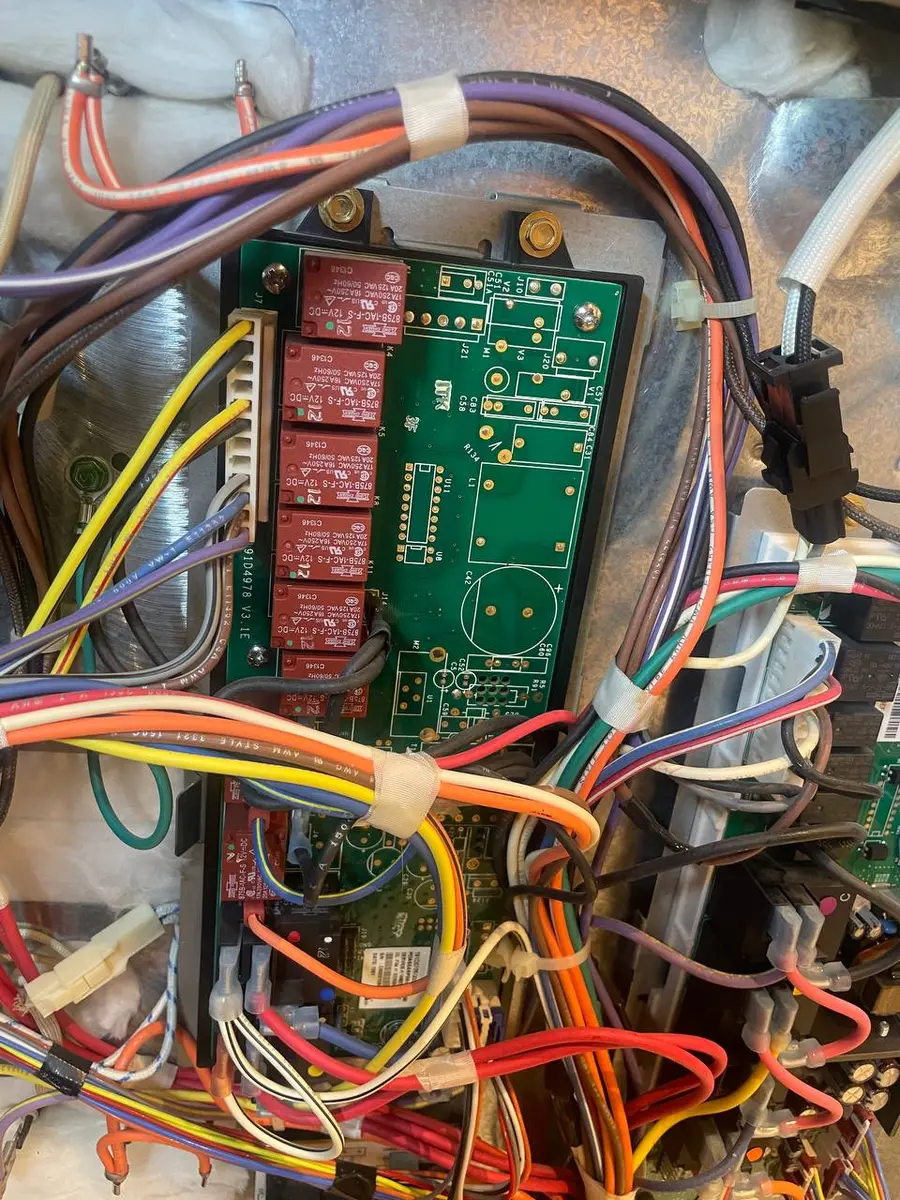
5. Control Board Component Failure (10% of cases)
The main electronic control board in Bosch refrigerators contains MOSFETs, capacitors, and relays that can fail with smoke or burning odor. Power surges during Sacramento summer brownouts are a common trigger. Bosch boards have conformal coating but this does not protect against surge damage to semiconductor components.
A failing board capacitor produces a distinct sour/chemical electrical smell different from a motor or heater burning. Inspect the board (behind the upper rear panel) for bulging capacitors, blackened components, or visible scorch marks on the circuit board surface.
DIY Difficulty: Not recommended without electronics experience Parts Cost: $150-350 Professional Repair Cost: $250-500
Same-Day Appliance Repair
Fixed or It's Free
$89 → $0 Service Call & Diagnosis — offer ends May 25
When to Call Emergency Service vs. Schedule Routine Repair
Call immediately (same-day) if:
- You see visible smoke or sparking
- The smell is chemical/sweet (possible refrigerant leak)
- Circuit breaker tripped along with the smell
- Scorch marks visible on walls or cabinetry
Schedule routine repair if:
- Smell only appears intermittently at specific times (likely defrost cycle related)
- Smell dissipated after power disconnection and does not return
- No visible damage, smoke, or scorch marks
The Real Cost of DIY
Average DIY attempt: $150-400 in tools you may use once, plus the risk of further damage. Our diagnostic visit costs $0 — we find the problem and give you an honest quote.
Licensed & Insured · 90-Day Warranty · Same-Day Service
Prevention Tips
- Clean condenser coils and fan area every 6 months — accumulated grease is a fire risk
- Ensure minimum 50mm (2 inch) clearance behind the unit for ventilation
- Install a surge protector rated for refrigerator amperage (dedicated 15A circuit recommended)
- Check door gaskets annually — compromised seals force longer compressor run times and higher thermal stress
- Monitor Home Connect temperature logs — sustained compressor operation above 80% duty cycle indicates thermal stress building toward component failure
FAQ
Q: Is a burning smell from my Bosch refrigerator dangerous?
It depends on the type. An electrical or chemical smell warrants immediate power disconnection and ventilation. A hot plastic smell from the condenser fan area is less immediately dangerous but still requires prompt repair to prevent wiring damage.
Q: Can I continue using my Bosch refrigerator if I smell burning?
No. Disconnect power immediately until the source is identified. Running a refrigerator with an electrical fault risks fire, further component damage, and potential refrigerant release.
Q: How much does it cost to fix a Bosch refrigerator with a burning smell?
Costs range from $120-500 depending on the cause. A condenser fan replacement is the least expensive fix. Control board or wiring repairs are more costly but still far less than unit replacement.
Q: Does the Bosch warranty cover burning smell issues?
Bosch provides a standard 1-year warranty (US) on all components. If the burning smell results from a manufacturing defect (wiring, board, sealed system), BSH may cover it under warranty. Keep your purchase documentation accessible.
Concerned about a burning smell from your Bosch refrigerator? Our technicians carry diagnostic equipment for BSH inverter systems and can identify the source safely. Schedule an urgent repair →